TL;DR: Is Anthropic hiring fewer junior people because of AI?
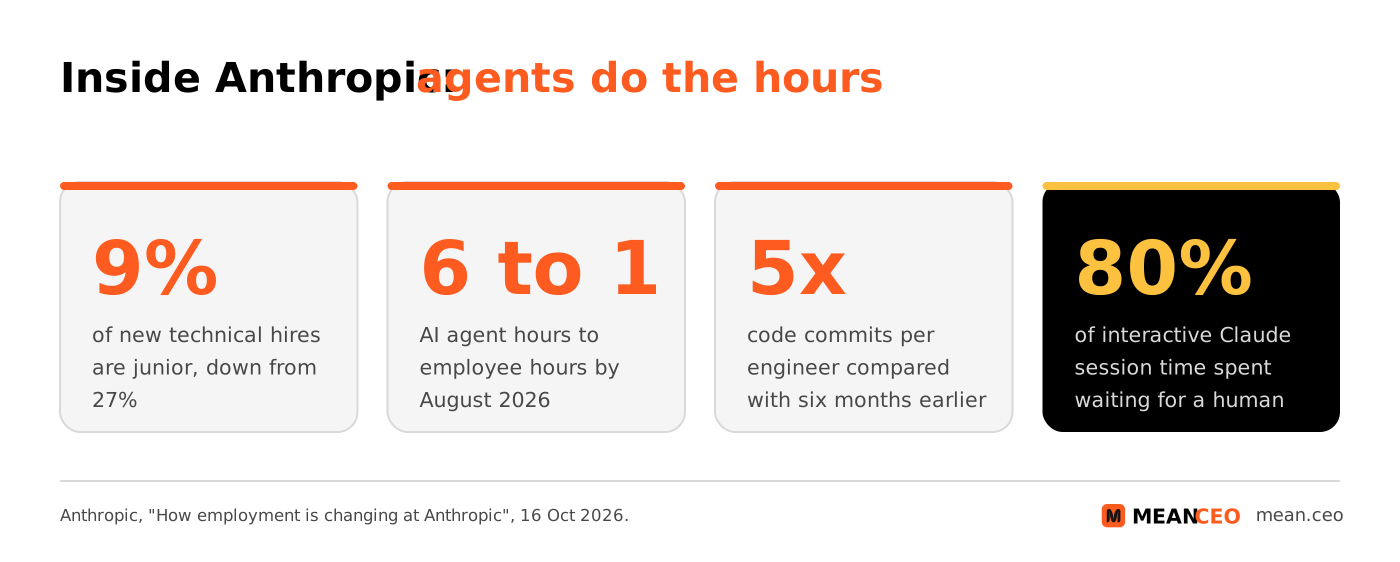
Yes, by its own account. In a report published on 16 October 2026, Anthropic says juniors made up 27% of its new technical hires before and only 9% now, while hours worked by AI agents rose to six times the hours of the employees running them. Code commits per engineer are 5x what they were six months earlier, and hiring managers now look for autonomy and judgment more than domain expertise. It's one company's data about itself, but it's the clearest picture yet of how a team built around agents hires. For a bootstrapped founder, the lesson is about your first hire: hire for judgment, and check what agents can do before you write the job ad.
Most debates about AI and jobs run on surveys and forecasts. This week one of the companies building the models published its own staff data, and it's blunt.
Anthropic, the maker of Claude, says it has been hiring a much smaller share of junior engineers and researchers as its AI agents took over more of the work. The agents now clock six hours for every hour of the people who launch them. And the humans who remain spend a growing share of their time managing those agents, not doing the work themselves.
What happened
On Friday 16 October 2026, Anthropic published "How employment is changing at Anthropic", a report by Nathan Wilmers, Regina Catipon, Maxim Massenkoff and Peter McCrory of the Anthropic Institute. It draws on internal data on employment, AI use, output, employee surveys, Slack communication, calendars and hiring decisions, plus 17 employee interviews.
The report's four key findings:
- Fewer juniors. Anthropic has been hiring a smaller share of junior technical staff, while hours worked by AI agents rose fast. "By August interactive AI agent hours outnumbered employees' six to one."
- More output. As agents spread through the company, Anthropic produced more code per person, closed more sales per rep and processed more contracts. The same employee's output rose after they adopted new AI tools.
- Human attention is the bottleneck. Even for non-technical staff, reading everything their Claude agents produce would take half their work week. So employees turn to "meta-work": building visibility tools and monitoring agent pipelines.
- Different hiring. Hiring managers increasingly emphasise autonomy and judgment over technical domain expertise and implementation.
TechCrunch covered the report on 17 October under the headline that Anthropic's workforce "has become less junior and is spending more time in meetings". The Decoder added a detail from the report's charts: in research departments, the ratio of agent hours to human hours reached 19 to 1.
The numbers behind the junior hiring drop
Discussion of weaker demand for junior technical staff started inside Anthropic in January 2026, in the teams that used Claude most. Writing code and finding bugs could increasingly be handed to Claude. One quote from the report: newly capable models "basically overnight changed what we were looking for".
By April, engineering and research teams had put less weight on hiring for lower-band technical roles. In a survey that month, most managers said they were hiring for a different set of skills because of AI, and around a third of machine-learning managers and a fifth of software-engineering managers said they were hiring less because of AI.
Source: Anthropic, "How employment is changing at Anthropic", 16 October 2026.
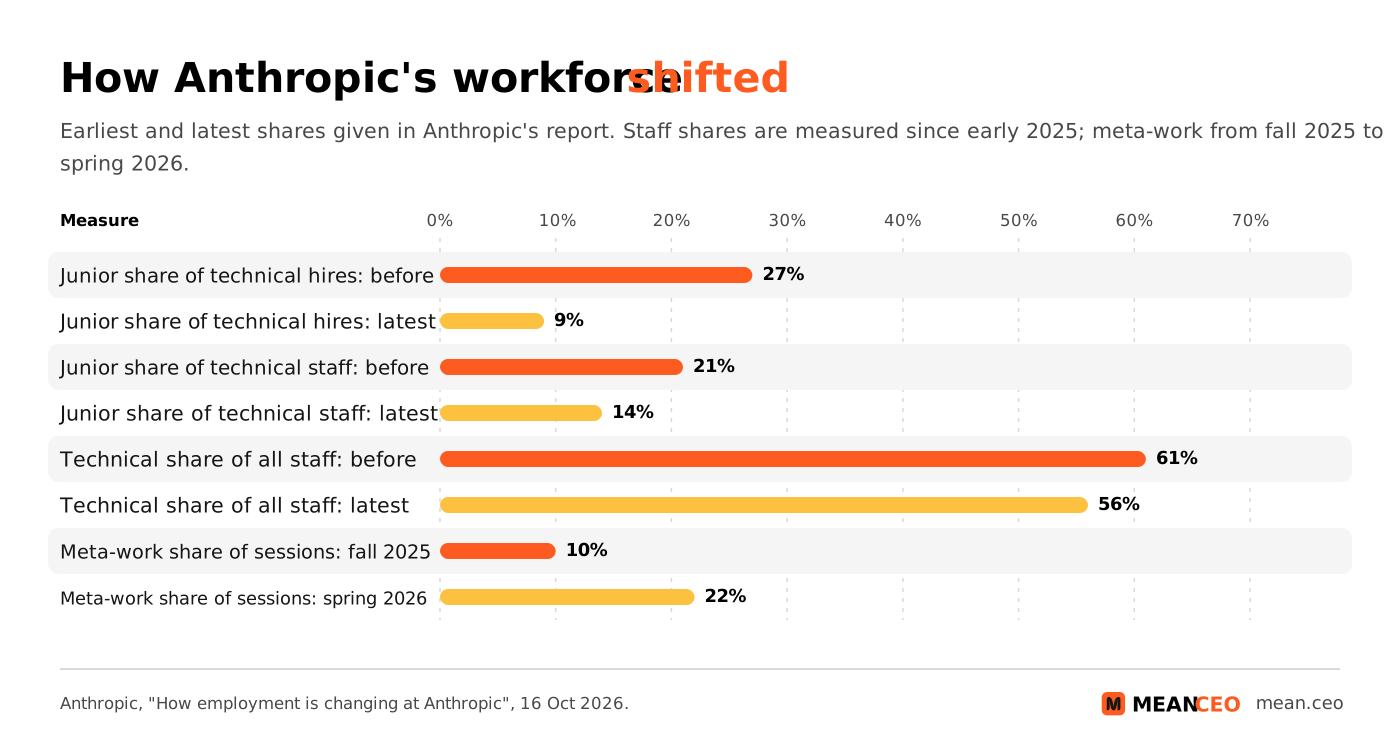
Two details are easy to miss. First, Anthropic still hires engineers: technical hiring kept growing in absolute numbers, but hiring in sales, finance and recruiting grew faster. Second, the admin layer barely grew at all. Agent assistants, automated review and outsourced ticket handling have kept the company "clerical-light" even as it tripled in size in the last year. An executive assistant who built a scheduling and email agent put it this way: "I think we've already moved past the point of Claude augmenting away the really entry-level admin type role." The money behind that growth is now on the record too: a leaked draft of the IPO filing shows Anthropic’s $16.3 billion first-half revenue and $80.7 billion loss.
For the rest of the month's Claude news, including new models and pricing, see our Anthropic and Claude news for October 2026.
Humans become managers of agents
The most useful part of the report for a solo founder isn't the hiring data. It's what happens to the people who stay.
- Agents wait for you. About 80% of interactive Claude session time is spent idle, waiting for human input. One engineer described facing "an army of Claudes, with every one asking for my attention". Another compared it to babysitting.
- Reading the output is a job. Anthropic converted agent output into reading time. For technical teams it climbed sharply over six months; even for non-technical teams it now fills more than half a work week.
- Meta-work doubles. Writing specs for multi-agent runs, having one agent review another and monitoring pipelines grew from 10% to 22% of sessions.
- More meetings, not fewer. The median employee spends 20% more time in meetings than a year ago. Even technical individual contributors are up 16%.
- Write it down. Decisions made in unrecorded meetings are invisible to agents. One employee kept getting agent requests for t-shirts and mugs because their name was on an old swag document.
Output did go up. Anthropic followed 192 engineers as they adopted coding agents and compared them with 74 who didn't. Code added rose sharply after adoption. The report admits that "more code does not necessarily mean better code or business impact", but it found no difference in how often agent-written code was later deleted or reverted compared with code the same person wrote by hand.
It's not only engineers. An account executive said Claude automations replaced around 20% of their previous tasks; another could talk to 30% more customers. Lawyers processed more contracts, and accounts payable moved more invoices. If you're building your own agent setup, our roundup of AI agents news for October 2026 tracks the tools.
Who Anthropic hires now
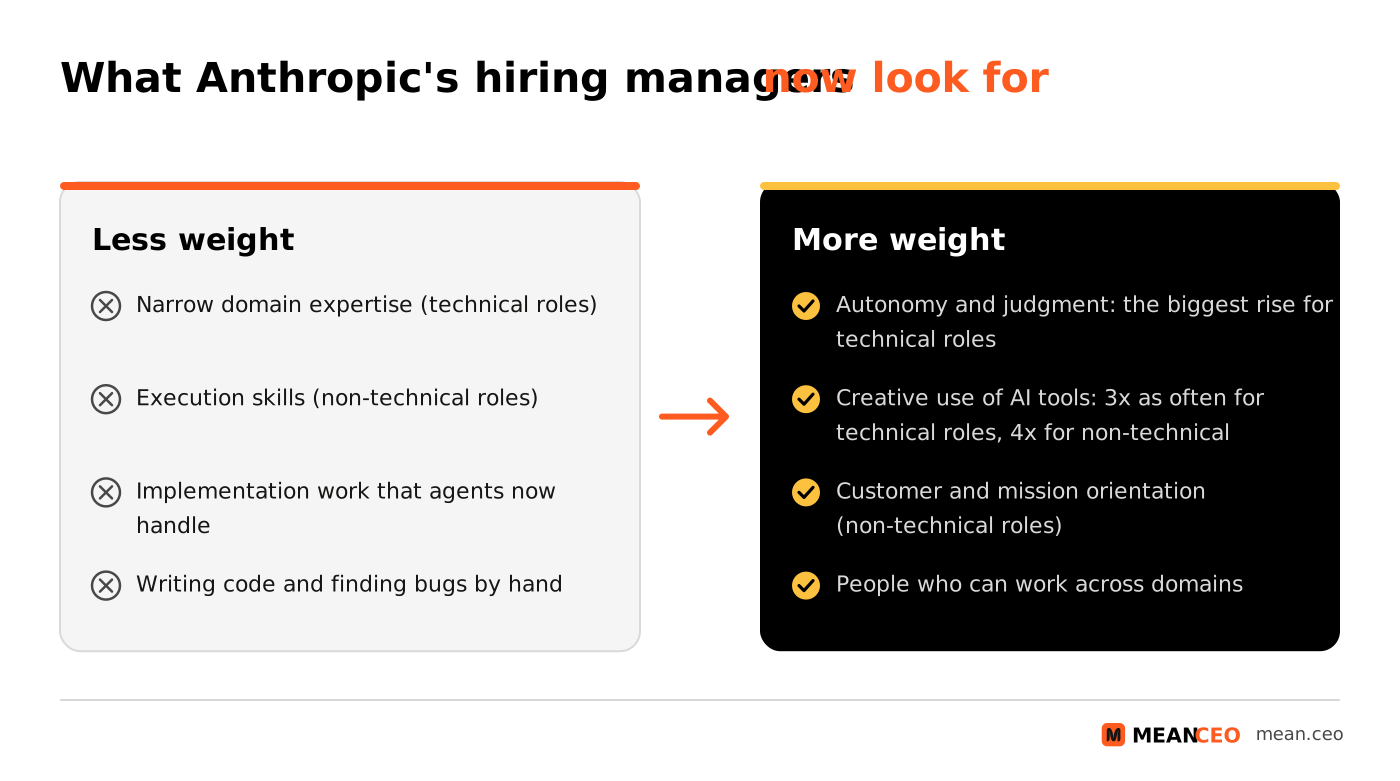
Anthropic used an automated coder on interview scorecards for thousands of hires since 2024. The clearest change: comments on a candidate's creative use of AI tools. In 2024 they appeared in around 5% of assessments for technical roles and 7% for non-technical roles. By 2026 those rates had tripled for technical roles and quadrupled for non-technical ones.
For technical candidates, the biggest increases were in comments on autonomy and judgment, while domain expertise shrank as a share of the assessment. "I expect models to continue to be jagged, so for my team I want them to be fungible across domains," one manager said. For non-technical roles, customer and mission orientation rose and execution skills fell.
Is this just Anthropic?
Be careful with the headline. This is one company, an AI lab with very fast revenue growth, writing about itself. The report says so: much of Anthropic's employment practice "cannot be replicated across the economy", and employees who adopted agents first were already on a steeper upward path. The 6 to 1 figure compares agent runtime with an assumed 40-hour human week, and a falling junior share doesn't mean fewer juniors in absolute terms while total hiring grows.
But outside research points the same way:
- AI-native startups are smaller and flatter. In "AI-Native Firms" (Harvard Business School working paper 26-090, June 2026), Hyunjin Kim of INSEAD and Rembrand Koning of HBS studied Y Combinator and US venture-backed startups first financed between 2020 and 2024. AI-native firms were 25% smaller than comparable non-AI startups, with roughly 15% lower shares of entry-level workers and of managers, and hierarchies half a level flatter, at comparable valuations.
- Junior jobs shrink at adopting firms. Harvard researchers Seyed Mahdi Hosseini Maasoum and Guy Lichtinger, using US résumé data on 65 million workers, found junior employment at generative-AI-adopting firms fell about 9% after six quarters compared with non-adopters, mostly through slower hiring, while senior employment stayed largely unchanged.
In Europe, young people already face a tight market. Eurostat put EU youth unemployment at 15.4% in August 2026, or 2.973 million people under 25. In the UK, Indeed's Hiring Lab found postings with "graduate" in the title down around 7% year on year in July, the lowest for that time of year since 2020, while a record 9.4% of UK job ads mentioned AI. Indeed links the junior pullback mainly to cost pressures and uncertainty, not to AI, so don't over-read it.
Anthropic itself flags the policy problem: "Employment protections for incumbents will not benefit those not hired to begin with." It calls for "farsighted government policy around retraining and income support".
The European rules on AI in hiring
If you use AI to screen candidates or manage staff in Europe, two dates matter.
Sources: Italian decree text (Gazzetta Ufficiale no. 234, 8 October 2026); EUR-Lex, Regulation (EU) 2026/1744.
For a small company, the Italian rule is easy to meet: let AI help you sort applications, but a person decides, and you can explain the decision. Hiring contractors instead of staff? Our contractors vs employees decision framework covers the trade-offs.
What this means for you
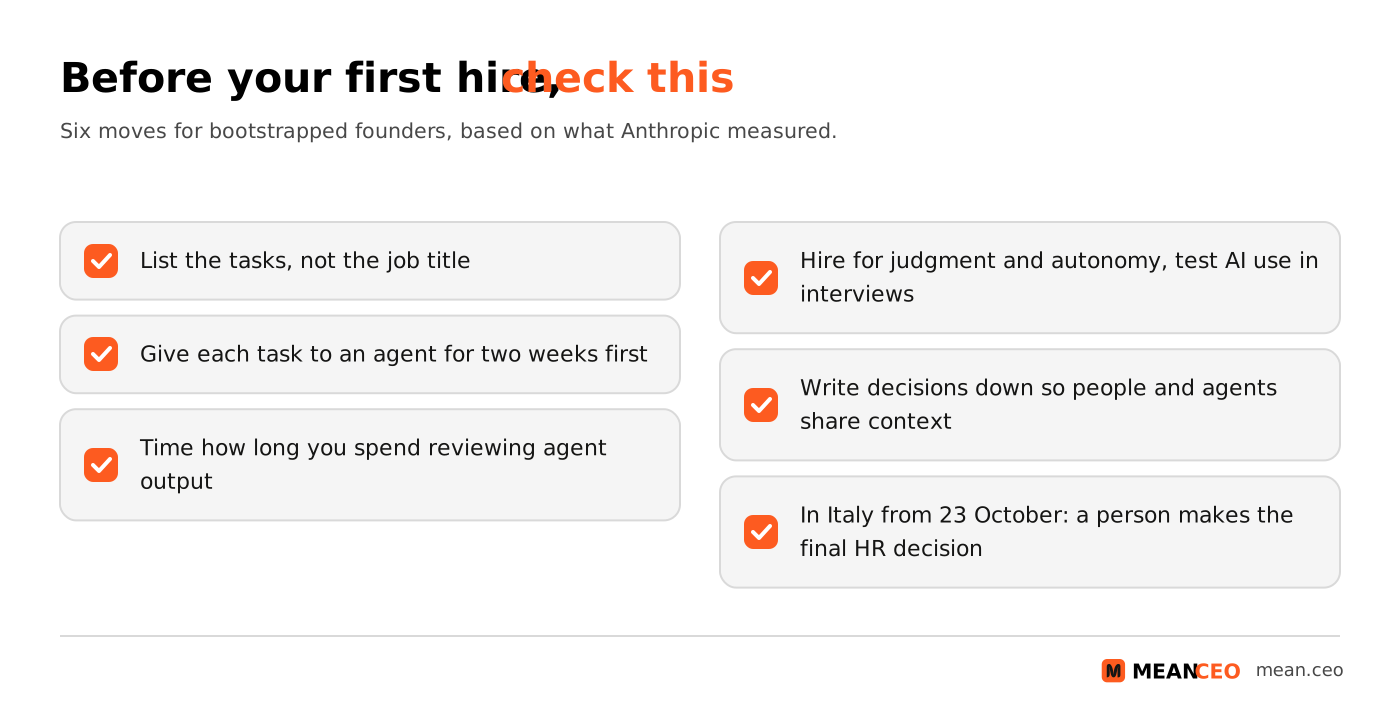
- Start from tasks, not titles. Anthropic's managers stopped hiring for implementation work that Claude now does. Before you hire, list the tasks that block you and try an agent on each one first. Our guide on when to hire your first employee as a bootstrapped founder walks through the money side.
- Automate the admin layer first. Anthropic tripled in size with almost no growth in clerical roles. A solo founder can do the same with scheduling, inbox triage and invoice agents. See automation before hiring for a step-by-step plan.
- Measure your review time. If agents wait for you 80% of the time, more agents won't help; your attention is the bottleneck. When reviewing eats more than half your week, that's the moment a person with judgment pays for themselves.
- Hire for judgment, test for AI use. In interviews, give candidates a real task and ask them to run it with an agent. Watch how they check the output and what they decide, not just what they produce.
- Write things down. Agents only know what's written. Decisions, specs and processes in a shared doc help both your future hire and your agents. Start with documenting processes before your first hire.
- Don't skip juniors completely. If nobody trains juniors, there are no seniors in five years. A junior who arrives fluent in agents and judgment can be your best-value hire. Pick the right tools for them from our AI tools stack for solo founders, and remember that your vendors can change too: Replit just switched its default model to OpenAI.
Are you getting customers from AI search yet?
More and more traffic is coming from Perplexity, ChatGPT, Grok and other AI tools.
👉 Rank on ChatGPT
FAQ: Anthropic, AI agents and junior hiring
Did Anthropic stop hiring junior employees?
No, but it hires far fewer of them as a share of new technical hires: juniors fell from 27% to 9%, according to Anthropic's report of 16 October 2026. Junior employees in technical departments fell from 21% to 14% since early 2025. Technical hiring overall kept growing in absolute numbers.
What does "agent hours outnumber employees six to one" mean?
It compares the runtime of AI agents launched by employees in interactive sessions (including inference and tool use, excluding waits over 30 minutes) with human work hours, assumed at 40 hours a week. By August 2026 agents logged six times as many hours. In research departments the ratio was 19 to 1.
What skills does Anthropic look for in new hires now?
Interview scorecards show more weight on autonomy and judgment for technical roles, and on customer and mission orientation for non-technical roles. Comments on creative use of AI tools tripled for technical roles and quadrupled for non-technical roles between 2024 and 2026. Domain expertise and execution skills got less weight.
Is Anthropic's data representative of other companies?
Not directly. It's one fast-growing AI lab reporting on itself, and the report says many of its practices can't be replicated across the economy. Independent research, such as Harvard Business School's "AI-Native Firms" paper, also finds AI-native startups are smaller and employ about 15% fewer entry-level workers.
Can I use AI to screen job applicants in Europe?
Yes, with limits. GDPR Article 22 protects people from decisions based solely on automated processing. In Italy, from 23 October 2026, a person must make the final hiring or dismissal decision, though AI screening and shortlisting are allowed. EU AI Act high-risk rules for recruitment AI apply from 2 December 2027.
Should a bootstrapped founder still hire people?
Yes, but later and for different reasons. Use agents for routine implementation and admin, then hire when your own review and decision time becomes the bottleneck. Look for people with judgment who already work well with AI tools.
About the Author
Violetta Bonenkamp, also known as MeanCEO, is an experienced startup founder with an impressive educational background including an MBA and four other higher education degrees. She has over 20 years of work experience across multiple countries, including 5 years as a solopreneur and serial entrepreneur. Throughout her startup experience she has applied for multiple startup grants at the EU level, in the Netherlands and Malta, and her startups received quite a few of those. She’s been living, studying and working in many countries around the globe and her extensive multicultural experience has influenced her immensely.
