TL;DR: How to Relocate Your Startup Within Europe
Relocating your startup across Europe opens access to new markets, talent and funding, but first decide what actually moves: only you, a new branch or subsidiary, or the company itself through an EU cross-border conversion. Each route has different tax effects, including exit tax on the assets that leave. Shortlist two or three countries, check the visa route if you are a non-EU founder (the Dutch start-up permit, the French Tech Visa, Estonia’s startup visa, Portugal’s StartUP Visa), and plan banking, VAT, payroll, contracts and IP records before you sign a lease.
💡 Ready to scale smartly? Check the European Startup Ecosystem Guide for in-depth insights by country.
How to Relocate Your Startup Within Europe
Relocating your startup within Europe involves balancing opportunities like access to new markets, talent pools, and funding options, with challenges such as navigating regulatory complexity, visa requirements, and operational adjustments. For founders, especially bootstrappers like myself, relocation decisions aren't just logistical; they are deeply strategic.
Whether you’re eyeing Amsterdam for its innovation ecosystem, Estonia for its digital administration, or France for its startup support and the French Tech Visa, Europe offers compelling advantages for entrepreneurs. However, moving a startup requires careful planning to ensure the shift boosts your growth potential and avoids costly missteps.
Are you ready to scale across Europe?
Learn how to leverage grants, local incentives, and visa programs to unlock new markets without sacrificing operational efficiency.
👉 Build a distributed startup team legally
First Decide What Is Actually Moving
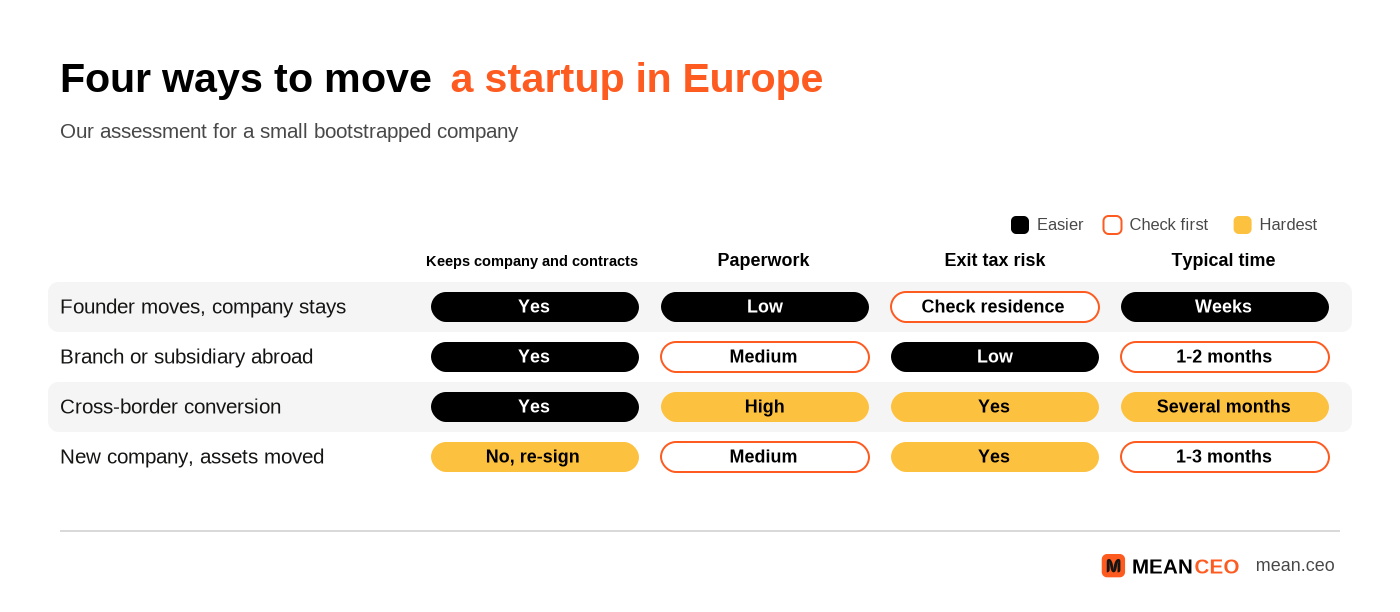
“Relocating a startup” can mean four very different things, and the paperwork, cost and tax bill depend on which one you choose. Many founders only need the first or second option; a full company move is the heaviest.
The cross-border conversion is the cleanest full move: under the EU’s Mobility Directive (EU) 2019/2121, which member states had to apply from 31 January 2023, a limited company can move its registered seat to another member state without being wound up, keeping its contracts, bank history and identity. It needs approval from both countries and usually a notary, so budget several months and adviser fees. If assets or the company’s tax residence leave a country, that country can charge exit tax on the unrealised gains; within the EU you can usually ask to pay it in instalments over five years.
What Are the Key Steps to Relocate Your Startup in 2026?
Successfully relocating your startup requires a strategic roadmap. Below are the essential steps:
1. Assess Your Business Objectives
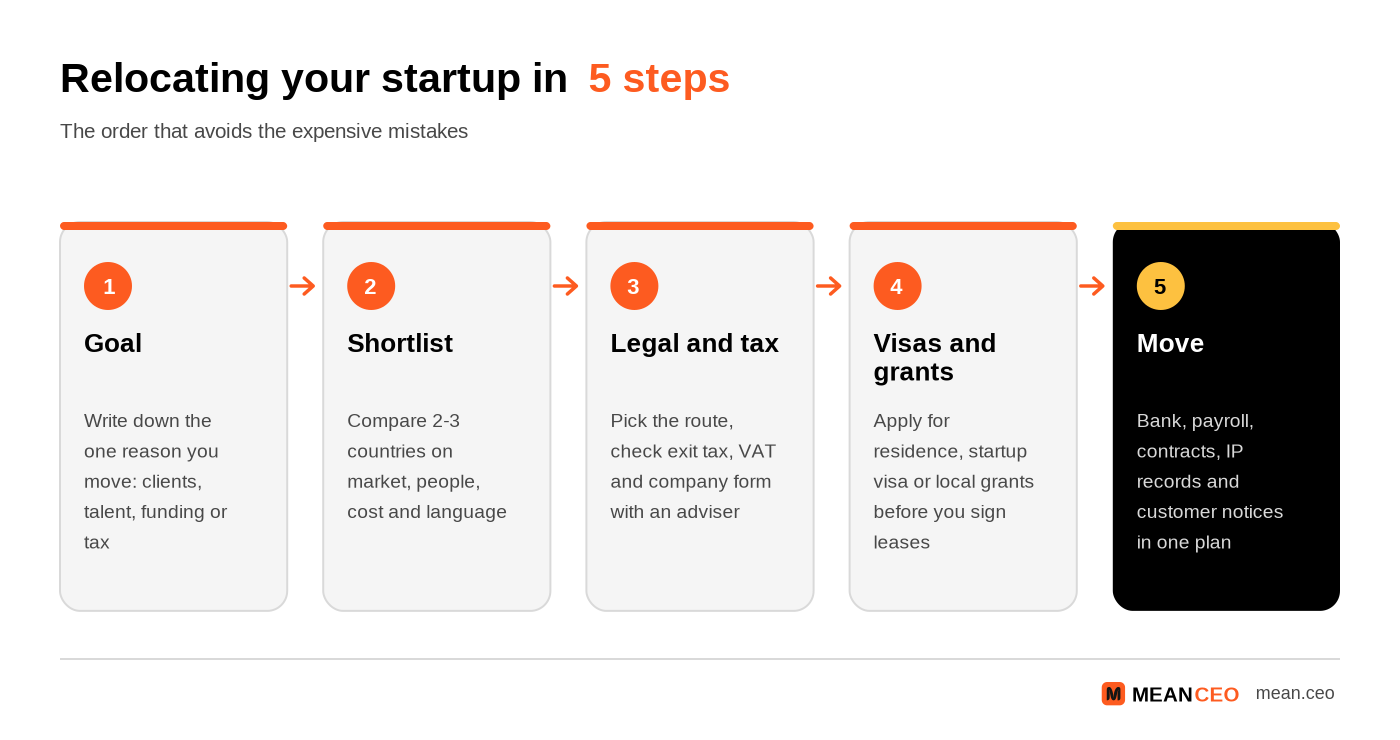
Why are you relocating? The specific goal, whether it’s accessing talent in Eastern Europe, reducing tax burdens, or operating within a more startup-friendly ecosystem, should shape your relocation strategy. For example, if accessing better tech talent is your priority, hiring remotely across the EU might suffice without full relocation. Cross-border hiring offers legal insights to manage this effectively.
2. Identify Potential Destinations
Europe offers diverse hubs tailored to different industries. For example, the Netherlands is strong for tech companies thanks to its digital infrastructure and English-speaking workforce, while Estonia appeals to remote-first firms with its fully digital company administration. France offers grants, a large research tax credit and a dedicated visa for founders. For data-driven comparisons, explore the Germany vs. France vs. Netherlands vs. UK guide.
One warning on Estonia: e-Residency gives you a digital ID to run an Estonian company remotely, but it is not a visa and gives no right to live in Estonia or the EU, and it does not change where you pay personal tax. If you run the company from another country, that country may treat the company as resident there too.
3. Review Legal and Tax Frameworks
Legal compliance is critical. Each country operates under its own tax codes and regulatory systems despite EU integration. For example, different VAT rules can make invoicing tricky if your operations span multiple countries. Startups should determine whether their company structure is better suited to a BV in the Netherlands, an SAS in France, or a GmbH in Germany. For clarity on entity formation and tax implications, consider the European company formation guide.
Sources: national company registers and tax authorities (business.gov.nl, gesetze-im-internet.de, service-public.gouv.fr, emta.ee, revenue.ie, Agencia Tributaria), checked November 2026.
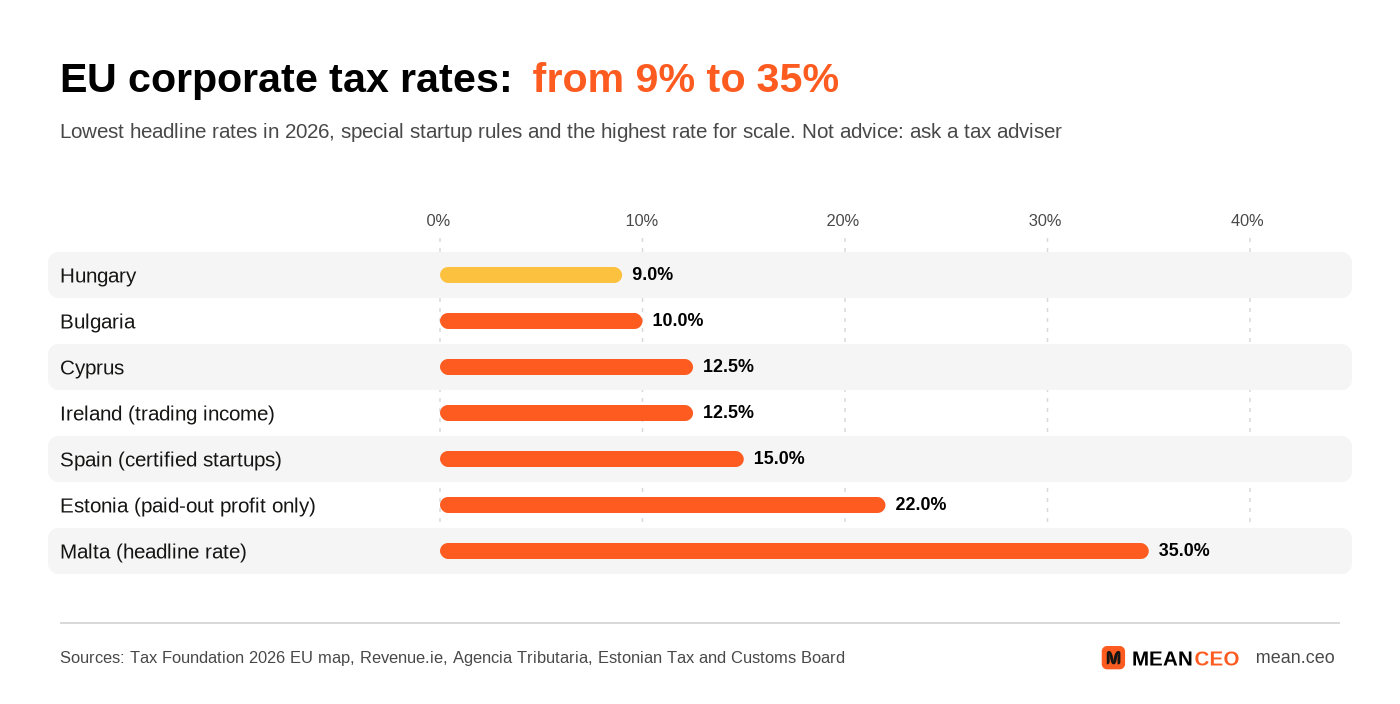
A low headline rate is rarely a reason to move on its own. Social security, salaries, accounting costs and where your customers are usually matter more for a bootstrapped company, and a company that is really managed from elsewhere may not get the low rate at all.
4. Leverage Visa Programs and Grants
Founders coming from outside the EU need a residence route, and several countries run startup visas built for exactly this. The Dutch start-up permit gives one year of residence to non-EU founders who work with a facilitator listed by RVO (the IND fee is €423), and after that year you can apply for a self-employed permit. The French Tech Visa for founders can be issued for up to four years and renewed, if a partner incubator selects your startup or a public body recognises your innovative project. Portugal’s StartUP Visa, run by IAPMEI, needs acceptance by a certified incubator. EU citizens need none of this: they can live and set up a company anywhere in the EU.
Sources: IND, La French Tech, Startup Estonia, IAPMEI, Irish Immigration Service, Spanish government (one.gob.es) and Italy’s business ministry, checked November 2026. Fees and conditions change, so confirm on the official page before you apply.
On the money side, France’s research tax credit (Crédit d’impôt recherche) covers 30% of eligible R&D spending, and EU programmes such as Horizon Europe can fund innovation projects. For hiring, the EU Blue Card lets you bring in highly qualified non-EU staff in 25 member states.
For a detailed breakdown of startup visa options, check out the complete guide to European startup visa programs.
5. Set Up Logistics for Relocation
Relocation doesn’t just involve relocating your office. Team relocation, banking arrangements, intellectual property registrations, and customer transition planning must also align. Engage a relocation consultant if needed, particularly for country-specific regulatory hurdles.
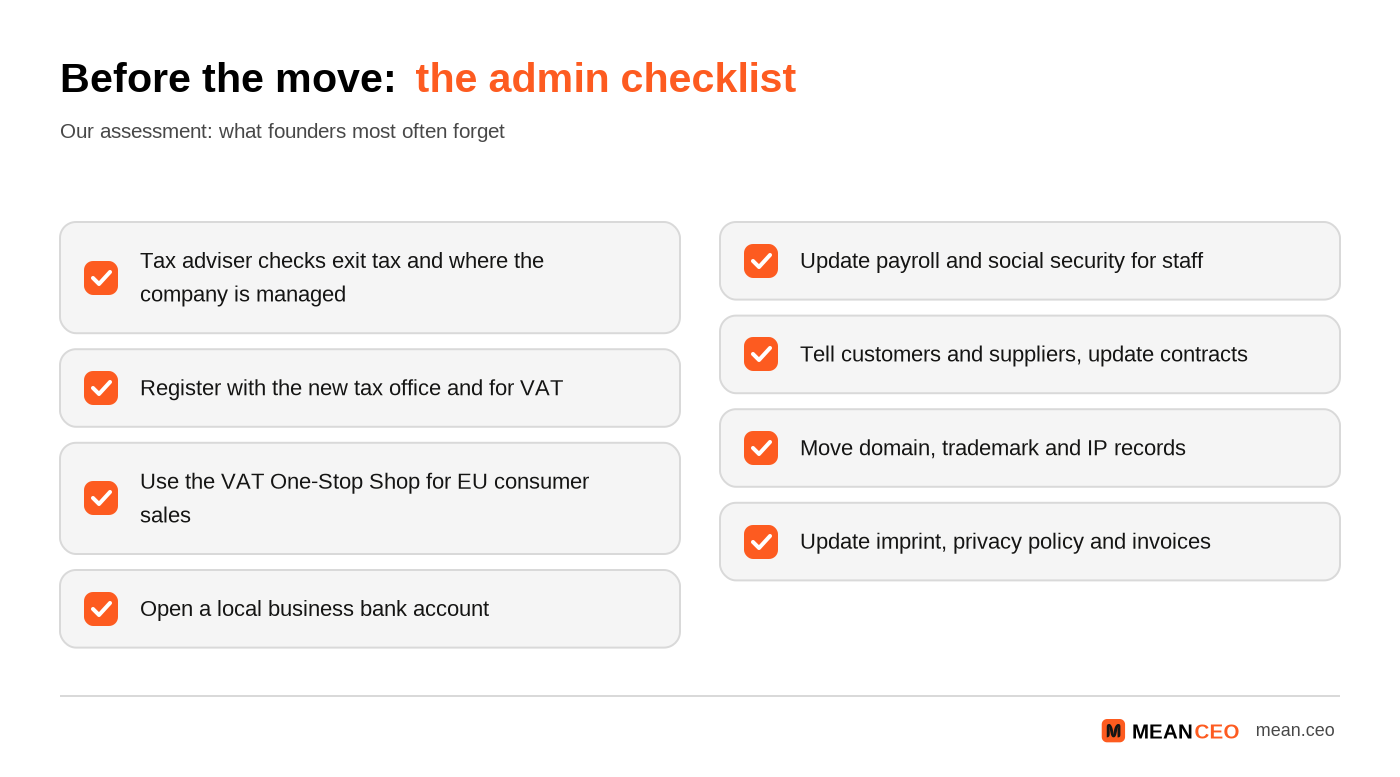
A few admin points catch almost every founder: register with the new tax office and for VAT, use the EU VAT One-Stop Shop if you sell to consumers in several member states, open a local business account (our guide to European startup banking options compares them), and move your trademark and IP records along with the company (see intellectual property protection for EU startups). If you employ people, check the employment rules of the new country in our guide to European labour laws for startups. Don’t forget the legal pages on your website: the imprint, privacy policy and invoices must show the new company details.
The Hidden Benefits of a European Relocation
Many startups underestimate the boost a new European base can provide. France backs innovation with its research tax credit and large public programmes, the Netherlands is a strong base for AI and robotics ventures, and the Nordics lead in green tech. Countries investing in green and socially sustainable solutions also offer growing opportunities for female founders who align with ESG values.
Future-proof your startup now.
Get actionable tips for market positioning, talent acquisition, and grant optimization in Europe in 2026.
👉 Hire across European borders legally
Avoiding Common Relocation Pitfalls
- Ignoring time-zone challenges when building teams across countries. Synchronization is crucial.
- Underestimating regulatory differences between EU countries, even for seemingly simple services.
- Moving the founder but not the company’s management on paper, so two countries both claim the company as tax resident.
- Forgetting exit tax when IP or other valuable assets leave the old country.
- Focusing on cost-saving benefits while ignoring the cultural synergy needed for team integration.
- Mistiming the product-market fit validation for a new market, leading to premature scaling.
Timeline: our assessment for a small company; a cross-border conversion can take longer.
Next Steps: Dive Into the Scale-Up Handbook
As you finalize your relocation plans, make sure to map out the phases thoroughly, paying special attention to your target market, cultural fit, and operational design. The European ecosystem is flourishing, with startups actively contributing to emerging technologies, deeptech solutions, and green innovation frameworks. By choosing a strategic relocation within Europe, you'll unlock not just incentives and funding, but the chance to scale your operations within globally interconnected ecosystems.
Ready to deepen your European expansion strategy? Explore the Ultimate Country-by-Country Founder Handbook focusing on startup ecosystems in 2026, and check the startup legal checklist by country before you register anything.
Boost Your SEO by Sharing Unique Insights.
Optimized founder content can rank on platforms like Google, ChatGPT, and more. More and more traffic is coming from Perplexity, ChatGPT, Grok and other AI tools.
👉 Rank on ChatGPT
People Also Ask:
What is the easiest country to move to in Europe?
For EU citizens, any EU country: you can live and register a company anywhere in the union. For non-EU founders, the easiest routes are the dedicated startup visas, such as the Dutch start-up permit, the French Tech Visa, Estonia’s startup visa and Portugal’s StartUP Visa. Portugal remains popular for its moderate cost of living, but note that its D7 visa is for people with passive income (pensions, rent, investments), not founders, and the old Non-Habitual Resident tax regime closed to newcomers in 2024; its narrower successor, IFICI, offers a 20% rate on income from eligible innovation jobs for ten years.
Can an American start a business in Europe?
Yes. Americans can own and register companies in most European countries, but living there and running the company in person needs a residence permit, such as a startup visa. Estonia’s e-Residency lets you open and run an Estonian company online without living there, but it is not a visa. Ireland runs the Start-up Entrepreneur Programme for founders with €50,000 in funding and charges 12.5% corporate tax on trading income.
What is the cheapest EU state to found a startup?
On headline corporate tax, Hungary (9%) and Bulgaria (10%) have the lowest rates in the EU in 2026, followed by Cyprus and Ireland at 12.5%. Salaries and rents are also lower in much of Central and Eastern Europe. But the cheapest place is usually the one where your customers and team already are, because accounting, legal and travel costs add up fast.
Which country is No. 1 in startup ecosystem rankings?
In the StartupBlink Global Startup Ecosystem Index 2026, the United States ranks first and the United Kingdom second, followed by Israel, Singapore and Canada. Sweden is the highest-ranked EU country (6th), with Germany 7th, Switzerland 8th and the Netherlands 10th.
What support exists for female entrepreneurs relocating to Europe?
The main EU scheme is Women TechEU, which gives women-led deep-tech startups €75,000 in equity-free funding plus coaching; the 2026–2028 edition is open, with the next full-proposal deadline on 14 January 2027. Many countries add national programmes, listed in our guide to European grants for female-founded startups. Platforms like Fe/male Switch provide mentorship and resources tailored to female entrepreneurs.
Why is Europe attracting startups from abroad?
Europe’s appeal lies in the access it provides to diverse markets, substantial grants, and government support for innovation. Countries such as the Netherlands emphasize startup-friendly policies while maintaining environmental sustainability compliance standards. Additionally, EU-wide programs such as InvestEU foster capital access for young businesses.
What industries are thriving for startups within Europe?
Industries such as fintech, greentech, and educational technology are thriving in Europe as of 2026. The EU’s focused regulations on sustainability and digital transformation provide fertile ground for innovation in these sectors, drawing both startups and talent from across the globe.
How can startups benefit from relocating within Europe?
Relocating within Europe can bring you closer to customers, give you access to a larger talent pool and open local grants and tax incentives, such as France’s research tax credit or Spain’s 15% rate for certified startups. Hubs like Amsterdam, Berlin, Stockholm and Paris add investors and peers, while the single market lets you keep selling across the EU.
What are visa options for entrepreneurs moving to Europe?
Most options are startup or entrepreneur visas: the Dutch start-up permit, the French Tech Visa for founders, Estonia’s startup visa, Portugal’s StartUP Visa, Ireland’s STEP, Spain’s entrepreneur visa and the Italia Startup Visa. They usually ask for an innovative business plan and backing from an approved incubator, facilitator or committee. The table above lists the main conditions.
How to fund a startup while operating across EU states?
Funding largely involves a mix of EU grants, national incentives like tax credits, and private financing. EU programmes such as Horizon Europe and the European Innovation Council fund innovation, and InvestEU uses an EU budget guarantee to mobilise investment. For more options beyond VC, see our guide to the European startup funding landscape.
FAQ on Relocating Your Startup Within Europe
What is the ideal timing for relocating your startup within Europe?
The ideal timing largely depends on growth stage and business objectives. Early-stage startups may benefit from relocating to leverage tax incentives or grants, while scaling companies should relocate after product-market fit is established. Explore strategies in the Startup Questions Handbook.
How does cultural diversity impact team relocation?
Cultural diversity enhances innovation but can challenge team cohesion. Proactively address language barriers and different work approaches. Occasional meet-ups and shared tools for virtual communication improve collaboration in cross-border teams. Learn how to build a distributed team across Europe legally.
What are some cost-effective ways to research European startup ecosystems?
Use open data resources, government websites, and reports that compare costs, talent pools, and incentives across regions. Platforms such as StartupBlink provide rankings by ecosystem strengths. For visibility, reviewing a European-focused AI-focused SEO Strategy could also aid outreach.
How do startup visas compare across European countries?
The Dutch start-up permit gives one year with a facilitator, the French Tech Visa up to four renewable years, and Estonia’s startup visa up to 365 days after Startup Committee approval. Estonia’s e-Residency simplifies running a company remotely but is not a visa. Visa advantages depend on local incentives and your startup’s stage. Choose based on your market strategy and operational needs.
What are some tax considerations when relocating a startup within Europe?
Tax considerations include corporate rates, exit tax on assets that leave, where the company is managed, VAT registration and R&D credits. France provides a research tax credit of 30% on eligible R&D spending, and Estonia taxes company profits only when they are paid out. Consultation with tax advisers skilled in cross-border moves can ensure compliance and maximize financial advantages.
Which European hubs lead in green-tech and sustainability startups?
Germany, the Netherlands, and the Nordics lead in green-tech with strong industry support and funding prioritization. These regions attract sustainability-focused startups, like electric mobility or ESG-aligned ventures, benefiting female entrepreneurs aiming to innovate in clean energy and circular economies.
What challenges can arise when relocating teams across time zones?
Managing time zones can complicate collaboration and decision-making. Offer flexible work hours, and integrate common tools like Slack and Notion for synchronization. Clear scheduling and a cultural understanding can significantly reduce time-zone friction within distributed teams in Europe and beyond.
What criteria should I use to select my new European base?
Prioritize based on market access, talent proximity, and industry fit. Consider legal systems, R&D funding, and the local cost structure. For example, choose Amsterdam for tech startups or France for government grants and diverse funding opportunities tailored to your sector.
How can AI help startups prepare for relocation in Europe?
AI simplifies market analysis, logistics planning, and competitor benchmarking for relocation. Tools like ChatGPT and localized AI applications optimize processes. Check out the AI for Startups Workshop for insights on automation and cost savings.
What should startups avoid when expanding to new European markets?
Avoid premature scaling and neglecting cultural due diligence. Misjudging customer preferences and underestimating regulatory nuances can be costly. Engage local advisors and test product-market fit incrementally to align with market specifics without spreading resources too thin.
Can relocation affect my intellectual property protection?
An EU trade mark or design registered with the EUIPO covers all member states, so it stays valid when you move; update the owner’s address and, after a transfer to a new company, record the new owner. Patents are handled by the European Patent Office, not the EUIPO; since 1 June 2023 a Unitary Patent covers 18 EU countries with one filing. Moving IP to a new company can also trigger tax, so plan it with your adviser.
About the Author
Violetta Bonenkamp, also known as MeanCEO, is an experienced startup founder with an impressive educational background including an MBA and four other higher education degrees. She has over 20 years of work experience across multiple countries, including 5 years as a solopreneur and serial entrepreneur. Throughout her startup experience she has applied for multiple startup grants at the EU level, in the Netherlands and Malta, and her startups received quite a few of those. She’s been living, studying and working in many countries around the globe and her extensive multicultural experience has influenced her immensely.
