TL;DR: European Labor Laws Every Startup Founder Should Know
The EU sets the floor for every employer: a working week of at most 48 hours on average, at least 4 weeks' paid leave, written terms within 7 days, maternity and parental leave and equal pay. Each country builds its own rules on top, so dismissal, fixed-term contracts, sick pay and extra payments differ sharply between Germany, France, the Netherlands, Poland and Spain. Get the hiring route, the local contract and payroll right before day one, treat freelancers as freelancers, and you can scale across Europe without legal surprises.
💡 Planning to scale your startup across Europe? Check out the European Startup Ecosystem Guide for country-specific insights on hiring and expanding.
European Labor Laws Every Startup Founder Should Know
Navigating labor laws in Europe presents unique challenges and opportunities for startup founders. With compliance affecting everything from hiring practices to scaling a distributed team, understanding these regulations can make or break a venture. For female founders like myself, ensuring equal pay and robust workplace protections often intersects with building diverse and inclusive teams in traditionally male-dominated industries.
Here’s why founders must pay attention to European labor laws: the EU sets baseline standards for working time, paid leave, written contracts, maternity leave and equal pay, but each country decides how dismissal, fixed-term contracts, sick pay and minimum wages work. For example, a German company with ten or fewer employees has much more freedom to end a contract than a Dutch company of the same size, where most dismissals need permission from the UWV or a court. For cross-border startups, that difference shapes where and how you hire.
The cheapest moment to get employment law right is before the first contract is signed. Every fix after that costs back pay, fees or trust.
Thinking about hiring internationally?
Avoid mistakes with hiring across borders.
👉 Read: Our Guide to Startup Hiring in Europe
The EU Baseline: Rules That Apply in Every Country
Whether you hire in Lisbon or Tallinn, a handful of EU directives set the minimum. The Working Time Directive caps the average week at 48 hours including overtime and guarantees at least four weeks of paid leave. The Transparent and Predictable Working Conditions Directive requires the key terms of the job in writing within seven calendar days of the first working day, and limits probation to six months in most cases.
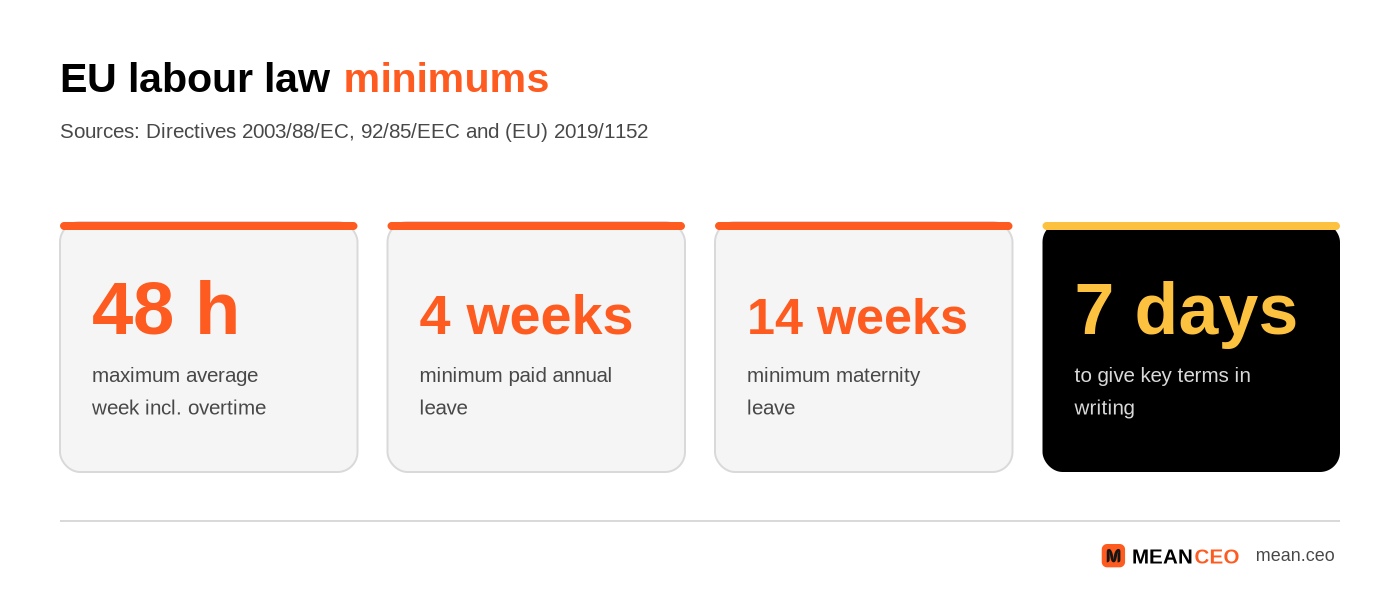
Directives set minimums that each country writes into its own law, often with more generous rules. Sources: EUR-Lex texts of each act (checked 22 November 2026).
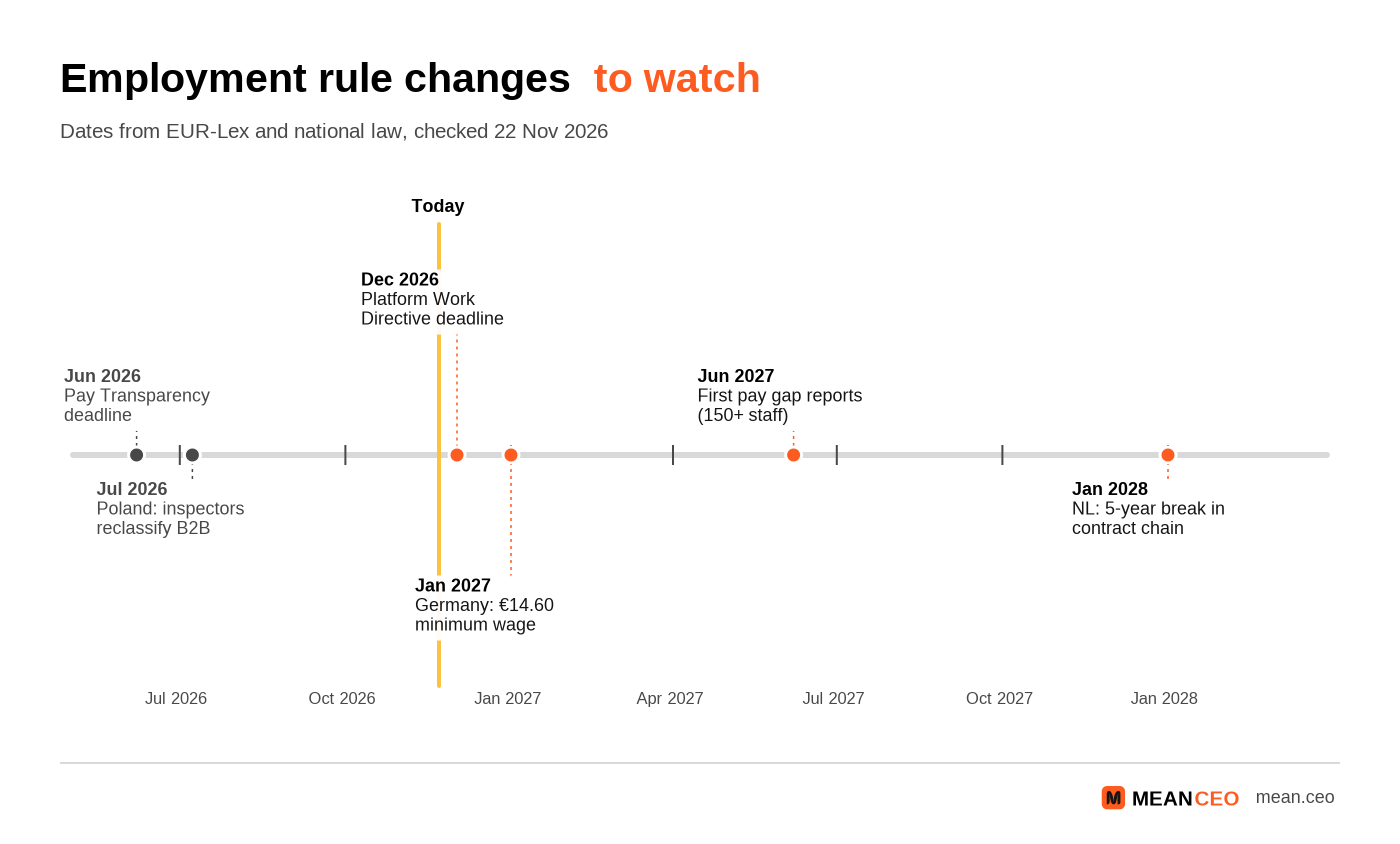
The newest rule to watch is the Pay Transparency Directive. Its deadline for national laws was 7 June 2026, but by late September 2026 only five member states had fully written it into national law, so check the status in your country. Once it applies, candidates must see the starting pay or pay range in the job ad or before the interview, and you can no longer ask what they earned before. Companies with 150 or more employees start reporting their gender pay gap from June 2027 and those with 100 to 149 from June 2031.
Why Knowing Labor Laws is Non-Negotiable
Labor laws aren’t just bureaucratic hurdles; they directly influence how you hire, manage employees, and scale sustainably. Missteps, like bypassing local contracts in favor of generic agreements, can erode trust and expose startups to penalties. For example:
- In France, dismissal requires a documented reason, a formal procedure and statutory severance once the employee has 8 months' service.
- Germany allows fixed-term contracts of up to 4 years without a reason for companies in their first 4 years, instead of the usual 2 years.
- The Netherlands turns fixed-term contracts into permanent ones after more than 3 contracts or 36 months, unless a collective agreement (cao) sets other limits.
How the Rules Differ by Country
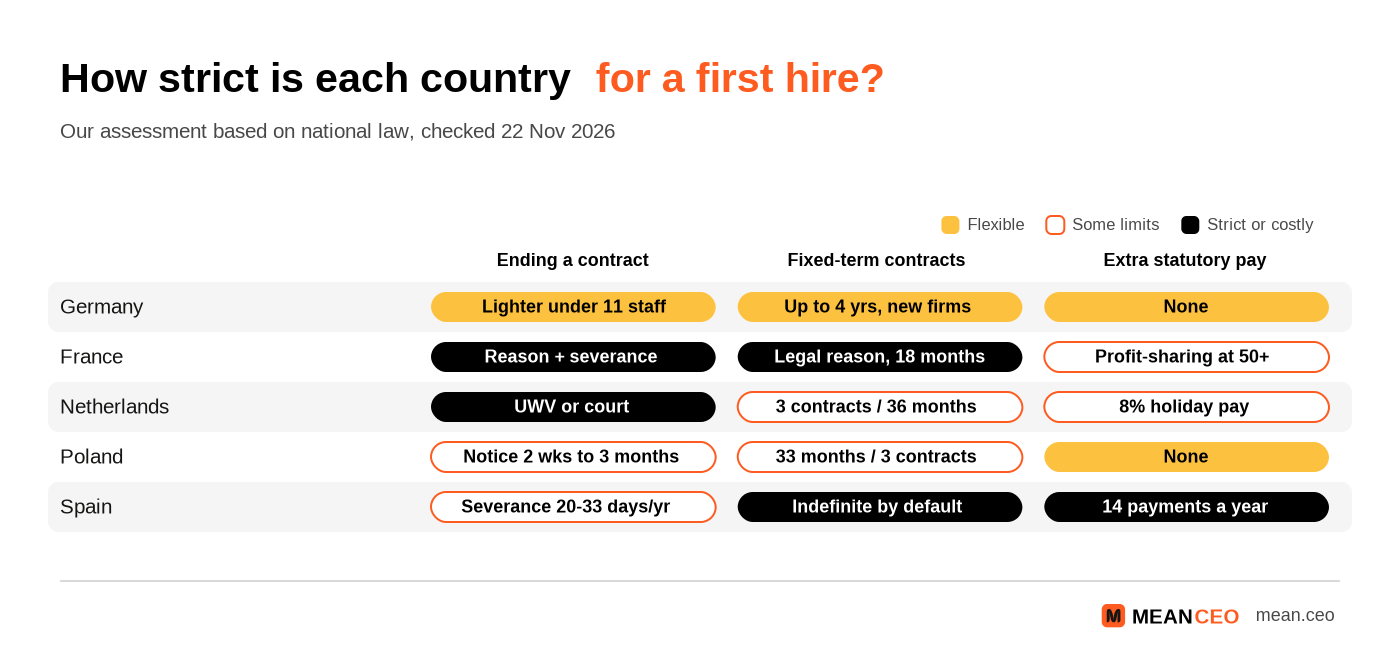
Most of the cost of an employee sits in national law. The table compares five common startup hiring countries on the points that hit a small team first.
Sources: gesetze-im-internet.de, service-public.gouv.fr, business.gov.nl, biznes.gov.pl, gov.pl and boe.es (checked 22 November 2026). Collective agreements in each country can add to these rules. For ten countries in more detail, including what an employee costs on top of salary, see our guide to employment law basics by European country.
Two details surprise founders most. In Germany, full dismissal protection only applies once a business regularly employs more than ten people, which gives very small teams more room. In the Netherlands, an employer keeps paying at least 70% of salary for up to two years when an employee is ill, so Dutch founders often take out sick-pay insurance with the first hire.
Actionable Steps to Comply with Labor Laws
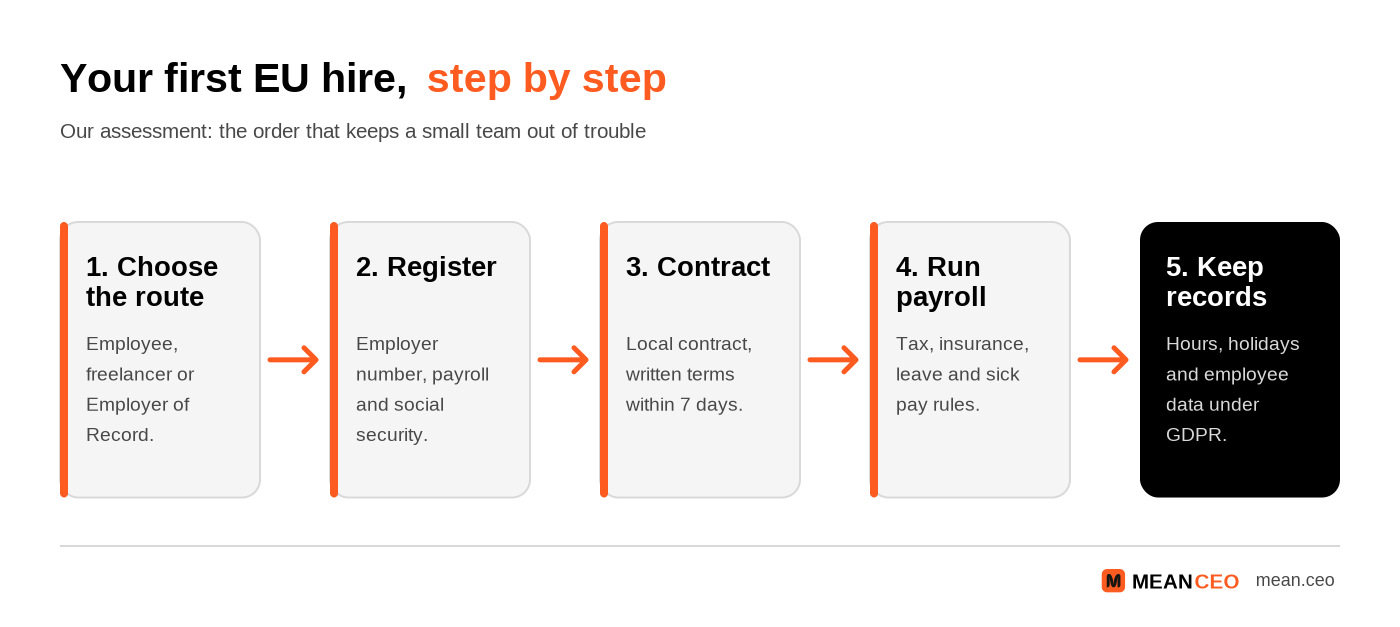
Step 1: Research local laws. Start by examining core regulations in countries where you hire, such as maternity or sick leave entitlements. The EU provides a baseline, but national laws diverge significantly.
Step 2: Document clear contracts. Contracts should comply with national laws. Include clauses for probation periods, termination notice durations, and compensation adjustments. Collaborating with local advisors helps avoid mistakes.
Step 3: Standardize hiring procedures. Use the same checklist for every hire: job ad with a pay range, local contract, employer registration, payroll set-up and onboarding. Our guide on how to hire across EU borders helps tailor that system for multi-national startups.
Step 4: Register before day one. Most countries expect the employer to register the new hire with tax and social security before work starts. In France, for example, the pre-hire declaration (DPAE) goes to URSSAF before the first working day.
Step 5: Record working time and protect employee data. The EU Court of Justice ruled in 2019 (CCOO, C-55/18) that employers need a system that records each worker's daily hours. Employee files fall under the GDPR too; our step-by-step GDPR guide covers the basics.
Mistakes Founders Make With Labor Laws
Many startup founders overlook labor laws until a costly mistake surfaces. Here are common pitfalls:
- Misclassifying workers: Labeling employees as contractors when they work like staff leads to fines, back taxes and social contributions. In Poland, labour inspectors can now reclassify such contracts by decision.
- Underestimating notice and severance costs: Statutory notice, severance and transition payments must be in the budget before you hire, not when you have to let someone go.
- Ignoring working time rules: Overtime beyond the legal limits, missing rest periods or no time records lead to claims and inspections.
- Copying one contract everywhere: An English template from another country rarely covers local probation, notice and leave rules.
- Job ads without pay: As pay transparency laws take effect, an ad or first interview without a pay range becomes a compliance problem.
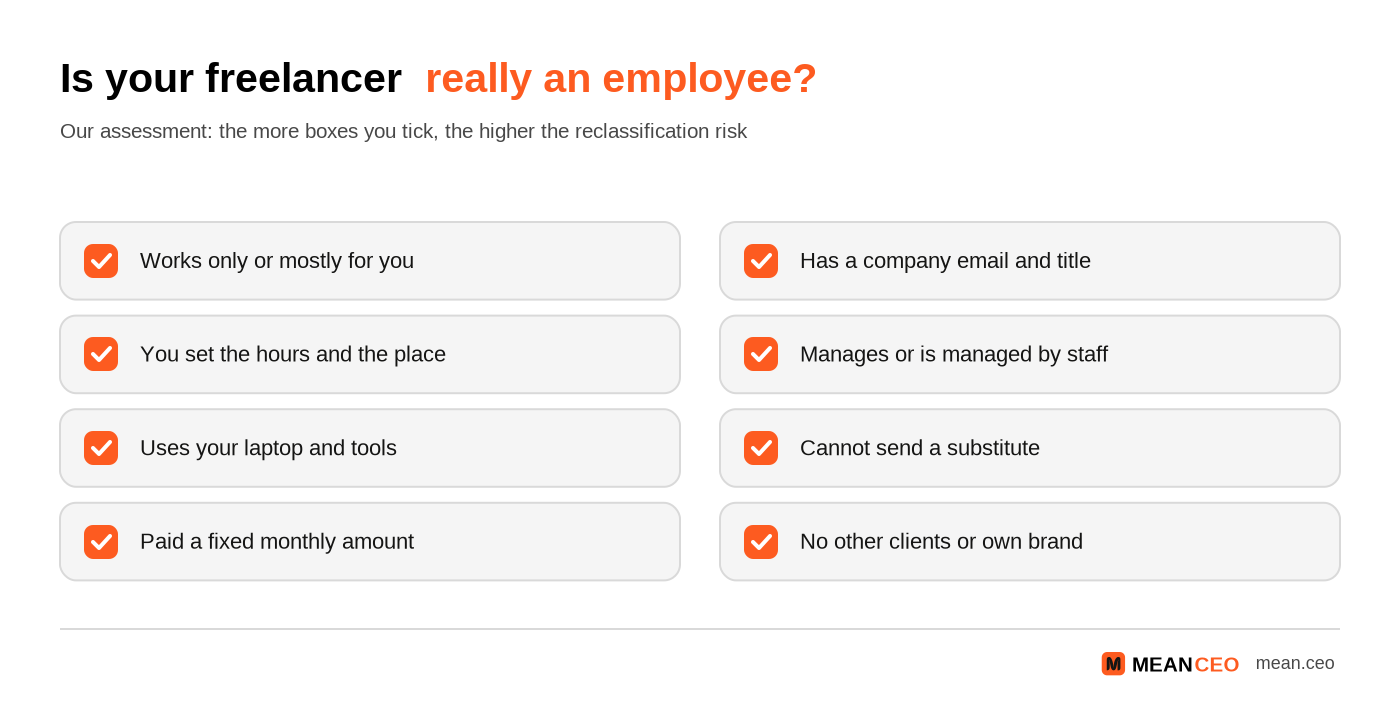
If several of these apply, read our guide to managing contractors vs employees before you renew the contract.
Expert Tips: Building Talent Pools Strategically
Founders often focus on growth without realizing labor laws enable or constrain how teams scale. From my own experience in scaling Fe/male Switch, employing talent across borders is easier when you follow these principles:
1. Use freelancers for real projects, not as hidden staff. Freelancers in Poland, Portugal or the Baltic states can be a good fit for defined projects, but someone who works full time for you, on your schedule and with your tools, needs an employment contract.
2. Invest in strong onboarding systems as you grow. Efficient processes reduce administrative friction and ensure employees understand their rights.
3. Test a country with an Employer of Record before opening a company. An Employer of Record is a local company that employs the person for you and handles the contract, payroll, tax and social security, while you direct the work. It costs a monthly fee per employee, so it suits the first one or two hires in a country. Explore cross-border guides like Cross-Border Hiring: Legal and Practical Guide.
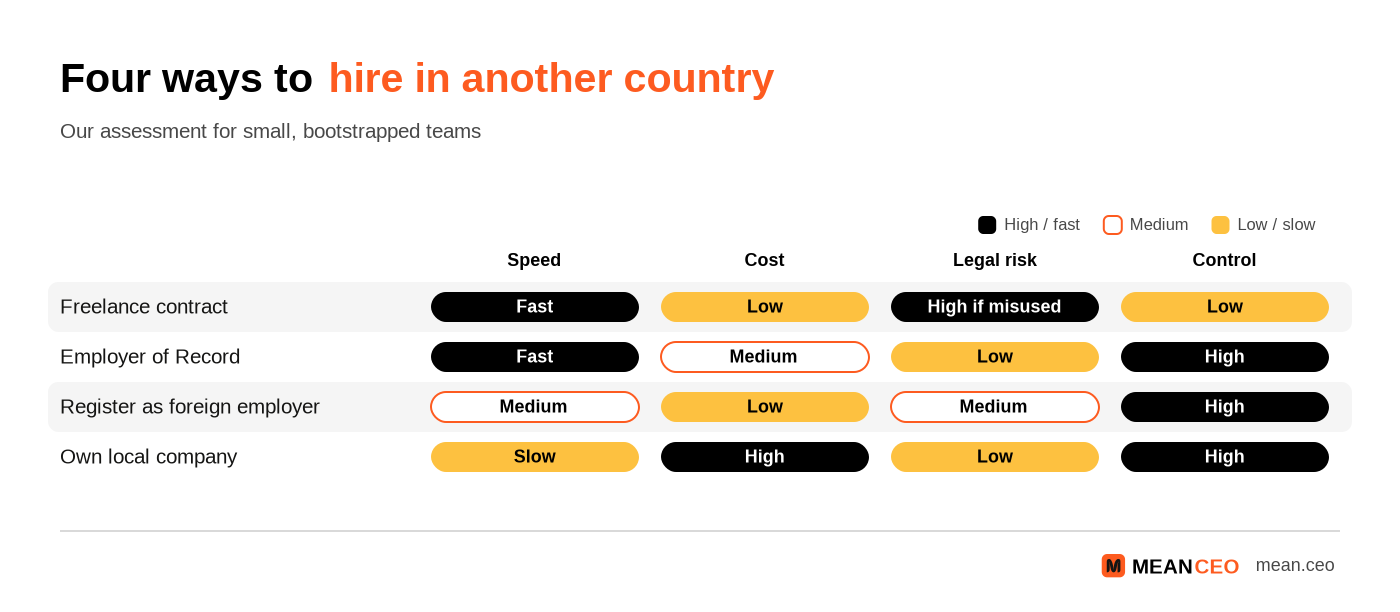
Our assessment. Employer of Record prices are not published in a comparable way, so ask at least two providers for a full quote. Not sure you need an employee yet? Read when to hire your first employee as a bootstrapped founder.
Dates to Watch in 2026 and 2027
Several rules change for employers over the next months. The Platform Work Directive must be in national law by 2 December 2026, Germany's minimum wage rises to €14.60 an hour on 1 January 2027, and the first gender pay gap reports under the Pay Transparency Directive are due in June 2027 for companies with 150 or more employees. In the Netherlands, a law passed for 2028 lengthens the break that restarts the fixed-term contract chain from six months to five years.
The Long-Term Benefits of Compliance
Although staying compliant requires time and resources, the payback is real. Clean contracts and payroll make investor and buyer due diligence faster, larger customers increasingly check how their suppliers employ people, and candidates trust an employer whose terms are clear from the first interview. It sets a foundation not just for better operations, but for establishing credibility.
Do better with startup legal compliance.
Craft scalable agreements without overspending on advisors.
👉 Consult the Ultimate Guide to Compliance
Closing Thoughts: Scaling Smarter With Compliance
Understanding how labor laws function isn’t an optional endeavor. For founders in Europe, it directly affects capacity to scale, manage risks, and earn reputational equity. By following structured systems, legal planning becomes a tool for growth rather than a hindrance.
If compliance feels daunting, focus initially on finding solutions that strike a balance: protecting employees without sacrificing startup agility. Your ultimate goal isn’t just avoiding fines but positioning your startup to thrive safely and sustainably. Our startup legal checklist by country lists the paperwork per market, and as you expand, the Company Formation Guide for EU Startups helps you decide when a local company makes sense.
Boost Your SEO by Sharing Unique Insights.
Optimized founder content can rank on platforms like Google, ChatGPT, and more. More and more traffic is coming from Perplexity, ChatGPT, Grok and other AI tools.
👉 Rank on ChatGPT
People Also Ask:
What are the main labor laws in Europe that startups should know?
Start with the EU minimums that apply in every member state: working time and paid leave, written terms for every new employee, maternity and parental leave, equal pay under Article 157 TFEU and the GDPR rules for employee data. Then check the national rules where your employee lives and works, because dismissal, fixed-term contracts, sick pay and minimum wage are set mostly by each country. Health and safety duties also apply from the first employee, whatever the company size.
What are the four types of EU laws?
Article 288 TFEU lists regulations, directives, decisions, recommendations and opinions. Regulations apply directly in every member state, directives set goals that each country writes into its own law, decisions bind the parties they name, and recommendations and opinions guide without binding anyone. Most EU employment rules are directives, which is why the details differ from country to country.
How do EU labor laws impact firing employees in startups?
The EU sets few dismissal rules of its own, apart from protection for pregnant workers, collective redundancies and discrimination. National law decides the rest. In Germany, full dismissal protection only applies in firms with more than 10 employees, while the Netherlands needs UWV permission or a court decision for most dismissals and France has statutory severance after 8 months. Our guide on how to fire your first employee covers the human side.
Do female startup founders face unique challenges under European labor laws?
The laws are the same for every employer, but founders who hire women in their child-bearing years, or plan their own maternity leave, need a cover plan. EU law gives at least 14 weeks' maternity leave and 4 months' parental leave per parent, and many countries pay part of it from social security rather than the employer. Check who pays in your country before budgeting.
What protections do employees have under EU labor laws?
Employees are protected on working time, paid leave, written terms, maternity and parental leave, equal pay, non-discrimination, health and safety and data protection. These protections apply to a two-person startup as much as to a multinational.
What is Article 157 of the EU Treaty and why is it significant?
Article 157 TFEU sets the principle of equal pay for men and women for equal work or work of equal value. The Pay Transparency Directive builds on it: candidates must see the pay or pay range before the interview, and employers may not ask about pay history. For a small team, a short salary band per role is the simplest way to comply.
What sectors in Europe prioritize female entrepreneurship assistance?
EU funding puts the most money into deep tech, health, climate and digital, and the EIC's Women TechEU grant of €75,000 targets women-led deep-tech startups. Our list of European grants for female-founded startups includes national programmes as well.
How can startups in Europe ensure compliance with labor laws?
Use a local contract template, send written terms before the first day, register as an employer, run payroll through a provider that knows the country, record working hours and keep employee data under the GDPR. Review the set-up once a year and whenever you hire in a new country.
Are there grants available for female-led startups complying with EU labor laws?
No grant pays for labour-law compliance as such. Women-led startups can apply for programmes such as Women TechEU, and many countries subsidise hiring of specific groups, such as young or long-term unemployed workers, through their public employment services. Ask the employment service in the country where you hire.
Does compliance with EU labor laws provide competitive advantages to startups?
Yes, in practical ways: clean contracts make due diligence faster when you raise money or sell the company, larger customers check suppliers' employment practices, and candidates trust an employer with clear terms. It also avoids the back payments that come with reclassified freelancers.
FAQ on European Labor Laws for Startup Founders
How can startups ensure compliance with labor laws across multiple countries?
Treat each country as its own set-up: a local contract, local payroll and the local social security system where the person works. An Employer of Record can cover the first hires until a country justifies its own company. Learn more in this detailed hiring guide.
What are the top labor law mistakes startups make during rapid expansion?
Calling employees freelancers, using one English contract everywhere, skipping written terms, ignoring working-time records and forgetting that pay transparency rules now apply to job ads. Dismissal is where mistakes cost most, especially in France, the Netherlands and Spain.
Do remote workers in Europe require compliance with labor laws in their location?
Yes. Employment law and social security generally follow the place where the work is physically done. Under a 2023 framework agreement, a cross-border teleworker can work up to just under half of their time from home and stay insured in the employer's country, but only if both countries signed it. For more, see remote hiring strategies.
What legal challenges do startups face with fixed-term contracts in Europe?
The limits differ a lot. Germany allows fixed-term contracts without a reason for up to 4 years in a company's first 4 years, Poland stops at 33 months and 3 contracts, the Netherlands at more than 3 contracts or 36 months, and France needs a legal reason for every contract. Spain made indefinite contracts the default in 2022. Going past the limit usually turns the contract into a permanent one.
How does GDPR intersect with labor law compliance?
The GDPR covers all employee data: CVs, contracts, payroll, sick notes and any monitoring. You need a lawful basis for each use, a privacy notice for staff and limits on monitoring, and countries may add their own rules for employment data. For more, check out GDPR compliance for startups.
What industries in Europe face stricter labor law enforcement?
Labour inspectors focus on sectors with many short contracts, subcontracting or undeclared work, such as construction, transport, hospitality, cleaning and platform work. In tech, the main risk is misclassified freelancers, which Poland's inspectors can now reclassify by decision.
Are bonuses and incentives part of statutory entitlements in Europe?
Usually not, but some fixed extras are. Spain requires two extra payments a year, Portugal requires holiday and Christmas allowances, the Netherlands requires an 8% holiday allowance, and in Italy a 13th month comes from the national collective agreements. France makes profit-sharing compulsory once a company has had 50 or more employees for 5 years.
What costs are tied to dismissal in high-protection markets?
Notice pay, statutory severance and legal fees. France pays 1/4 of a month's salary per year of service for the first 10 years after 8 months' service, the Netherlands pays a transition payment of 1/3 of a month's salary per year from day one, and Spain pays 33 days per year for unfair dismissal, capped at 24 months.
Are freelance contracts a better option for startups in Europe?
For short, defined projects, yes. For someone who works full time for you, follows your schedule and uses your tools, no: that looks like employment, and the company pays the back taxes and contributions. Our guide to contractor vs employee classification shows the tests.
How can labor laws support scaling a distributed European team?
Clear rules make costs predictable: once you know notice periods, sick pay and extra payments per country, you can budget each hire properly. Estonia's digital nomad visa and the EU telework agreement help with mobile staff, while Employers of Record let you test a country before opening a company there.
About the Author
Violetta Bonenkamp, also known as MeanCEO, is an experienced startup founder with an impressive educational background including an MBA and four other higher education degrees. She has over 20 years of work experience across multiple countries, including 5 years as a solopreneur and serial entrepreneur. Throughout her startup experience she has applied for multiple startup grants at the EU level, in the Netherlands and Malta, and her startups received quite a few of those. She’s been living, studying and working in many countries around the globe and her extensive multicultural experience has influenced her immensely.
