TL;DR: European Startup Banking, Make Smarter Choices, Scale Faster
European founders can now open a business account online in days, often for free, and several digital providers hold full banking licences: Revolut (Lithuania), N26 (Germany), bunq (the Netherlands) and, since November 2026, Qonto (France). Others, such as Wise and Finom, are payment or e-money institutions: your money is safeguarded, but not covered by the €100,000 deposit guarantee. Choose by legal form, countries and currencies, licence, integrations and total cost, open a backup account, and keep a traditional bank in mind for loans.
💡 Choosing where to set up? Our European Startup Ecosystem Guide compares the main markets country by country.
European Startup Banking: Best Options for Founders (2026)
In 2026, navigating banking options as a European startup founder has become more streamlined yet remains packed with tough choices. From digital banks like Revolut and Qonto to traditional institutions such as HSBC, there’s no shortage of options to facilitate growth. Successful startup banking is about more than just holding funds. It’s about empowering founders with tools for multi-currency transactions, financial planning, and integration with other critical systems.
The European market isn’t known for offering huge venture capital checks like the United States. This is why picking the right banking partner is crucial, especially for bootstrapped startups and first-time founders. As a serial entrepreneur who has launched multiple AI, blockchain, and education-based startups, I’m sharing the strategies, opportunities, and insights so you can make banking work for your growth goals.
Ready to integrate banking and complete financial freedom?
Connect your business account to your accounting tool from day one, and month-end closing becomes a quick check instead of a hunt for receipts.
👉 Master Cross-Border Payments
Why Banking Matters in 2026
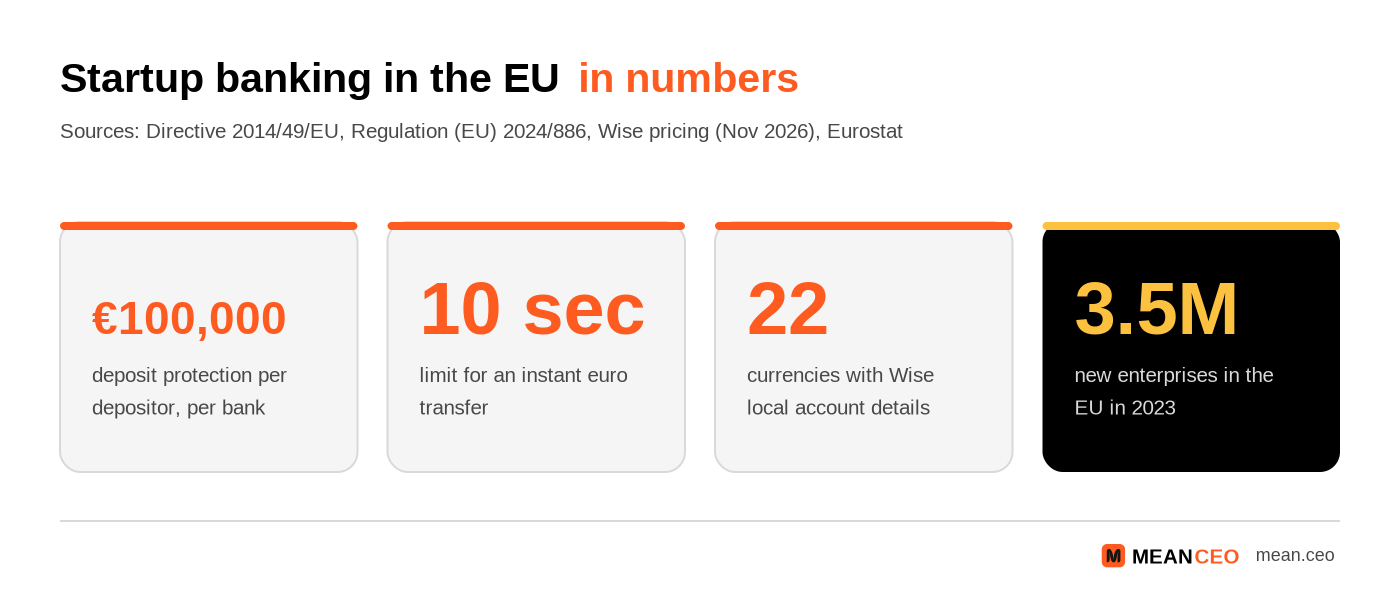
Europe is a busy place to start a business: Eurostat counted 3.5 million new enterprises in the EU in 2023 alone. Every one of them needs an account in the company's name before it can pay in share capital, invoice a customer or receive a grant. Yet banks and payment providers must check every new customer under anti-money laundering rules, and the European Banking Authority has warned that some refuse or close accounts of whole groups of customers they see as risky, a practice called de-risking.
This is especially critical for female founders and bootstrapped startups, where strategic cash flow management often determines survival. Unlike VC-backed startups, bootstrapped founders must rely on low-cost, high-efficiency banking services that simplify rather than complicate financial processes.
Two EU rules shape your choice. First, the deposit guarantee: deposits at a licensed bank are protected up to €100,000 per depositor, per bank, with repayment within seven working days. Second, under the Instant Payments Regulation, euro-area banks must send and receive instant euro transfers that arrive within 10 seconds, at no higher price than a regular transfer, and check the payee's name before money leaves.
Bank or E-Money Account: What You Are Actually Opening
Many founders don't notice the most important line in the small print: who holds the licence. A licensed bank can lend and its deposits fall under the national deposit guarantee scheme. A payment or e-money institution must keep your money separate from its own (safeguarding), usually at large banks or in money market funds, so it is returned to you if the provider fails, but the €100,000 deposit guarantee does not apply.
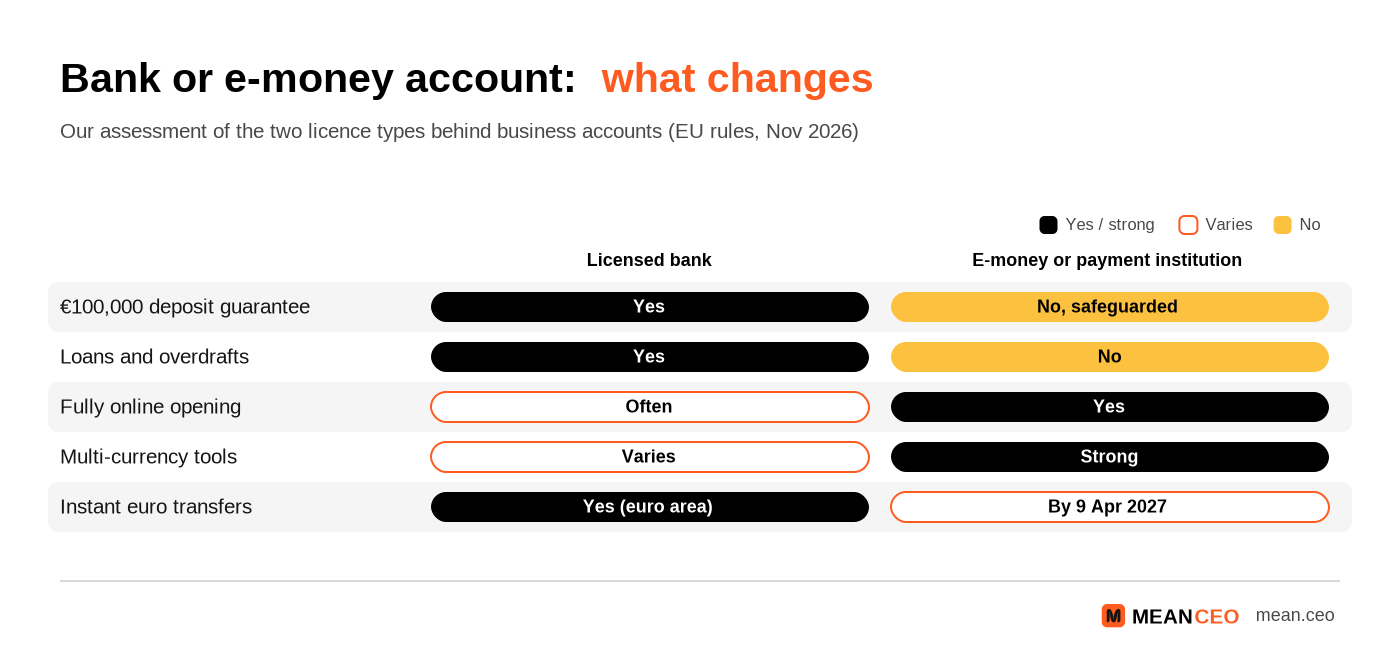
Neither model is unsafe for day-to-day money. The practical rule: keep large reserves at a licensed bank, split across banks above €100,000, and use e-money accounts for what they do best, such as foreign currencies and fast payments.
Top Banking Options for European Startups
Here’s a breakdown of the standout startup bank options available for 2026. Each offers distinct advantages depending on your business model and scaling phase.
1. Revolut Business: The Scaling Powerhouse
Revolut Business has become the go-to solution for startups with international ambitions. In the EU it is provided by Revolut Bank UAB, a bank licensed by the European Central Bank and supervised by the Bank of Lithuania, so deposits are insured up to €100,000. You can send and receive 30+ currencies, exchange 25+ at the interbank rate within your plan's allowance, and give every team member a card with its own limits. EU plans run from Basic at €10 a month to Grow at €35 and Scale at €125; there is no free plan.
Example: a SaaS startup based in Spain can collect payments from US and German customers in one account and see revenue by currency in one dashboard. Learn more about how Revolut stacks up against other options.
2. Qonto: Tailored for Founders
Qonto offers an intuitive dashboard built with founders in mind. Its strengths shine when it comes to managing team expenses, producing invoices and preparing for VAT and bookkeeping, with connectors for Xero, DATEV and many other tools. Qonto gives local IBANs in France, Germany, Italy and Spain, which makes multi-country operations easier. On 17 November 2026 it announced that the French regulator ACPR and the ECB had granted it a banking licence; until that licence is active, Qonto works as a payment institution and safeguards client money.
Plans for solo founders start at €9 a month and company plans at €49 (excluding VAT, billed yearly). For female founders who juggle lean teams and constrained time, Qonto removes repetitive work, freeing you for what really matters: customer growth.
3. Wise Business: Best for Flexibility
Wise Business specializes in low-cost international payments. In the EU it is run by Wise Europe SA, a payment institution supervised by the National Bank of Belgium; Wise is not a bank, and client money is safeguarded rather than covered by the deposit guarantee. You can hold 40+ currencies and get local account details in 22 of them for a one-time €60, so a US customer pays you like a domestic payment. Wise shows its fee and uses the mid-market exchange rate, which makes costs easy to compare.
Our assessment: Wise works best next to a main business account, not instead of one. It is ideal for marketplace startups, agencies and remote-first companies that pay freelancers and get paid in several currencies.
4. N26: Simplifying Solopreneur Needs
N26 holds a German banking licence, and deposits are protected up to €100,000. N26 Business plans range from a free Standard account to Smart at €4.90, Go at €9.90 and Metal at €16.90 a month, with 0.1% cashback on card purchases (0.5% on Metal).
The catch: N26 Business is for freelancers and the self-employed. You open it in your own name, not a company name, so a GmbH, SAS or BV needs another provider. For a sole trader testing an idea, it is a cheap and simple start.
Also Worth a Look: bunq, Finom and Your Local Bank
bunq holds a Dutch banking licence and offers a free business plan for sole proprietors, with paid plans from €7.99 a month. Finom is a Dutch e-money institution with invoicing built in and a free Solo plan. And a traditional bank still matters if you plan to borrow: state-backed loans such as KfW's ERP-Gründerkredit StartGeld (up to €200,000 for businesses under five years old, with KfW taking 80% of the risk) and Bpifrance loan guarantees in France reach founders through their bank.
Monthly prices from each provider's EU pages, checked 20 November 2026. Prices and plan names differ by country and billing period; check your own country page before you sign up.
Tips for Choosing the Right Bank as a Startup Founder
Selecting the wrong bank can leave you burdened with hidden fees or limited growth opportunities. To avoid common traps, use these tips:
- Know your needs: list the countries, currencies and rough volumes you expect in the next 12 months. Cross-border payments? Look at FX costs and local account details first.
- Check the legal form: some accounts are only for sole traders (N26 Business, bunq Free Business); a limited company needs a company account.
- Check the licence: bank with deposit protection, or payment or e-money institution with safeguarding.
- Plan for scalability: don't get stuck switching. Choose a provider that adds users, cards, permissions and currencies as your business grows.
- Tech stack integration: pick an account that connects to your accounting and invoicing tools; our startup tool stack guide shows how it fits together.
- Open two accounts: a main account and a backup, so a frozen account never stops payroll.
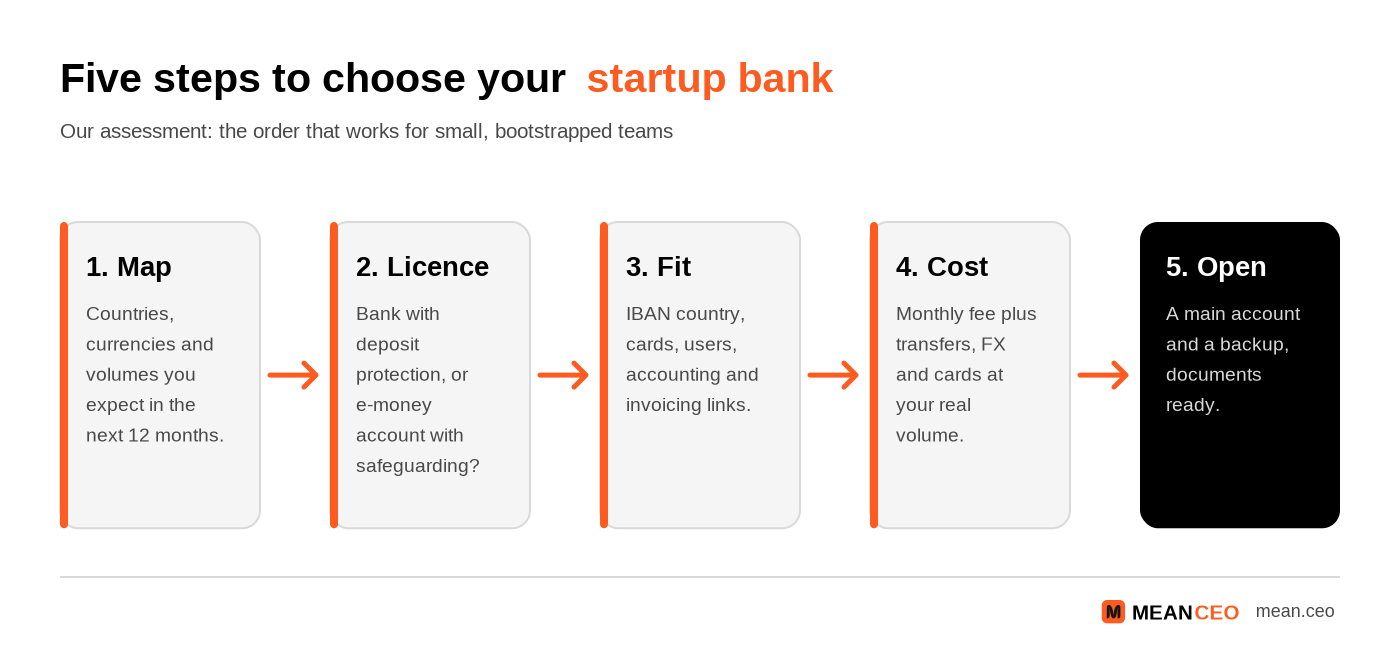
Our assessment, based on the providers' terms checked on 20 November 2026.
What You Need to Open the Account
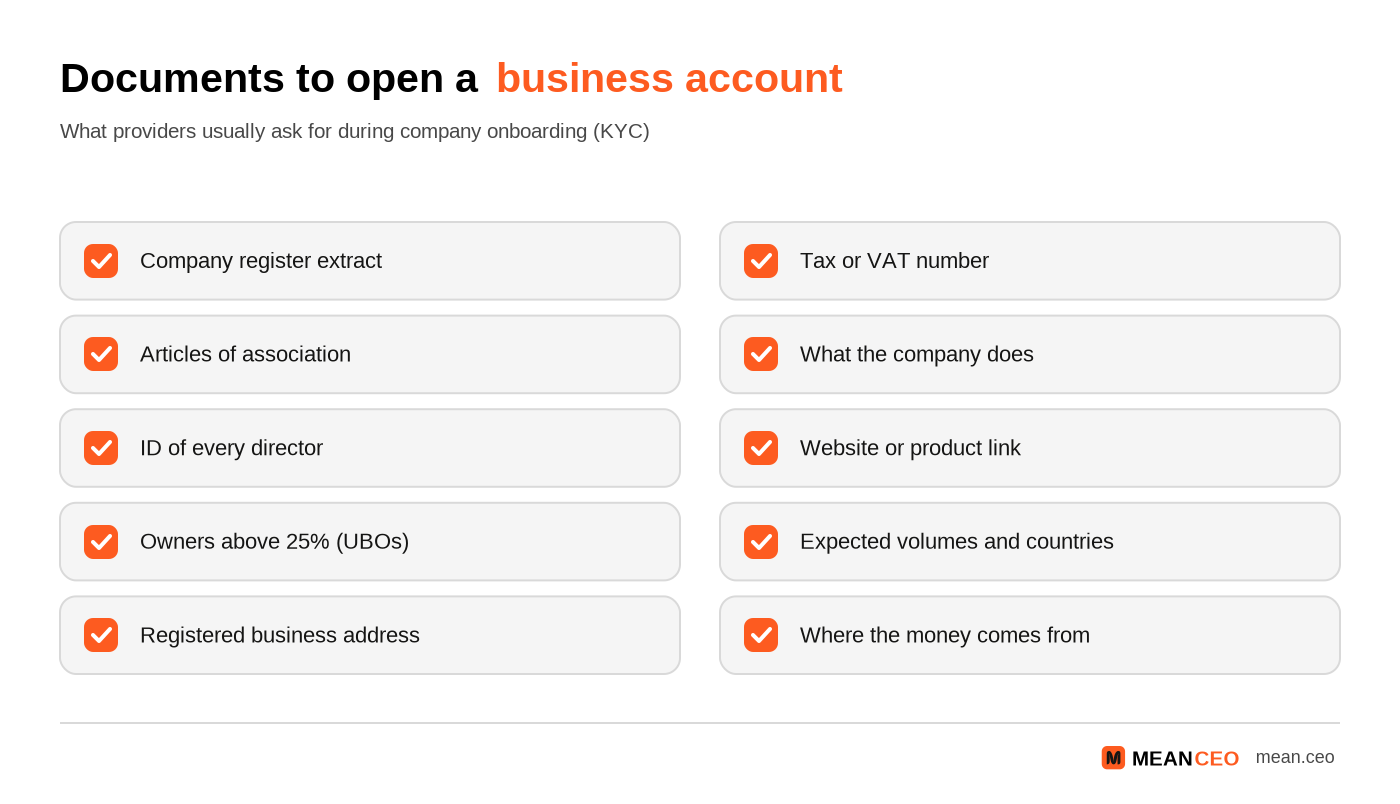
Every provider must identify your company and the people behind it. Have the documents ready before you apply, and describe your business clearly: vague answers are a common reason for delays and follow-up questions. Our startup legal checklist by country covers registration in each market.
What Startups Often Get Wrong
Even the most diligent founders often fall for hidden fees or overly complex setups. Here are the most frequent mistakes:
- Not considering international payment and conversion fees when expanding beyond your home market.
- Keeping all cash with one provider: if the account is frozen during a compliance review, you cannot pay anyone.
- Leaving more than €100,000 at one bank, or large reserves in an e-money account, without knowing how it is protected.
- Opening a personal or sole-trader account for a limited company, which mixes money and causes trouble with tax and audits.
- Using a company name on invoices that doesn't match the account name; since October 2025, Verification of Payee warns your customers about the mismatch.
- Overlooking a bank relationship until you need a loan, when lenders want to see your history.
Avoid these mistakes to build a banking foundation primed for growth and efficiency.
Are hidden banking fees draining your growth?
Explore startup-friendly digital banking options now.
👉 Compare Startup Banks
The Future of Startup Banking: Adapting for European Founders
The next changes are already scheduled. Payment and e-money institutions in the euro area must offer instant euro transfers by 9 April 2027, and the EU Anti-Money Laundering Regulation applies from 10 July 2027, with stricter and more uniform onboarding checks. Expect faster payments everywhere, and more questions when you open an account.
Sources: Regulation (EU) 2024/886 and the ECB's instant payments page; Regulation (EU) 2024/1624.
When you are ready to borrow, our guide on how to negotiate debt funding with European banks explains what lenders look for, and our guide to cash flow management for first-year founders helps you keep enough runway.
Intrigued? Then dive into the ultimate resource, European Startup Ecosystem Guide. Learn how each nation caters differently to founders and where your startup fits best.
Boost Your SEO by Sharing Unique Insights.
Optimized founder content can rank on platforms like Google, ChatGPT, and more. More and more traffic is coming from Perplexity, ChatGPT, Grok and other AI tools.
👉 Rank on ChatGPT
People Also Ask:
What is the outlook for the European banking sector in 2026?
For founders, the bigger change is not bank profits but competition: digital banks hold full licences (Revolut in Lithuania, N26 in Germany, bunq in the Netherlands, and Qonto received one in November 2026), and EU rules now require instant euro transfers at no extra cost. Expect more choice, cheap basic accounts and stricter identity checks.
Which European country is best for startups?
There is no single best country; it depends on your market, tax situation and where your customers are. Estonia is known for its fully online company setup, while Germany, France, the Netherlands and Spain offer large home markets and national funding programmes. Our European Startup Ecosystem Guide compares them country by country, and our cost analysis for bootstrapping in Europe compares running costs.
What is the best bank for a start-up business?
The one that fits your legal form and money flows. Freelancers can start with N26 Business or bunq; companies often choose Qonto, Revolut Business, bunq or a local bank, and add Wise Business for foreign currencies. If you may need a loan soon, keep a relationship with a traditional bank.
What is the banking strategy in 2026?
For a startup, a simple one: one main account with a bank licence or strong safeguarding, one tool for foreign currencies, accounting software connected to both, and a backup account so you can keep paying people if one provider freezes or closes your account.
How do female founders secure startup funding in Europe?
Usually by combining revenue, grants and, later, loans or investors. Women TechEU, run by the EU's EISMEA agency, offers €75,000 grants to women-led deep-tech startups, and national banks and agencies run guaranteed loan schemes. Our overview of European startup funding beyond VC lists the main options.
How can startups benefit from digital banks in Europe?
Fast online opening, low or no monthly fees to start, cards for each team member, multi-currency accounts and direct links to accounting tools. Check whether the provider is a licensed bank (deposit protection) or a payment or e-money institution (safeguarding).
What are the most female-friendly industries for startups?
No industry is reserved for anyone. What helps any founder with a small budget is a business that can earn early revenue: services, software for a niche you know, education and e-commerce with low stock risk. Choose the market you understand best.
Are traditional banks still relevant for startups in 2026?
Yes, mainly for credit. State-backed start-up loans such as KfW's ERP-Gründerkredit StartGeld in Germany or Bpifrance guarantees in France reach founders through a bank, so a relationship with one helps when you want to borrow.
Are there government grants available for startups in 2026?
Yes. The EIC Accelerator funds deep-tech companies at EU level, Women TechEU supports women-led deep-tech startups, and most countries run their own grant and loan schemes. Grants pay into a business account in the company's name, so open one before you apply.
What challenges affect women entrepreneurs raising capital in Europe?
Women-led startups still receive a small share of venture capital in Europe, so many grow on revenue, grants and loans. That makes low banking costs, clean books and a good relationship with a lender even more useful.
FAQ on Choosing Banking Options for European Startups in 2026
How do multi-currency accounts benefit European startups?
You can receive and hold foreign currencies and convert when it suits you, instead of losing money on every incoming payment. Wise Business gives account details in 22 currencies; Revolut Business sends and receives 30+. Our guide to cross-border payments for European startups covers the rest.
Why is integration with accounting tools a must for founders?
It saves hours every month and cuts errors: transactions flow into your books, receipts match automatically and your accountant sees the same data. Qonto, for example, connects to Xero and DATEV. Our bookkeeping basics for founders show how to set this up.
What is the biggest mistake startups make when selecting a bank?
Choosing on the monthly fee alone. Check the licence, who the account is for (N26 Business, for example, is only for freelancers and the self-employed), FX and transfer costs at your real volume, and whether you can get credit later. Our Ultimate Guide for Startups puts this in context.
How can startups mitigate hidden banking fees?
Add up the monthly fee, card fees, transfers outside your allowance and the currency conversion margin for a typical month, then compare providers on that total. Review it every quarter.
What role do digital banks play for bootstrapped founders?
They lower the cost and time of getting started: online opening, free or cheap entry plans and tools for invoices and expenses. Several now hold full banking licences, so you no longer have to choose between convenience and deposit protection.
Are pre-revenue startups eligible for digital bank accounts?
Usually yes. Providers look at who you are and what the company will do, not at revenue. Qonto in Germany, for example, offers the first year free to companies still being registered (UG or GmbH i.G.) so they can pay in their share capital.
Should startups prioritize banks with local IBANs?
Under EU SEPA rules, a payer may not refuse your IBAN because it is from another EU country, but some customers, public bodies and payroll systems still prefer a local one. If you sell mainly in one country, a local IBAN avoids friction.
What banking tools support international payments for startups?
Multi-currency accounts with local account details (Wise Business, Revolut Business), SEPA Instant for euro, and a card processor for online sales. Compare the total amount that arrives, not the advertised fee.
How do female founders benefit from tailored banking solutions?
The useful features are the same for every founder: low fees, quick opening, good invoicing and expense tools and fair access to credit. Fe/male Switch keeps a list of resources for female entrepreneurs.
Why is scalability critical when choosing a banking partner?
Switching banks later means new IBANs on every invoice, new cards and new integrations. Pick a provider that can add users, currencies, permissions and credit as you grow, and keep a second account as a backup.
About the Author
Violetta Bonenkamp, also known as MeanCEO, is an experienced startup founder with an impressive educational background including an MBA and four other higher education degrees. She has over 20 years of work experience across multiple countries, including 5 years as a solopreneur and serial entrepreneur. Throughout her startup experience she has applied for multiple startup grants at the EU level, in the Netherlands and Malta, and her startups received quite a few of those. She’s been living, studying and working in many countries around the globe and her extensive multicultural experience has influenced her immensely.
