TL;DR: From 0 to 10K Monthly Organic Visitors: Startup SEO Timeline
For a new site in a low-competition niche, plan on 6 to 12 months of steady work before organic traffic adds up to 10,000 visitors a month; competitive markets take longer, and nobody can promise a date. Ahrefs found that only 1.74% of new pages reach Google’s top 10 within a year, so start with long-tail queries you can win, build content clusters, fix the technical basics, earn a few good links and refresh what slips. Judge progress by impressions and queries first, clicks second.
💡 Want to grow before you have many links? Read SEO for Startups: Building Organic Traffic Without Backlinks.
From 0 to 10K Monthly Organic Visitors: Startup SEO Timeline
Growing your startup’s organic traffic from 0 to 10,000 monthly visitors is achievable, and it’s a milestone worth planning for: by then search is a channel you can count on, not a lucky week. This guide breaks down a realistic timeline, the traffic math behind the goal, the signs that you’re on track and why SEO suits resource-strapped founders in Europe.
In my experience building startups like Fe/male Switch, SEO compounds, especially for bootstrapped founders. Unlike paid ads, the work keeps paying after you stop, rewarding consistency and data-driven creativity. Let’s dive into what it takes.
"SEO is your silent salesforce that works 24/7, doesn’t demand salaries, and scales as you grow." – Violetta Bonenkamp, Mean CEO
How Long Does It Really Take to Reach 10K Visitors?
For a new site in a low-competition niche, reaching 10K monthly organic visitors usually takes 6 to 12 months of consistent work, and in crowded markets such as finance, software or health it often takes longer. Your niche, the competition, how many useful pages you publish and how many sites link to you all change the speed. Here’s the general shape of the curve:
- Months 1-3: Foundational work, such as keyword research, technical fixes and your first pages. Traffic is close to zero, but impressions start to appear in Search Console.
- Months 4-6: Content starts ranking for long-tail keywords, bringing impressions and the first clicks. Traffic builds slowly.
- Months 7-12: Growth speeds up as your clusters cover a topic, older pages climb and links start to add up.
Consistent effort is key. If you have no backlinks yet, don’t look for shortcuts: build structured, value-driven content clusters instead. Semantic SEO techniques help you rank while your link profile is still small.
What the Data Says About New Pages
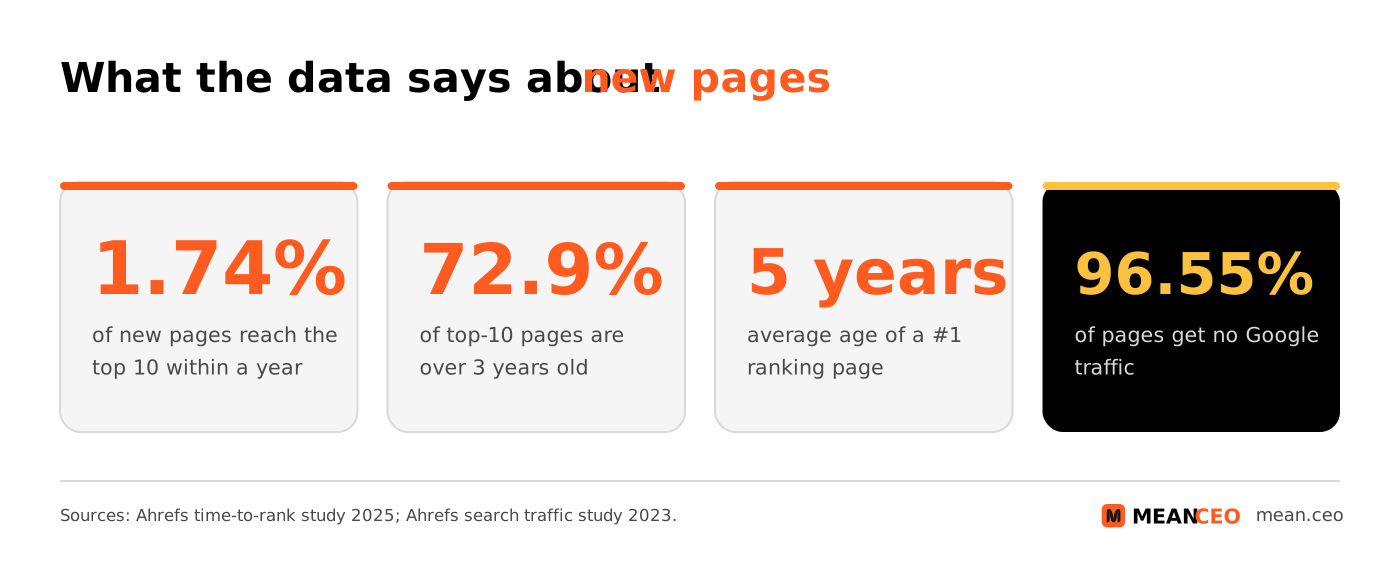
Patience isn’t a cliché here; it’s in the data. In Ahrefs’ 2025 study of how long it takes to rank, only 1.74% of pages first seen in September 2023 reached Google’s top 10 for any keyword within a year, down from 5.7% in its 2017 study. 72.9% of pages in the top 10 were more than three years old, and the average page in position one was five years old. Ahrefs’ 2023 search traffic study found that 96.55% of pages get no traffic from Google at all.
That doesn’t mean a new startup can’t win. Those studies cover every keyword, including the hardest ones. Small sites get their first clicks from specific, low-competition questions, and a site with dozens of pages that each win a little adds up to real traffic.
The Traffic Math Behind 10K Visitors
10,000 visitors a month sounds abstract until you split it into pages. Most pages bring a little traffic and a few bring a lot, so the same total can come from very different sites:
Source: our illustration, not a benchmark. Your own split is in Google Search Console: sort pages by clicks and see how many do the work.
Boost Your SEO by Publishing Informative Articles That Rank.
Online startups looking for backlinks, organic traffic, or press mentions can benefit from optimized content.
👉 Start Now.
Step-By-Step Startup SEO Timeline Explained
Here’s how most startups achieve their first 10K organic visitors, broken into actionable steps you can follow.
Phase 1: Foundation (Months 1-3)
This step lays the groundwork for SEO performance.
- Keyword research: Identify low-competition, high-intent keywords in your niche. Focus on clusters, not individual terms. For niche strategies, check out this guide on niche keyword research.
- Site audit: Fix page speed, titles, meta descriptions, internal linking and structured data. Our technical SEO checklist for startup websites covers what to check first.
- Content plan: Brainstorm 20 to 30 blog topics that cover your keyword clusters. Plan pillar posts and supporting subtopics.
Phase 2: Content Velocity (Months 4-6)
Here’s where publishing consistently becomes non-negotiable. Build topical relevance by prioritizing clusters.
- Publish steadily: Pick a pace you can keep for a year, for most founders one or two well-researched articles a week, all inside your keyword clusters. Make each page as long as the question needs: Google’s guide to creating helpful, reliable, people-first content says it has no preferred word count.
- Internal linking: Link supporting content back to your core pillar posts, and pillars to their subtopics, so search engines see how your pages fit together.
- Optimise based on data: Use Google Search Console to find queries with many impressions but few clicks, then improve those pages’ titles, intros and answers.
Publishing regularly builds trust with readers, but frequency alone isn’t a ranking factor: Google said in 2022 that posting daily, or at any set frequency, doesn’t help you rank. Good posts take time, too: bloggers in Orbit Media’s 2026 survey spent an average of 3 hours 20 minutes writing a post, and the average post ran to about 1,312 words. More on how publishing speed affects SEO in our guide to content velocity.
Phase 3: Build Authority (Months 7-12)
At this stage, your goal is to solidify topical authority and start competing for higher-traffic head terms.
- Backlink outreach: Earn links through partnerships, collaborations, guest posts and data people want to quote. Our list of 15 link-building strategies without a budget has ideas you can start this week.
- Update old content: Refresh older posts with new data, better visuals and clearer answers.
- Keep scaling content: Go after more competitive search terms as your site earns links and trust, and add new clusters next to the ones that already rank.
"SEO is like planting a tree. The roots take months to form, but the shade lasts forever."
Month-by-Month Milestones
Here’s what we’d expect to see at each stage and how to tell whether the plan is working. Treat the numbers in Search Console as your scoreboard, not the calendar.
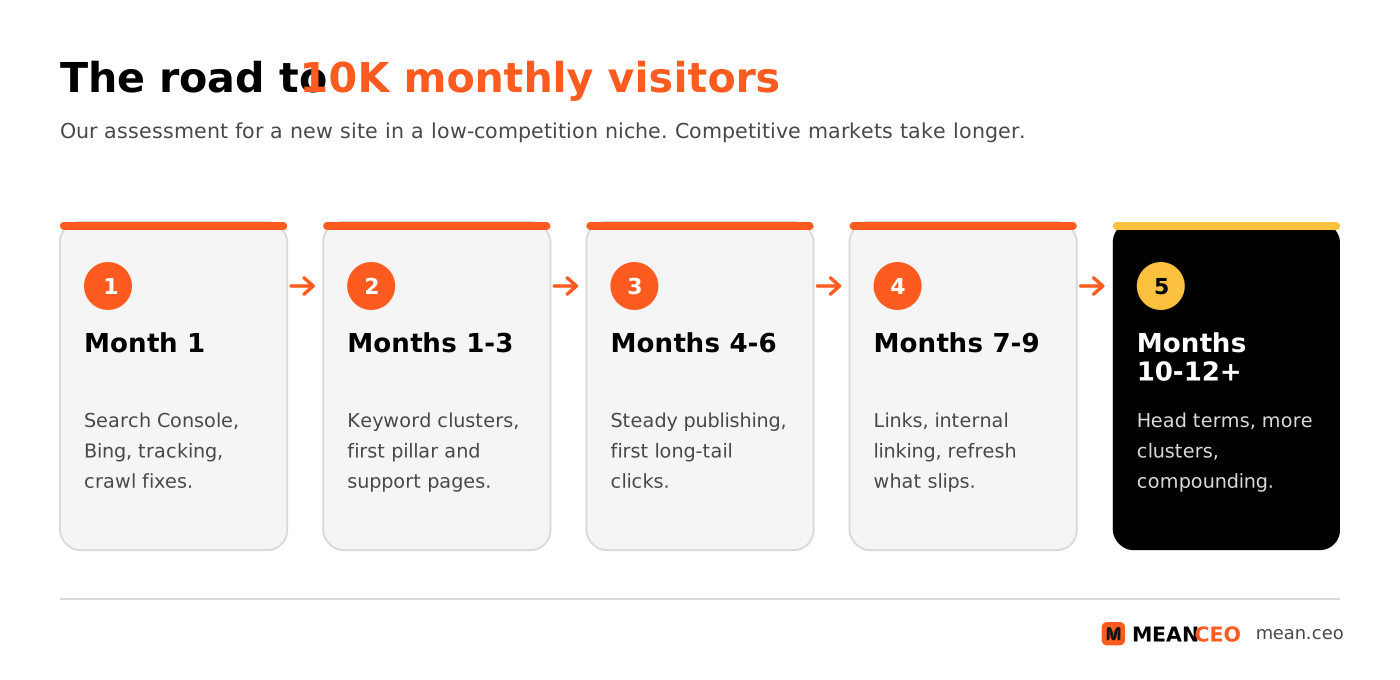
Source: our assessment for a new site in a low-competition niche. Our six-month SEO roadmap for bootstrapped startups turns the first half into weekly tasks.
Rank on ChatGPT with SEO-ready insights.
Optimizing for global search engines is only half the story. Generative engines like ChatGPT are becoming traffic drivers.
👉 Learn More and Adapt Your Strategy
Common Mistakes Founders Make
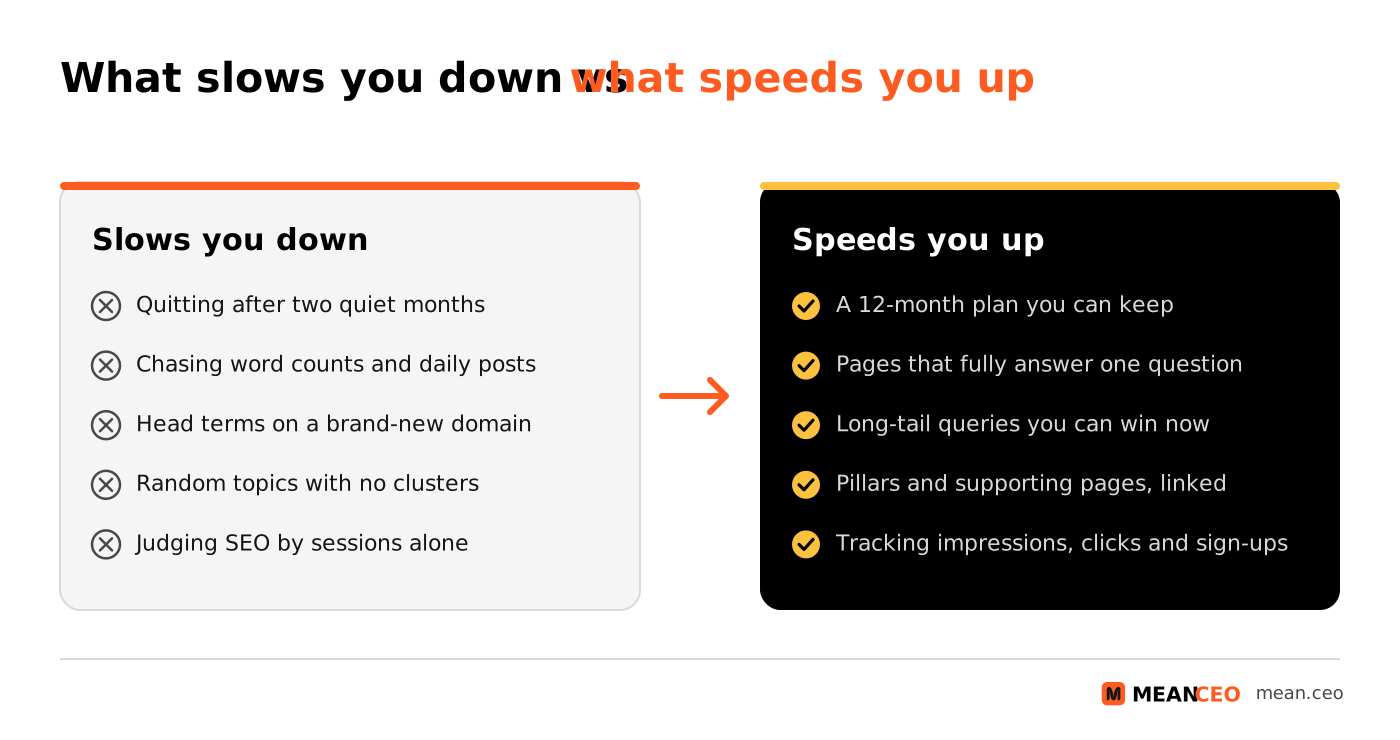
- Underestimating time: Many founders expect results in two months and quit just as their pages start to climb.
- Skipping keyword research: Publishing without targeting the right clusters wastes your best hours.
- Ignoring on-page SEO: Slow pages, vague titles and missing internal links hold back even good content.
- Chasing word counts and daily posts: Neither is a ranking factor. Pages that fully answer one question beat long, padded ones.
- Aiming at head terms too early: A brand-new site rarely ranks for “CRM software”; it can rank for “CRM for Dutch accountants”.
- Measuring only sessions: Track sign-ups and leads from organic search too, or you can’t tell which pages earn their keep.
How to Tell If You’re on Track
Clicks are the last thing to move. Impressions and the number of queries you appear for move first, so watch them every month. Our guide to Google Search Console metrics that matter for startups shows where to click.
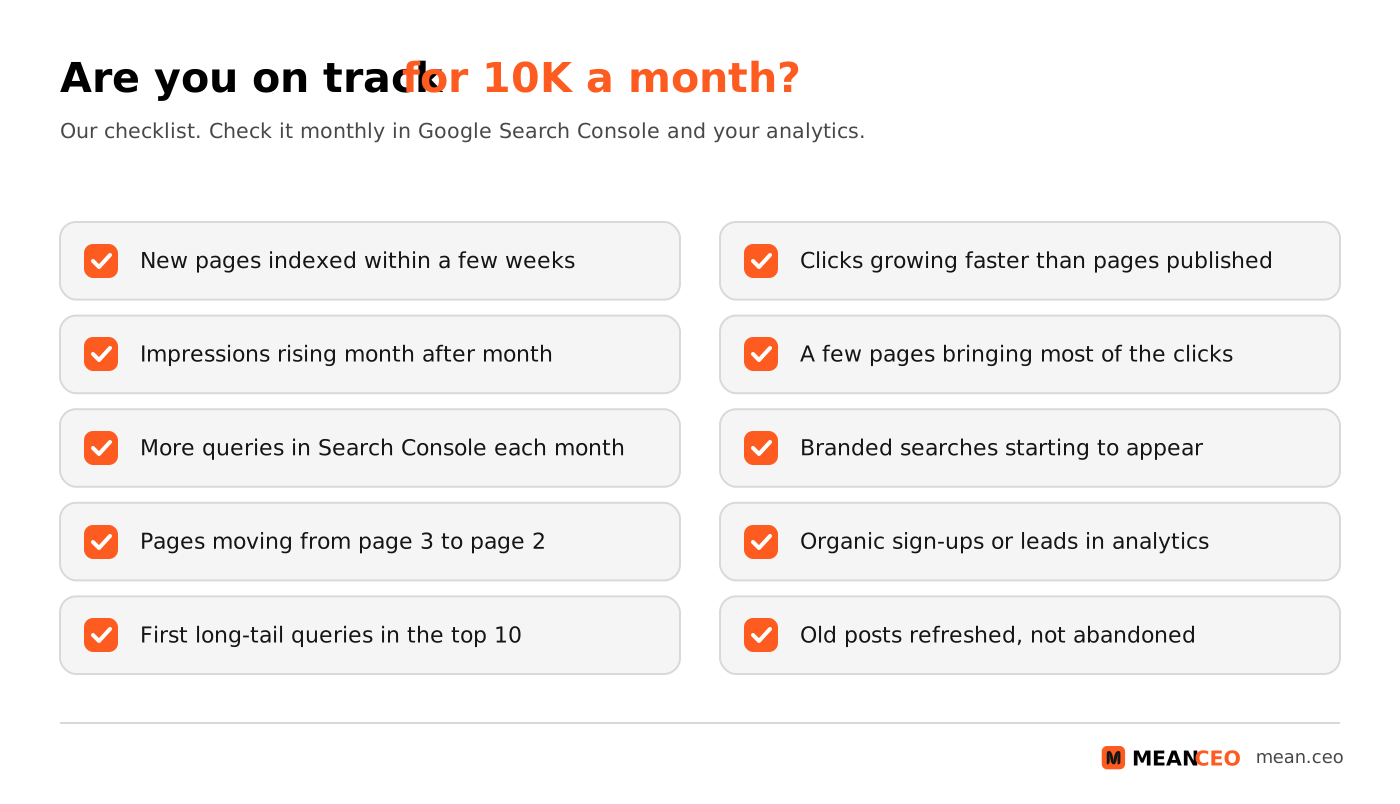
Source: our assessment. New to the numbers? Start with SEO analytics for non-marketers.
What AI Answers Change About the Timeline
AI answers mean some searches end without a click, so impressions in Search Console can grow faster than visits. Google said at I/O in May 2026 that AI Overviews has more than 2.5 billion monthly users. The fix isn’t a separate strategy: Google says there are no extra requirements to appear in AI Overviews or AI Mode, and those appearances are counted in Search Console’s performance report. Answer questions clearly at the top of each section, add first-hand experience and keep tracking sign-ups, not just sessions. For more, see our guide to AI-powered SEO on a startup budget.
Conclusion: Why SEO Wins for Founders in Europe
SEO isn’t optional for bootstrapped startups. It’s sustainable, scalable and cheap per visitor in a continent where paid marketing budgets are tight. By using structured systems such as pillar-cluster models, clear answers that AI assistants can quote and backlink-light tactics, European founders can turn constraints into advantages. Give it 12 months, measure the right signals and keep going when the first months are quiet.
Looking to scale even further or reach 100K organic visitors? Dive into Violetta Bonenkamp’s insights on content marketing strategies, or plan your clusters with our topical authority plan for startup blogs.
People Also Ask:
What is the 80/20 rule of SEO?
The 80/20 rule is the Pareto principle applied to SEO: a small share of your pages usually brings most of your organic traffic. It’s a rule of thumb, not a fixed ratio. Check it in Search Console by sorting pages by clicks, then improve, update and link to those top pages first. For startups with little time, it’s a simple way to decide where effort goes.
Is SEO dead or evolving in 2026?
SEO is evolving in 2026, not dying. People get answers from AI Overviews, AI Mode and chat assistants as well as from blue links, and those answers are built from web pages. Google says the same SEO best practices apply to its AI features, so helpful content, solid technical basics and trustworthy sources matter as much as ever.
What is a good number of website visitors per month?
It depends on what your site sells and how well it converts. For many startups, 5,000 to 10,000 monthly visitors is a useful milestone: enough data to see which topics attract buyers and to test conversion. A niche B2B tool can do well with far fewer visitors if the right people arrive; a media site needs far more.
What are the 3 C’s of SEO?
There’s no official definition, but a common version is content, code and credibility. Content means pages that answer what people search for. Code is the technical side: crawlable pages, titles, speed, mobile layout and structured data. Credibility comes from links, mentions, real authors and accurate facts that make your site worth trusting.
How can female entrepreneurs grow organic traffic for startups?
The same way any founder can: content for a clearly defined niche audience, guest posts on respected sites in that niche, and partnerships that earn links. First-hand experience is an advantage, because it gives you angles and examples generic content can’t copy. Founder communities such as Fe/male Switch also help with feedback, guest posts and links.
How long does it take to go from 0 to 10K monthly organic visitors?
There’s no reliable average, because niche, competition and effort vary so much. For a new site in a low-competition niche, 6 to 12 months of steady work is a realistic plan; competitive markets take longer. Ahrefs found that only 1.74% of new pages reach the top 10 within a year, which is why long-tail topics, internal links and regular refreshes matter so much early on.
What distinguishes startups that bootstrap SEO effectively?
Startups effectively bootstrapping SEO focus on authenticity and iterative growth. They publish high-quality content answering specific queries, optimize for long-tail keywords, and experiment with link-building strategies. Founders often invest personal time in learning SEO fundamentals and use free or affordable tools until revenue justifies scaling.
What role does content play in startup SEO strategies in 2026?
Content remains the backbone of SEO in 2026. Startups do best with niche, evergreen articles that solve specific problems or share first-hand insight; case studies and step-by-step guides work well. Consistency matters for you and your readers: a steady rhythm, such as one strong article a week, builds a library that compounds.
How do women-led startups achieve SEO success without large budgets?
The same way as other bootstrapped startups: free tools such as Search Console, content built on first-hand experience, guest posts and partnerships that earn links, and communities that spread the word. Links from social media posts are usually nofollow, so treat social channels as a way to get your content seen and linked by others, not as a backlink source.
How can AI tools help startups grow organic traffic?
AI tools speed up keyword clustering, content briefs, first drafts, meta tags and reporting. ChatGPT or Claude can help you outline and edit, while Search Console data tells you what to fix. Check every fact and add your own experience before publishing: Google’s spam policies target pages mass-produced with little value for readers.
FAQ on Scaling to 10K Monthly Organic Visitors for Startups
What are the top metrics to track during a startup's SEO campaign?
Track organic traffic growth, keyword rankings, click-through rates, backlink profiles, and user engagement metrics like time on page. Use tools like Google Search Console for granular analysis and aim to optimize content for both ranking improvement and conversion rates over time.
Can SEO strategies improve visibility in AI-generated search results?
Yes. Pages that rank well in search are also the ones AI answers draw from. Google’s guide to AI features in Search says there are no extra requirements or special optimisations to appear in AI Overviews or AI Mode. Answer one question per section, cite sources and keep author details visible. For detailed steps, explore AI-driven search optimizations.
How can startups validate their content’s effectiveness for SEO?
Run hypothesis tests by analyzing impression-to-click ratios, session durations, and bounce rates. Use tools like A/B testing or rapid iteration SOPs discussed in this Rapid Validation guide.
What content formats drive the most backlinks and engagement?
Original research, practical guides, free tools and calculators usually earn the most links, because other writers need something to cite. Visuals, clear headings and a short FAQ help readers. Don’t add FAQ markup expecting extra space in results: Google limited FAQ rich results to well-known government and health sites in August 2023 and stopped showing them for all sites in May 2026.
Why is content velocity critical for startup SEO?
Publishing consistently fills your clusters faster, so Google and readers see you cover a topic in depth. Frequency itself isn’t a ranking factor, though, and Google has no preferred word count. Pick a pace you can keep for a year, such as one or two well-researched posts a week, and refresh your best posts as facts change.
What role does internal linking play in driving SEO results?
Internal linking connects thematic content clusters, improving crawlability and contextual relevance for search engines. Link subtopics to pillar pages and vice versa to establish site hierarchy and user navigation efficiency.
How can startups without technical SEO expertise get started?
Use platform-based SEO-friendly tools like Yoast for WordPress or AI-powered platforms to handle technical gaps. Focus initially on proper meta descriptions, schema markup, site speed, and clean URLs to establish a foundational SEO setup.
Why should startups adopt semantic search practices in today's SEO?
Semantic search means search engines read the meaning and intent of a query, not just its words; Google’s BERT update in 2019 was one big step. AI assistants work the same way. Structured, interlinked topic clusters that cover related questions in plain language fit how both read pages. Explore more on semantic search advantages.
What SEO tools should be in a startup’s arsenal?
Start free: Google Search Console, Bing Webmaster Tools and Google Analytics cover indexing, queries and conversions. Add Ahrefs or Semrush for backlink and competitor research, and a content tool such as Surfer SEO, once the free data stops answering your questions. See our guide to writing SEO content that converts for how to use the data.
How does zero-backlink SEO work for resource-strapped startups?
Zero-backlink SEO leverages internal links, semantic content clustering, and detailed on-page optimizations. This approach minimizes dependency on external outreach. Target long-tail, low-competition keywords first to build initial rankings organically.
About the Author
Violetta Bonenkamp, also known as MeanCEO, is an experienced startup founder with an impressive educational background including an MBA and four other higher education degrees. She has over 20 years of work experience across multiple countries, including 5 years as a solopreneur and serial entrepreneur. Throughout her startup experience she has applied for multiple startup grants at the EU level, in the Netherlands and Malta, and her startups received quite a few of those. She’s been living, studying and working in many countries around the globe and her extensive multicultural experience has influenced her immensely.
