MVP testing for products aimed at women: what to test, how to test it and what generic guides miss
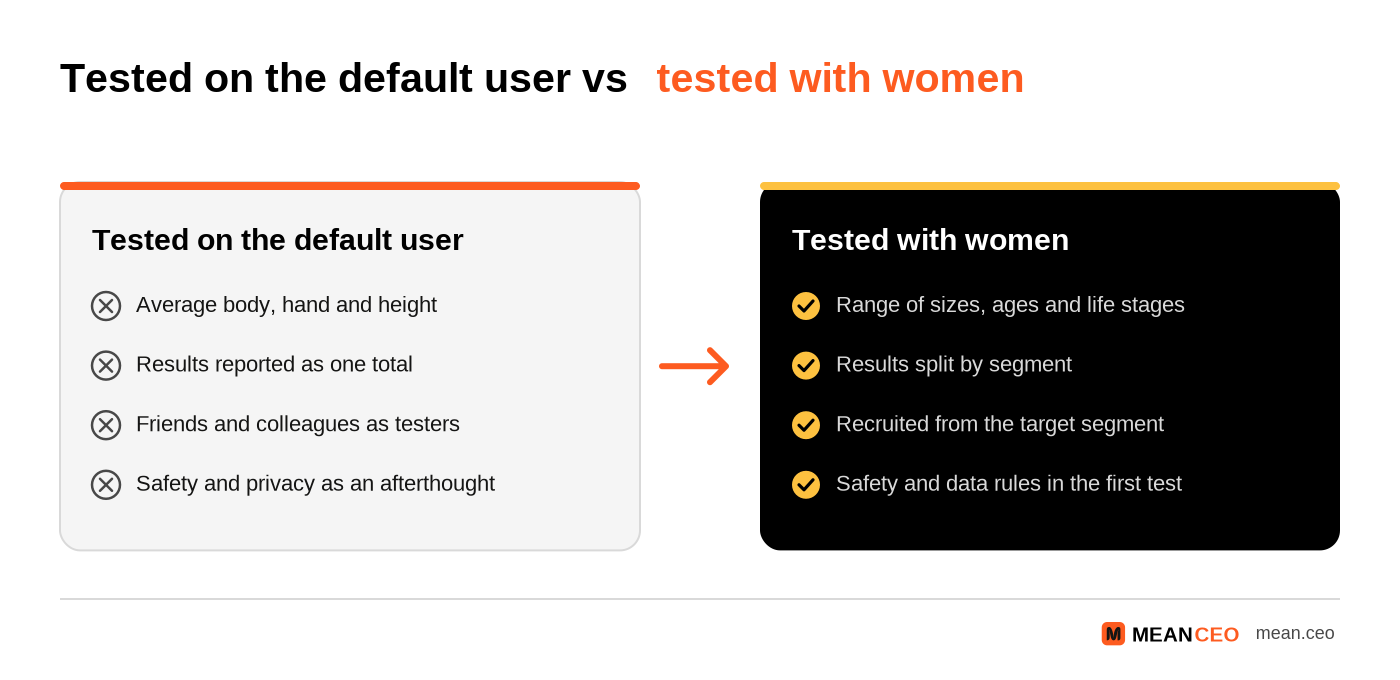
MVP testing means putting the smallest version of your product in front of real customers to check your riskiest assumption before you spend more on building. When the customers are women, there is a second job: making sure the product was tested on women at all. Many products were designed and tested around an average man, and the gaps only show up after launch.
Quick answer: write down the one assumption that would kill the business if it were wrong, pick the cheapest test that checks it (a landing page, a pre-order, a concierge service done by hand), recruit testers from your real segment across a range of ages, sizes and situations, set the success threshold before you start, and split the results by segment so an average doesn't hide the people the product fails.
Chat with your AI friend PlayPal, and experience a whole new level of companionship! Discover fun conversations, advice, and endless support—all at your fingertips! Chat with PlayPal NOW!
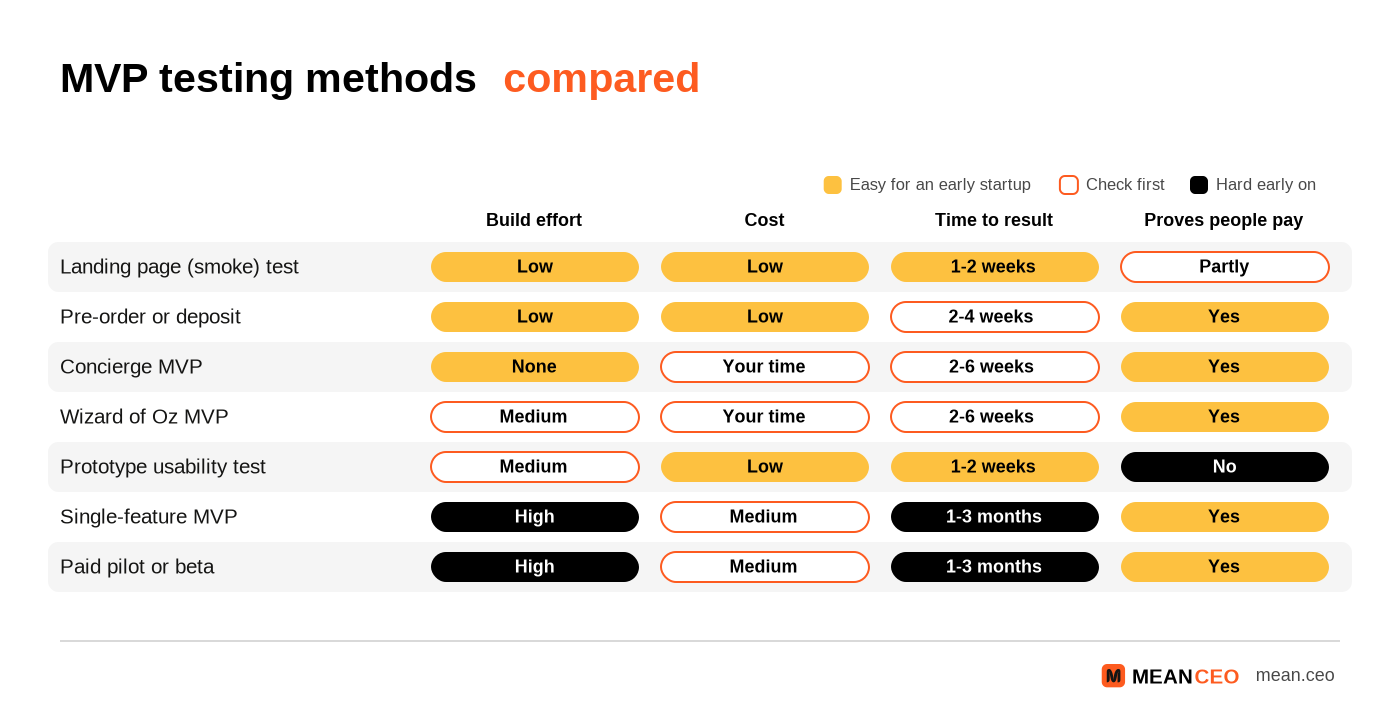
7 MVP test types and when to use each
You don't need a finished app to test an MVP. Most early tests need a page, a spreadsheet or your own time. Choose by what you need to learn, not by what you'd enjoy building.
Source: Mean CEO comparison for early-stage founders. For what to build once a test works, see our guides to the minimum viable product and building an MVP on a bootstrap budget.
Why products for women need their own tests: the gender data gap
The gender data gap is what happens when products, standards and data are built around a default user who turns out to be a man. Two well-documented examples:
- Cars. Researchers at the University of Virginia found that belted women have 73% greater odds of serious injury in frontal crashes than belted men, after controlling for crash severity, age, height, weight and car model year. Crash-test dummies have long been modelled on an average male body.
- Offices. A 2015 study in Nature Climate Change found that indoor climate standards use a metabolic rate based on an average man and may overestimate women's metabolic rate by up to 35%, which is one reason many offices feel too cold for women.
Neither problem came from bad intentions. They came from testing on whoever was available. A startup MVP test that recruits from the founder's network repeats the same mistake on a smaller scale.
How to run MVP testing in 6 steps
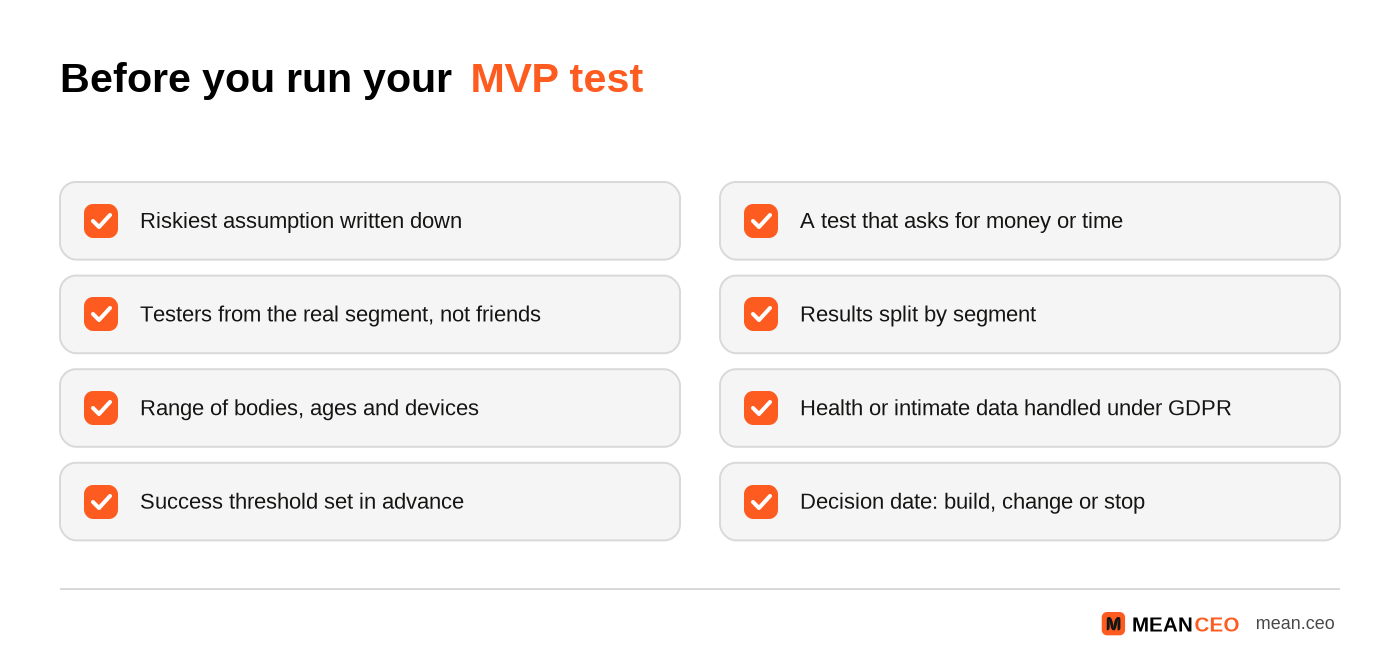
- Write down your riskiest assumption. Not "women will like it" but "new mothers returning to work will pay €15 a month for meal plans they can cook in 20 minutes". If this is wrong, nothing else matters.
- Recruit from the real segment. Find testers where your customers already are: communities, local groups, forums, people who complained about the problem online. Aim for a spread of ages, sizes, incomes and situations inside the segment, not just people like you.
- Pick the cheapest test that answers the question. Use the table above. If the risk is demand, a landing page or pre-order is enough; if it's usability or fit, you need a prototype in their hands.
- Set the success threshold first. Write the number that counts as a pass, for example "20 deposits from 400 targeted visitors" or "7 of 10 testers finish setup without help", before anyone sees the test.
- Run it and watch behaviour. What people do beats what they say. Record where they stop, what they ask, and what they try to do that the product doesn't allow. Our guide to customer feedback systems shows how to keep collecting this after launch.
- Decide: build, change or stop. Compare the result with your threshold, not with your hopes. A pass means build the next piece; a near miss means change one thing and test again; a clear fail is cheap knowledge.
Copy this plan into a document before each test:
Illustrative example, not a real company. For the evidence investors accept from tests like this, see our guide to market testing for startups; to turn sign-ups into buyers, see building a waitlist that converts.
What generic MVP guides miss when the customer is a woman
- Split the results. If your audience is mixed, report results by gender and by segment. An overall 60% success rate can hide a product that works for 80% of men and 35% of women.
- Test the body, not the average. For anything worn, held, carried or sat in, test across a range of sizes and strengths. A product that fits the middle of the range fails at both ends.
- Handle intimate data properly from the first test. Health data and data about a person's sex life are special-category data under Article 9 of the GDPR. Period, fertility and pregnancy features need explicit consent and minimal collection, even in a prototype.
- Design for safety. Location sharing, public profiles and messaging can expose users to stalking or harassment. Ask testers how they'd feel if an ex-partner or stranger saw the data.
- Test in the real context. Run tests where and when the product will be used, not only in a quiet room. Usage on the commute, at night or with interruptions is different from a calm demo.
- Check who buys. The user isn't always the payer: employers, insurers, partners or parents may buy. Test the payer's decision too.
MVP examples for women's products
Three illustrative examples of the cheapest useful test for different ideas. They are not real companies; they show how to match the test to the risk.
Before any of these, check that the problem itself is real with our guide on how to validate a startup idea. If you need a no-code build for the test, our sister sites compare options in building an MVP without code and a no-code MVP builder comparison.
MVP testing mistakes to avoid
- Testing on friends. They are polite and they aren't your segment. Their praise is the most expensive feedback you'll get.
- Counting likes and compliments. A test that asks for nothing proves nothing. Ask for an email, a deposit or an hour of their time.
- Building too much first. If a landing page or a manual service can answer the question, a coded app is waste.
- Changing the threshold afterwards. If 12 deposits was a fail before the test, it's a fail after it.
- Designing for an imagined woman. "Women want it pink and simple" is a guess, not a finding. Let testers tell you what they need.
- Stopping after one test. Passing a demand test doesn't mean the product works. Test demand, then use, then product-market fit.
Dreaming of startup success but too scared to get started?
Join the Fe/male Switch women-first startup game and turn that dream into your reality. With tailored guidance, support networks, and a plethora of resources, we'll nurture your ascent to the startup stratosphere! And we have AI co-founders, PlayPals!
Join F/MS now.
FAQ on MVP testing
What is MVP testing?
Putting the smallest version of your product in front of real customers to check your riskiest assumption, usually demand, usability or willingness to pay, before you invest more in building.
How do you test an MVP?
Write the assumption, pick the cheapest test that checks it (landing page, pre-order, concierge, Wizard of Oz, prototype, single feature or pilot), recruit testers from your real segment, set a pass mark first, run the test and decide to build, change or stop.
How many people do I need to test an MVP?
For usability tests, small groups of 5 to 10 people per segment find most problems. For demand tests such as landing pages and pre-orders you need a few hundred targeted visitors to see a reliable sign-up or order rate.
What is the gender data gap?
The gap between how products, standards and data treat men and women, because they were built or tested around a default user who was a man. Crash-test dummies and office temperature standards are well-documented examples.
How do I recruit women to test my MVP?
Go where your segment already is: communities, clubs, forums, professional groups and people who complained about the problem online. Offer a small thank-you, explain how you'll use their data, and avoid relying on friends and family.
What are some MVP examples?
A landing page with a pre-order button, a service delivered by hand before any software exists, a front end where the founder does the work behind the scenes, a clickable prototype, or a single working feature offered to a small paying group.
Should an MVP for women be designed differently?
It should be tested differently: with women from the segment, across a range of bodies and situations, with results split by segment and with careful handling of health and safety data. The design should follow what those tests show, not stereotypes.
When is MVP testing finished?
When a test meets the pass mark you set in advance and the next risk is a different one. Then you move from testing demand to testing use, retention and finally product-market fit.
About the Author
Violetta Bonenkamp, also known as MeanCEO, is an experienced startup founder with an impressive educational background including an MBA and four other higher education degrees. She has over 20 years of work experience across multiple countries, including 5 years as a solopreneur and serial entrepreneur.
