
TL;DR: What changed at Stripe?
On 19 November 2026 Stripe gave AI agents write access to Stripe Treasury. Agents you connect through Stripe's MCP server, such as Claude or Codex, can now transfer funds, convert currencies and pay vendors within limits you set. It is a public preview. By default a human still approves every refund, payout and outbound transfer an agent starts, but with an agent API key you can let small payments through on their own. The catch for Europe: Treasury itself is only in private preview in 21 European countries, so most EU founders can't use the money-moving part yet. Start with read-only reports, and set up approvals now.
For two years, AI agents in finance have mostly read things: dashboards, invoices, bank exports. Stripe now lets them act. An agent can top up an account, convert euros to dollars and prepare a supplier payment without a human typing anything.
Here is what Stripe launched, how the controls work, where it's available, and what a bootstrapped founder in Europe should do with it this month.
What happened
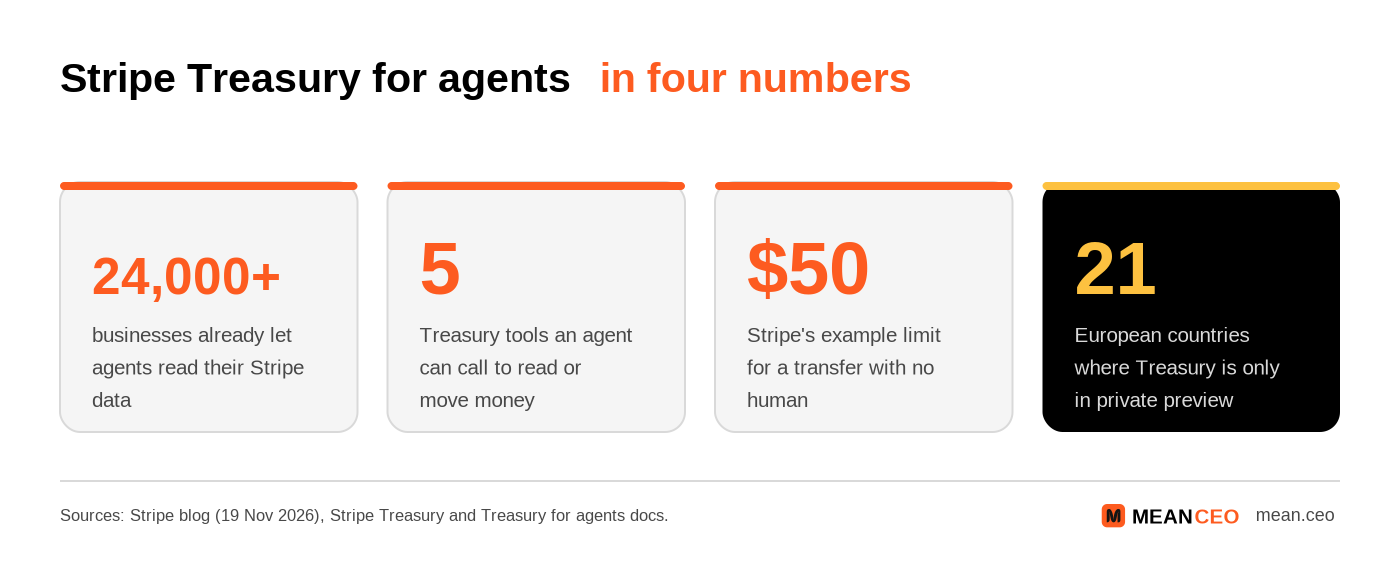
On 19 November 2026, Stripe announced that agents can now move money on Stripe, in a blog post by Meredith Neyrand, product manager for Stripe Treasury. More than 24,000 businesses already used Treasury for agents with read access, for jobs like reviewing transactions, building cash flow models and reconciling payments. The new part is write access with controls you set: agents can transfer funds, convert currencies and pay vendors.
Stripe's own line sums up the shift: agents "don't just analyze your business, but also help run it." Its examples are a payables agent that watches balances, keeps the bill-pay account topped up and prepares vendor payments, and a payroll agent that converts currencies so staff get paid on time.
You connect a compatible AI tool through Stripe's Model Context Protocol (MCP) server and choose three things: what Stripe data the agent can see, which actions it can take and when a human has to approve. The Treasury for agents documentation lists Cursor, Claude Code, Claude Desktop, Codex, ChatGPT and VS Code as supported clients. The feature is in public preview. Stripe says the next step is letting agents create cards with spending limits.
These are the Treasury tools an agent can call, with the permission each one needs:
Source: Stripe Treasury for agents docs, read 22 November 2026. All five are marked public preview.
How the controls work
Stripe offers two ways to connect an agent, and the difference matters more than the launch itself.
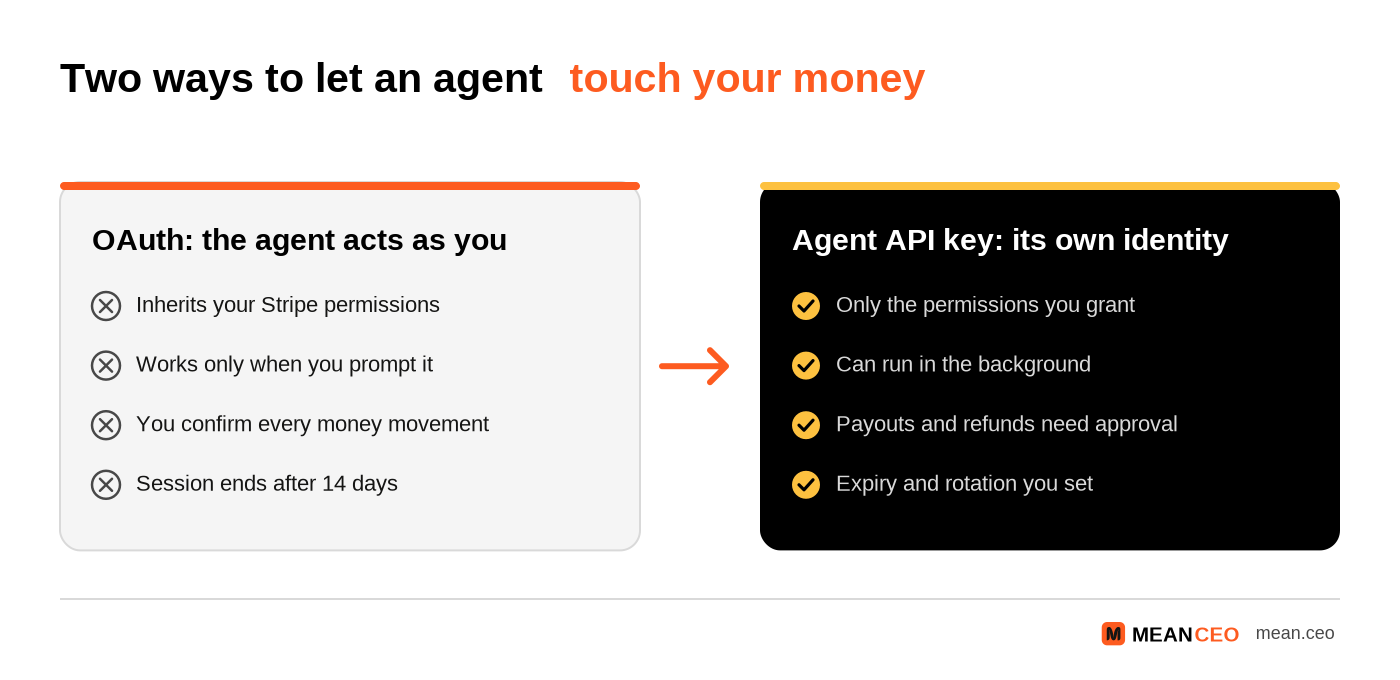
- Through your user account (OAuth). The agent acts as an extension of you and inherits your permissions. You confirm every action that moves money, including a refund or a payout. The docs add that OAuth refresh tokens expire after 14 days, so you reconnect at least every two weeks.
- With its own agent API key. The agent gets its own identity and persistent access. You set the key's permissions, expiry date and rotation schedule, and it can work in the background, for example preparing reports overnight.
For agent keys, Stripe's default is that refunds, payouts and outbound transfers started by an agent need human approval. You can change those rules. Stripe's example: an agent sends an ACH transfer under $50 automatically and routes anything larger to an approver. You can also add approval rules for other risky actions, such as adding or removing an account administrator or changing a bank account.
Stripe's API keys documentation explains the design. Agent-tagged keys are restricted keys that are automatically subject to approval rules, where a designated reviewer approves sensitive actions before they take effect. Stripe calls them the recommended way to give autonomous agents access, and describes the rules as a safeguard against agent mistakes, unexpected behaviour and hallucinations.
That warning about leaked keys is not theoretical. This month we covered how Claude Code's "don't ask again" option saved secrets into a settings file and how one AI vendor's leaked key exposed Cursor, Notion and Uber. A Stripe key that can send money is a bigger prize than either. Keep it in a secrets vault, never in your code, and limit it to your own servers, as Stripe's key docs advise.
Where you can use it in Europe
Agents can only move money that sits in Stripe Treasury, and the Treasury documentation shows where Treasury is open. It is available in the United States and the United Kingdom. In Europe it is in private preview, which means you have to request access, for businesses in 21 countries:
The 21 European countries are Austria, Belgium, Bulgaria, Croatia, Cyprus, Estonia, Finland, France, Germany, Greece, Ireland, Italy, Latvia, Lithuania, Luxembourg, Malta, the Netherlands, Portugal, Slovakia, Slovenia and Spain. That is exactly the euro area. EU members with their own currency are not on the list, and neither are Switzerland and Norway. Stripe gives no date for wider access.
Some details also differ by country. The docs say account structures outside the US can differ, FDIC deposit insurance applies only to US balances, and a Treasury financial account has no monthly fee or minimum balance. A financial account can hold USD, EUR and GBP.
What this means for you
Most bootstrapped founders in Europe can't switch on the paying part yet. The useful move is to get the boring parts right now, so you are ready when it opens, and to decide which money jobs you would actually hand to a machine.
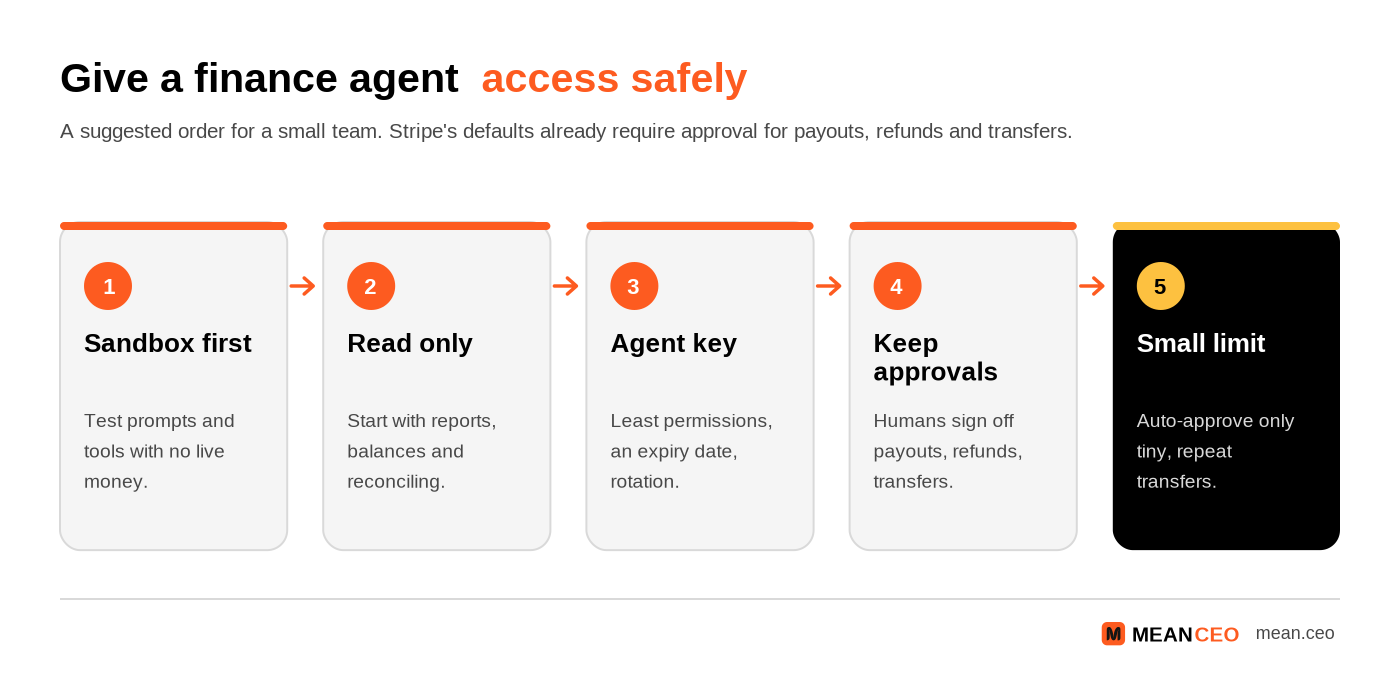
- Start with read-only jobs. Daily cash reports, matching payouts to invoices and spotting late payers are safe wins. Our guide to bookkeeping basics for founders lists the routines worth automating first.
- Write your approval rules before you need them. Decide who approves payouts, refunds and new recipients, and who is the backup when you're on holiday. If you are the only founder, a trusted accountant can be the second pair of eyes.
- Use an agent key, not your own login, for anything automatic. Give it only the tools the job needs, an expiry date and a rotation schedule. Never auto-approve new recipients or bank account changes: that is how invoice fraud works.
- Keep the auto-limit tiny. Stripe's example is $50. Start lower, watch a month of activity, then decide. Our cash flow guide for first-year founders shows how much buffer a small company should keep before automating anything.
- Plan currency jobs carefully. Paying contractors abroad is the obvious use for an agent that converts currencies. Read our explainer on cross-border payments to international freelancers before you let software pick the timing.
- Watch the AI money stack, not just Stripe. Anthropic now lets your customers pay for Claude in your app from their own accounts, and agent tools change monthly. We track it in our Stripe news for November 2026 and AI agents news for November 2026.
Here is a short list to run before any agent touches real money:
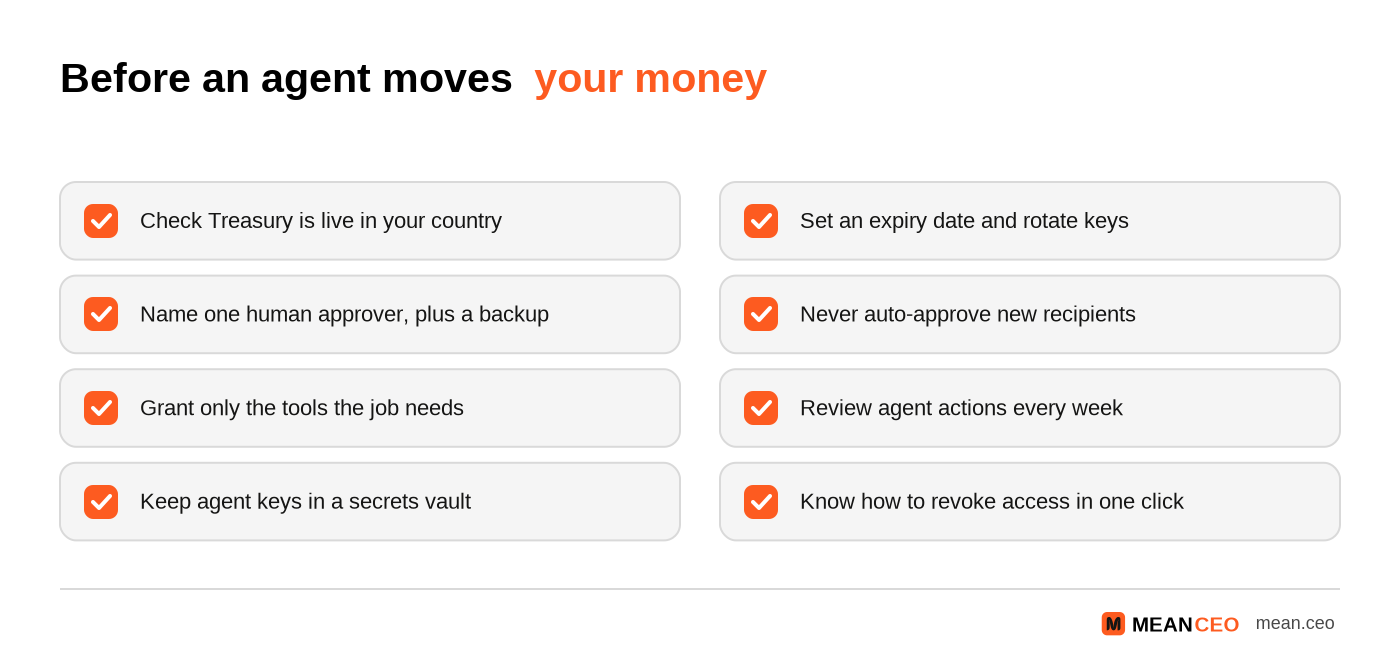
Revoking is easy to forget. The docs show that you can see every authorised MCP client under OAuth sessions in your user settings and revoke it there, and an administrator can switch MCP access off for the whole team, separately for live mode and the sandbox.
My take: this is the right way to launch money-moving agents. Approvals are on by default, limits are explicit, and agents get their own keys instead of borrowing yours. But a solo founder does not need an agent to pay three invoices a month. The real value today is the read side: a clear daily picture of cash. Let the agent count your money for a quarter before you let it spend any. And if you're in the euro area, request Treasury access now: a private preview only lets in the businesses that ask.
Are you getting customers from AI search yet?
More and more traffic is coming from Perplexity, ChatGPT, Grok and other AI tools.
👉 Rank on ChatGPT
FAQ: Stripe Treasury for agents
What did Stripe launch on 19 November 2026?
Write access for AI agents in Stripe Treasury. Agents connected through Stripe's MCP server can transfer funds, convert currencies and pay vendors within limits you set. Before this, more than 24,000 businesses used Treasury for agents with read access only. The new features are in public preview.
Which AI tools can connect to it?
Stripe's docs list Cursor, Claude Code, Claude Desktop, Codex, ChatGPT and VS Code, plus other MCP clients set up manually. Stripe's blog names Claude and Codex as examples.
Can an agent pay someone without my approval?
Not by default. With OAuth you confirm every action that moves money. With an agent API key, refunds, payouts and outbound transfers need human approval unless you change the rules, for example to let ACH transfers under $50 go through automatically.
Is Stripe Treasury available in the EU?
Only in private preview, on request, for businesses in 21 euro-area countries. It is available in the US and the UK. EU countries with their own currency, such as Poland and Sweden, are not on Stripe's list.
What is the difference between OAuth and an agent API key?
With OAuth the agent acts as you, inherits your permissions and works when you prompt it; the session lasts at most 14 days. An agent API key gives the agent its own identity with the permissions, expiry date and rotation schedule you set, and it can work in the background.
What should a small startup automate first?
Read-only jobs: daily cash reports, reconciling payouts with invoices and flagging late payers. Leave new recipients, bank account changes and large transfers to a human, and keep any automatic limit very small.
About the Author
Violetta Bonenkamp, also known as MeanCEO, is an experienced startup founder with an impressive educational background including an MBA and four other higher education degrees. She has over 20 years of work experience across multiple countries, including 5 years as a solopreneur and serial entrepreneur. Throughout her startup experience she has applied for multiple startup grants at the EU level, in the Netherlands and Malta, and her startups received quite a few of those. She’s been living, studying and working in many countries around the globe and her extensive multicultural experience has influenced her immensely.
