TL;DR: What happened at Fireworks AI, and why should founders care?
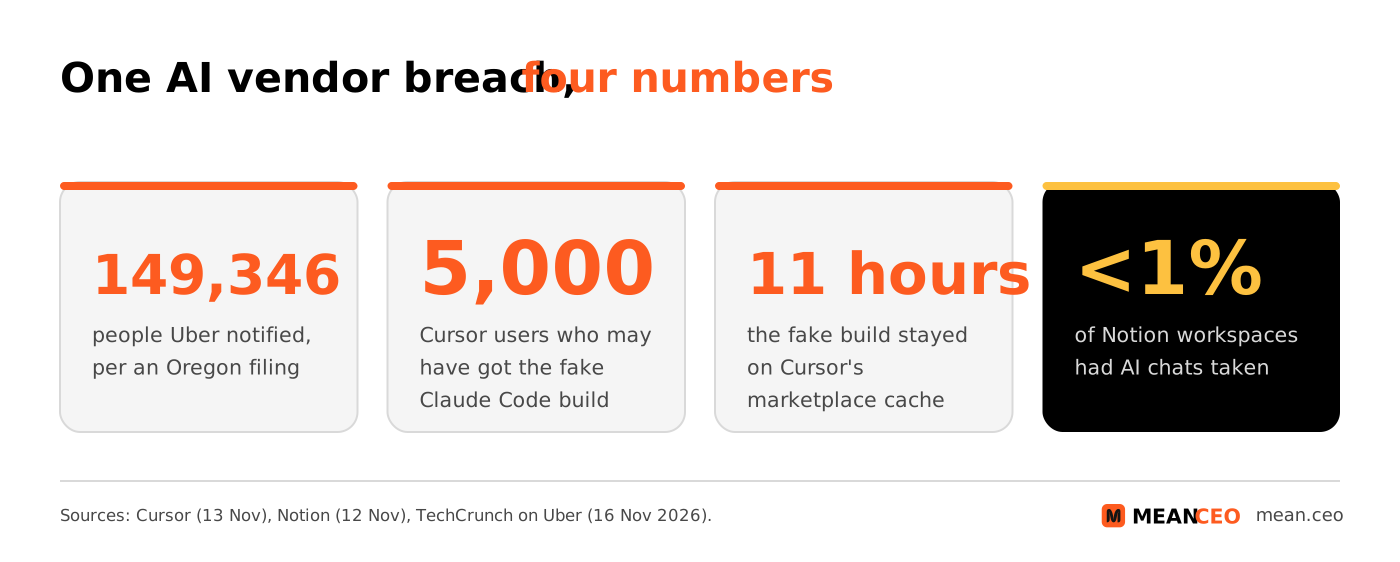
Fireworks AI, a company that runs open-weight AI models for other businesses, was breached in October 2026. The damage has spread since. On 13 November Cursor said a key it had given Fireworks let the attacker into its own tools, and that this is how the fake Claude Code extension reached Cursor users on 29 October. Notion says AI chat transcripts from fewer than 1% of its workspaces were taken, and Uber has notified 149,346 people, according to TechCrunch. If you use any of these tools, rotate every key you ever pasted into an AI chat or a support ticket, and check which AI vendors your vendors use.
You never signed a contract with Fireworks AI. Your data may have been there anyway.
That's the lesson of the last two weeks. Fireworks sells AI inference: it runs open-weight models for companies that don't want to run their own GPUs. Cursor, Notion and Uber used it. When attackers got into Fireworks, they didn't stop there. They used what they found to reach its customers, and in Cursor's case its customers' customers. Here's what each company has confirmed, how one leaked key turned into a fake extension on developers' laptops, and what to do about it if you build with AI tools.
What happened at Fireworks AI
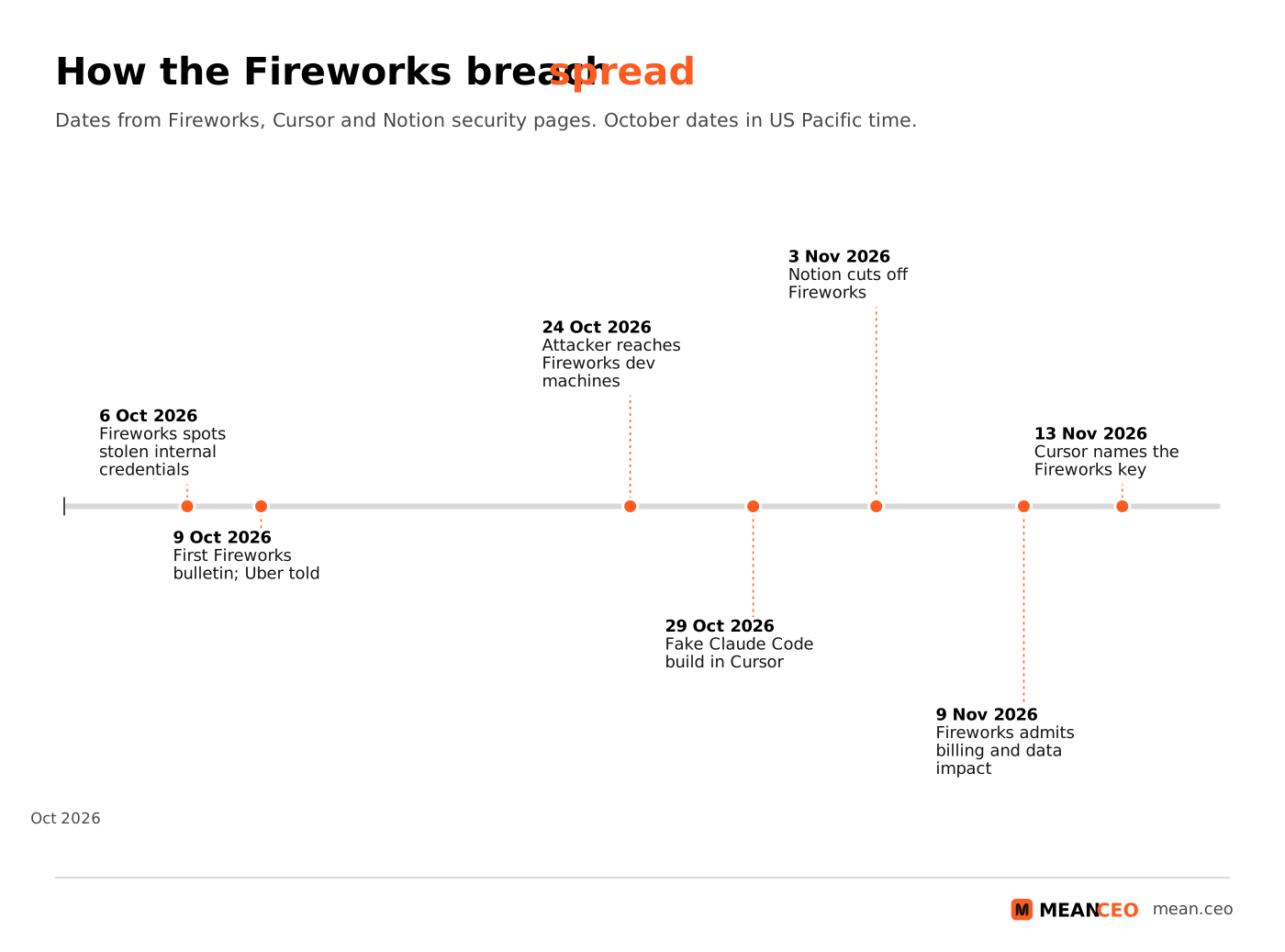
The first sign came in early October. In its first security bulletin of 9 October 2026, Fireworks said it spotted the activity on 6 October and that the incident involved "unauthorized use of internal Fireworks credentials". In some customer accounts, the attacker captured environment variables used in evaluation jobs, including API keys and tokens that customers had stored as secrets. Fireworks revoked its own keys and told customers to rotate the rest at the source, because "removing a stored secret alone does not invalidate the underlying credential."
Then it got worse. In an update last revised on 9 November, Fireworks said a third-party cloud provider that hosted its research machines had its own security incident on 23 October. On 24 October the attacker used that to reach Fireworks development machines and run a workload that hit more customer data. Fireworks says it detected this the same day.
The update lists what was taken: resource metadata, billing details such as addresses, invoice history, balances and credit usage, and, for a limited set of accounts, more secrets, datasets and incomplete model weights. Fireworks says its inference service, Training SDK and Nexus show no detected impact, and that it never stored card numbers. It hasn't said how many customers were hit. It has called in Palo Alto Networks' Unit 42 and law enforcement, and it links the attack to a financially motivated group that sells stolen AI access through illegal routing services.
That business has a name: LLMJacking. In a report published on 2 November, Google's threat intelligence team and Mandiant described attackers who steal cloud and AI keys and resell the model access. In some cases, victims saw more than $100,000 in fraudulent charges in a single day, and up to $1 million in total before the access was cut. Google's report doesn't mention Fireworks, but it describes the same kind of business Fireworks blames. Platforms are starting to fence keys in: Shopify now requires every public app to limit its API tokens to an IP allowlist by 20 November 2026, so a stolen token fails from anywhere else.
Cursor: the missing piece of the fake Claude Code story
On 1 November we reported on the tampered Claude Code extension that Cursor served for about 11 hours on 29 October. At the time, nobody said how the attacker got in. Cursor's update of 13 November closes that gap.
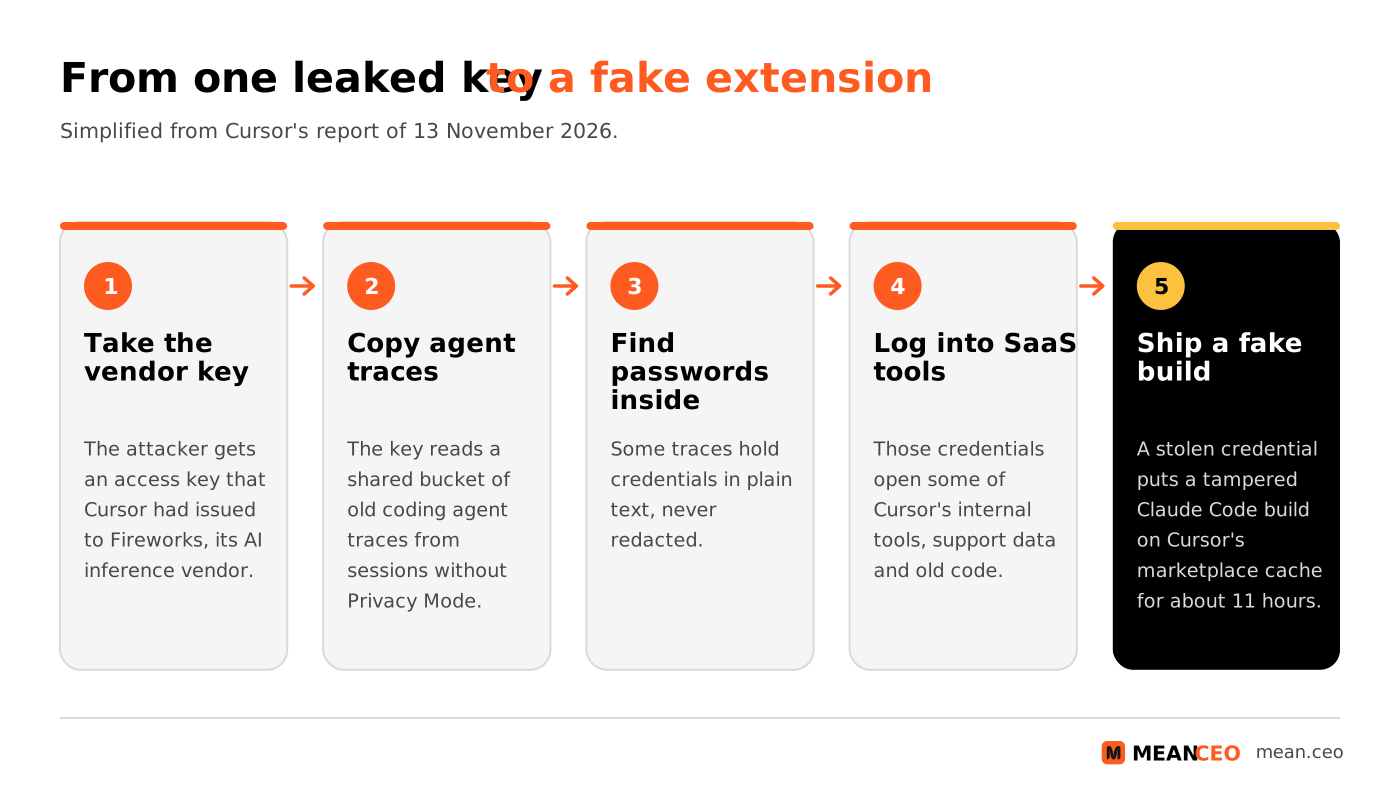
According to Cursor, the attacker got hold of an access key that Cursor had issued to Fireworks, which Fireworks exposed. That key read a storage bucket Cursor used to share data with Fireworks. Inside were limited coding agent traces, mostly from 2025, from "sessions not in Privacy Mode, which we were permitted to use for model training." Some traces held credentials that had never been redacted. With those, the attacker got into some of the SaaS tools Cursor uses, and with "a stolen credential" from that data placed the fake build "directly on the cache used to serve the Cursor VS Code extension marketplace."
Cursor says the exposed data included archived, non-production code repositories, some support emails, usage metrics and contact details, summaries of some agent conversations, and credentials users had sent to Cursor support. Fewer than 0.01% of customers had API credentials exposed, and traces were exposed for fewer than 0.05% of users who weren't in Privacy Mode. "The last attacker activity we have seen was on November 1, and it was blocked," Cursor writes. It has moved all inference traffic off Fireworks.
Two points from the report matter if you use Claude Code in Cursor. First, "Anthropic did not publish this copy, and this was not a vulnerability in Anthropic's product." Second, if you installed version 2.1.312 or 2.1.313 from Cursor's marketplace that day, "Uninstalling the extension alone may not be enough." Follow Cursor's original cleanup steps, which we summarised in our first post. Cursor says users whose traces were exposed have been told directly, and that if you got no notice, your data wasn't in them.
Notion and Uber: the same vendor, different data
Notion's security advisory of 12 November says Fireworks first told it on 2 November that a small set of data had been accessed. Notion cut Fireworks off on 3 November and deleted its data there the next day. By 8 November the final dataset was confirmed: Notion AI chat transcripts used for its Insights feature, from fewer than 1% of workspaces. Most couldn't be tied to a user or company, but some messages contained Notion API keys and keys for other services. Notion revoked its own keys, reported the others to the companies that issued them, and switched Insights off. Its advice: "treat this data as if it were exposed."
Uber's case is about people, not code. TechCrunch reported on 16 November that Uber notified 149,346 people, according to a filing with Oregon's attorney general, after names, addresses, dates of birth and driver's licence numbers were taken. Uber said Fireworks told it on 9 October that hackers had stolen internal credentials used to access Uber's data. Because those were Fireworks' own credentials, Uber told TechCrunch, "no alerts were triggered." The notices TechCrunch cites are all in the United States.
Sources: Fireworks bulletins of 9 October and 9 November, Cursor's update of 13 November, Notion's advisory of 12 November and TechCrunch's report on Uber of 16 November 2026.
Why this matters if you build in Europe
Fireworks is a well-known inference provider, and Cursor, Notion and Uber each shared data with it for ordinary business reasons, from model training to AI features. The risk sat one or two steps away from the people whose data it was. A Notion user typing into an AI chat had no reason to know an outside company processed those words. A developer installing an update from Cursor's marketplace had no reason to suspect a password sitting in a 2025 log file.
For you, the same chain runs in both directions. You're a customer of AI tools, so your keys and code can leak through their vendors. And if your product uses an inference provider, you're the Notion in this story: your users' data goes to a company they've never heard of. Under Article 28 of the GDPR (Adopted, in force since 2018), a processor can't bring in another processor without the controller's prior written authorisation, specific or general. In practice, that means your sub-processor list and your data processing agreements should name every AI provider that touches personal data, and your customers should hear from you if one of them is breached.
This also isn't the first chain like this. In October, Railway's breach led to about $740,000 of AI usage on stolen keys. Earlier this month, Claude Code's "don't ask again" option was shown to save passwords into files that ended up on GitHub. The pattern is the same each time: AI keys are worth real money, and they sit in more places than founders think.
What this means for you
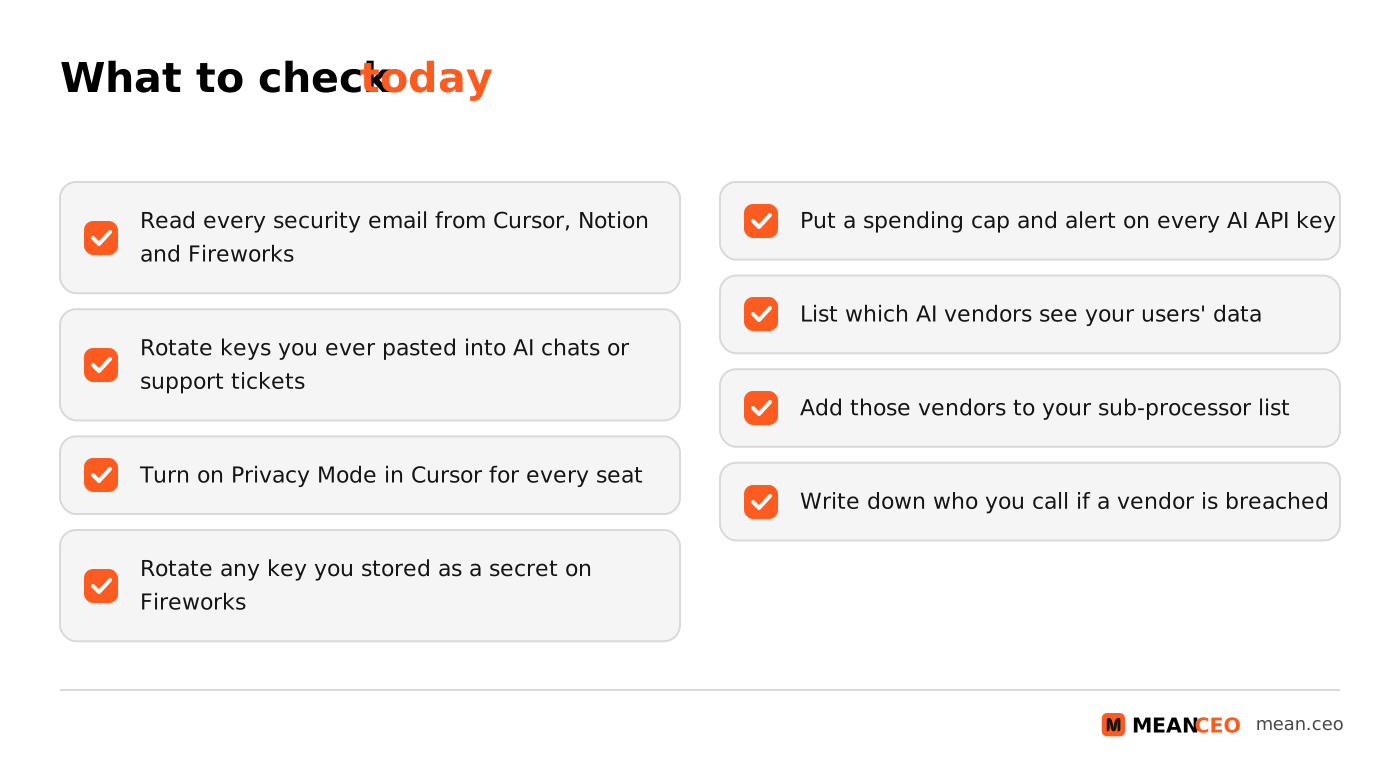
- Read your security emails. Cursor, Notion and Fireworks say they've contacted every affected customer directly. Search your inbox and your team admin's inbox for their notices from October and November.
- Rotate anything you pasted. Any API key, password or token that ever went into an AI chat, a coding agent session or a support ticket should be treated as exposed. Rotate it at the service that issued it, not just where you stored it.
- Turn on Privacy Mode or no-training settings. In this breach, Cursor users with Privacy Mode had no prompts or code exposed. Check it for every seat on your team, not just your own.
- Cap your AI spending. Stolen AI keys get resold, so put a monthly budget, an alert and per-key limits on every provider account. Google's LLMJacking report found victims who were billed more than $100,000 in a day.
- Map your AI vendors. List every AI tool and model provider that sees customer data, and the vendors behind them. Our guide on how to evaluate an AI tool has questions to ask before you sign up.
- Write a one-page breach plan. Decide now who rotates keys, who tells customers and who checks whether you must notify a data protection authority. Our guide on building security into a startup is a good place to start.
My take: we spend a lot of time picking the right AI model and very little asking where our data goes after it leaves the chat box. This breach didn't need a clever exploit at Cursor, Notion or Uber. It needed one vendor with weak credentials and a few old logs full of passwords. As a bootstrapper, you can't audit Fireworks. You can keep secrets out of chats, turn on the privacy settings you already pay for, cap your bills and know your vendor chain. That's boring work, and it's what kept most customers safe this time. For the rest of this month's security news, see our cybersecurity news for November 2026.
Are you getting customers from AI search yet?
More and more traffic is coming from Perplexity, ChatGPT, Grok and other AI tools.
👉 Rank on ChatGPT
FAQ: the Fireworks AI breach, Cursor, Notion and Uber
What is Fireworks AI?
Fireworks AI is an inference provider. It runs open-weight AI models for companies that use them in their products or tools, so those companies don't need their own GPUs. Cursor, Notion and Uber were among its customers.
Was the fake Claude Code extension caused by the Fireworks breach?
Yes, according to Cursor. Its 13 November update says the attacker used a key Cursor had issued to Fireworks, found credentials in old agent traces, and used a stolen credential to place the tampered build on Cursor's marketplace cache. Cursor says it wasn't a vulnerability in Anthropic's product. Our first report on the backdoored extension has the cleanup steps.
Was my Cursor data exposed?
Cursor says it has notified every affected user directly, and that if you didn't get a notice, your data wasn't in the exposed traces. Prompts and code from users with Privacy Mode turned on weren't exposed.
What did the hackers take from Notion?
Notion AI chat transcripts used for its Insights feature, from fewer than 1% of workspaces. Some messages contained API keys. Notion says most transcripts couldn't be linked to a user or company, and that affected customers should treat the data as exposed.
Is this a GDPR issue for my startup?
It can be. If your product sends personal data to an AI provider, that provider is usually a processor or sub-processor under GDPR Article 28. You need written authorisation in your contracts, and a breach at that provider may trigger your own duty to notify within 72 hours. Ask a lawyer about your specific case.
What is LLMJacking?
It's the theft and resale of access to AI models. Attackers steal cloud or API keys and sell the model access through illegal routing services, leaving the victim with the bill. Google's threat team found cases of more than $100,000 in charges in a single day.
About the Author
Violetta Bonenkamp, also known as MeanCEO, is an experienced startup founder with an impressive educational background including an MBA and four other higher education degrees. She has over 20 years of work experience across multiple countries, including 5 years as a solopreneur and serial entrepreneur. Throughout her startup experience she has applied for multiple startup grants at the EU level, in the Netherlands and Malta, and her startups received quite a few of those. She’s been living, studying and working in many countries around the globe and her extensive multicultural experience has influenced her immensely.
