TL;DR: What are the self-employed tax changes in Budget 2026?
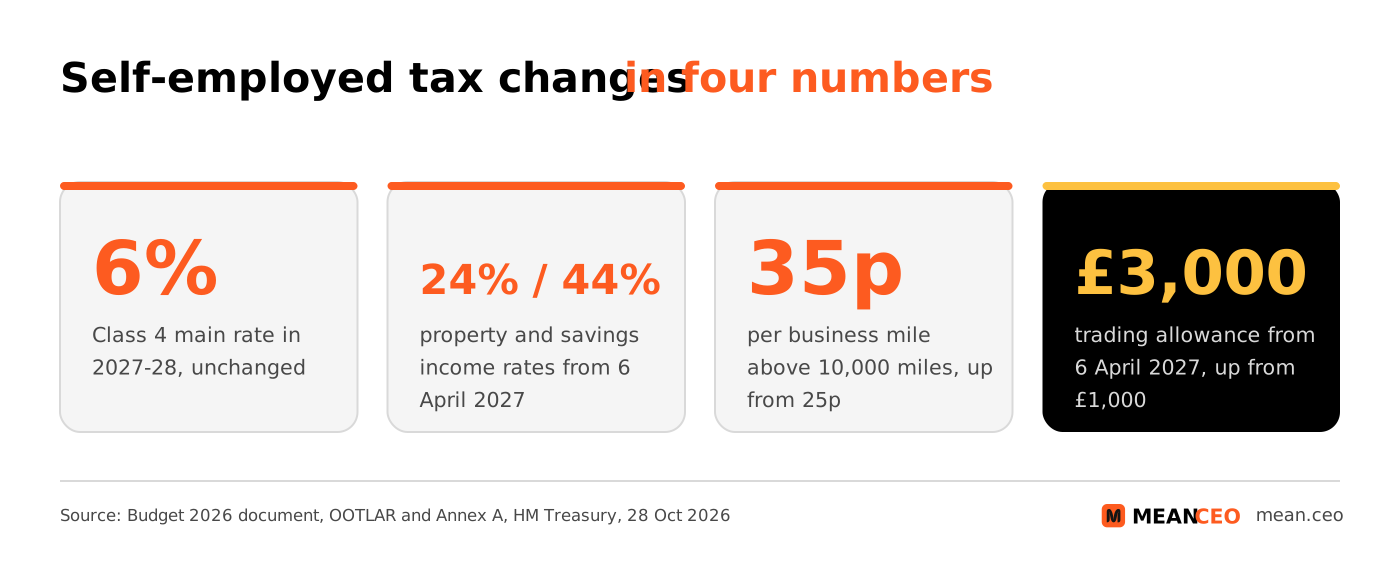
Your trading profit is taxed exactly as before in 2027-28: Income Tax at 20%, 40% and 45%, Class 4 National Insurance at 6% and 2%, and every threshold frozen. The changes sit around it. From 6 April 2027, property and savings income is taxed at 24%, 44% and 49%, the trading allowance rises to £3,000, mileage above 10,000 miles pays 35p and the Business Asset Disposal Relief (BADR) limit halves to £500,000. Overseas suppliers start charging UK VAT to unregistered businesses on 1 April 2027, and April 2029 brings automated payments on account, Direct Debit for VAT and parental pay for self-employed fathers and partners.
The self-employed tax changes in Chancellor John Healey's Budget on Wednesday 28 October 2026 leave the tax on your trading profit alone and move almost everything around it. Here is what the Autumn Budget 2026 changed for small businesses in one place. This article is the version for full-time sole traders, freelance developers, consultants and solo founders who haven't incorporated: every change with its start date, the four that cost or save real money, what is still open, and what to do before 6 April 2027.
What changes for the self-employed in Budget 2026?
Everything below comes from the Budget 2026 document, HM Treasury's overview of tax legislation and rates (OOTLAR) and its Annex A rates tables. Most tax items are announced: they still need Finance Bill 2026-27, which Parliament hasn't passed yet.
What stays the same for sole traders in 2027-28?
Annex A lists the 2027-28 rates next to this year's, and for trading profit the two columns match. That's the quiet headline: with the Personal Allowance and the bands frozen, every pound of extra profit you earn next year is taxed at the same rate, with no inflation uplift to soften it. The OOTLAR confirms the remaining National Insurance limits and thresholds stay at 2026-27 levels until the 2030-31 tax year.
Our worked example, for a freelance developer with £45,000 of profit: Income Tax is £6,486 (20% of £32,430) and Class 4 is £1,945.80 (6% of £32,430), so £8,431.80 in both years. Push profit to £50,000 and the whole extra £5,000 is taxed at the same 20% plus 6%, because the bands didn't move.
How much more tax on rental and savings income from April 2027?
This is the biggest money change for the self-employed, and it hits the ones who did well. From 6 April 2027, property income gets its own rates in England, Wales and Northern Ireland: 24% basic, 44% higher and 49% additional. Savings income moves to the same 24%, 44% and 49% across the UK. The Treasury's press release calls it "a further two percentage points across all bands". Against the 2026-27 rates in Annex A (20%, 40% and 45%), it's 4 points.
Our example: a consultant with £70,000 of trading profit and £10,000 of rental profit pays 40% on the rent in 2026-27, so £4,000. In 2027-28 the same rent is taxed at 44%: £4,400, or £400 more a year for the same flat. The Treasury says 84% of taxpayers will see no increase. A higher-rate sole trader with a rented flat or large savings next to the business is in the other 16%.
What changes for overseas software bills on 1 April 2027?
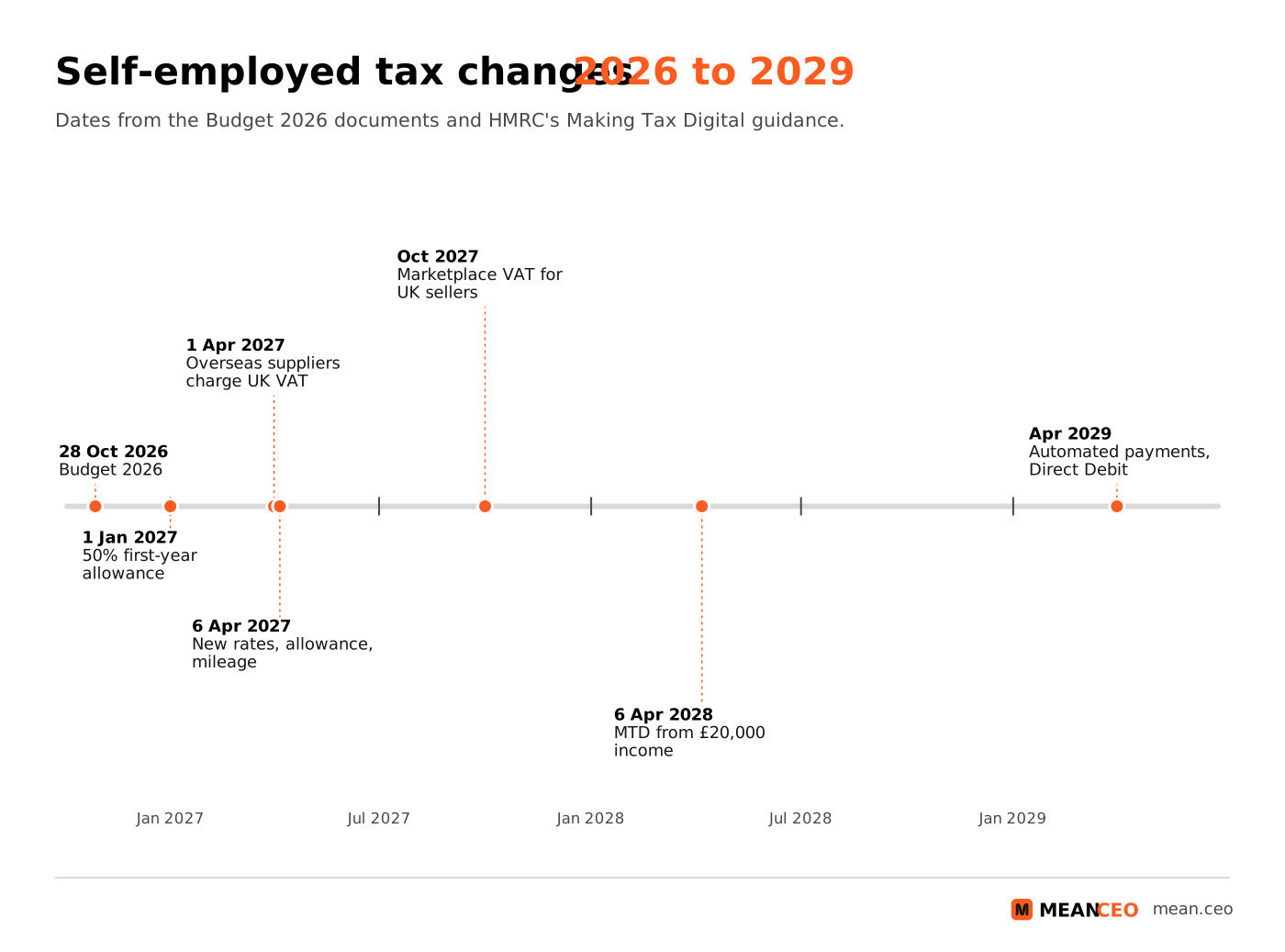
Today, a UK business buying services from an overseas supplier accounts for VAT itself through the reverse charge. From 1 April 2027, that reverse charge only applies if you are VAT-registered. If you aren't, the OOTLAR says the overseas supplier must charge and account for UK VAT, and as an unregistered business you can't reclaim it.
Our example: a solo founder under the £90,000 threshold spends £150 a month on tools from suppliers abroad that currently bill without VAT. At the 20% standard rate that's £30 a month extra, £360 a year. The full mechanics, and the e-invoicing deadline that follows in 2029, are in our UK e-invoicing guide for SaaS founders. If you sell physical products through Amazon, eBay or Etsy, read the online marketplace VAT explainer for October 2027.
How do mileage, the trading allowance and capital allowances change?
- Mileage: the 55p rate for the first 10,000 business miles, introduced as a temporary rate, becomes permanent, and miles above 10,000 rise from 25p to 35p from 6 April 2027, for employees and for self-employed simplified mileage. Treasury counts about 1 million self-employed people who benefit and puts the saving at £120 a year for 6,000 business miles. Our example: at 14,000 business miles, the 4,000 miles above the line earn 10p more each, a £400 bigger deduction, so a basic-rate sole trader (20% tax plus 6% Class 4) saves £104.
- Trading allowance: £3,000 from 6 April 2027, and the Self Assessment reporting threshold for trading income moves with it. For a full-time sole trader it matters only if you run a second small activity on the side. The worked examples are in the trading allowance guide on femaleswitch.com.
- Capital allowances: the main rate first-year allowance rises to 50% for spending on or after 1 January 2027, and the main writing-down allowance falls to 12% from 6 April 2027 for Income Tax. The Annual Investment Allowance stays at £1 million, far above what a typical sole trader spends on laptops and kit in a year.
What about Making Tax Digital, payments on account and Direct Debit?
Three admin changes, and the first one is close. HMRC's Making Tax Digital eligibility page says sole traders and landlords with qualifying income over £30,000 in 2025-26 must use MTD for Income Tax from 6 April 2027, and over £20,000 in 2026-27 from 6 April 2028. The Budget gives the April 2027 group a soft landing: no penalty points for late submission of the first four quarterly updates in 2027-28. It also defers MTD for "several taxpayer groups until further notice", without naming them in the Budget document.
From April 2029, anyone who makes payments on account will pay smaller, more regular, automated amounts through the year, and eligible taxpayers can choose to pay through PAYE. The same month, VAT-registered businesses must set up a Direct Debit for VAT and PAYE return liabilities, with defined exceptions; you can still pay another way before a cut-off date, and the Direct Debit collects what's left. If your cash flow lives on the January and July lump sums, start smoothing it now with a monthly tax pot and the habits in bookkeeping guide for founders.
Does Budget 2026 change parental pay and selling your business?
Two life events get new rules. From April 2029, eligible self-employed fathers, partners and adopters in Great Britain, who are excluded from the system today, can claim parental pay; the Budget document expects more than 150,000 parents a year to benefit. The Budget document doesn't set the amounts or the eligibility test, and the wider Parental Leave and Pay Review concludes in early 2027.
On the way out, the Business Asset Disposal Relief lifetime limit halves from £1,000,000 to £500,000 for disposals on or after 6 April 2027, with special rules for contracts signed before that date and completed later. If you plan to sell a sole-trader business with a big gain, the timing now carries a price tag. Founders building a company to scale should read our breakdown of Founders' Relief and its 10% rate, which needs a company, staff and growth that a solo practice won't have.
Should you incorporate after Budget 2026?
The Budget leaves the main comparison where it was: dividend rates stay at 10.75%, 35.75% and 39.35% above the £500 allowance, and the Budget document keeps the Corporation Tax headline rate capped at 25%. What moves is the edges. Rental property or large savings held in your own name cost 4 points more than this year, and the BADR exit relief shrinks. Run the numbers with an accountant using your own 2027-28 forecast; a headline rate on a blog won't settle it. If your back office is a mess, the back office stack for bootstrapped founders is the first fix. If growing means borrowing, the Budget also gave the British Business Bank £5bn more for SME loans, equity and venture debt.
What we don't know yet
- The final text: the tax items still need Finance Bill 2026-27 to pass.
- Which taxpayer groups get the MTD deferral, and until when.
- How the automated in-year payments will be calculated from April 2029; the government says it will keep working on detailed design.
- The Direct Debit exceptions and cut-off dates.
- The parental pay rates and eligibility rules for self-employed fathers and partners.
What do the self-employed tax changes mean for you?
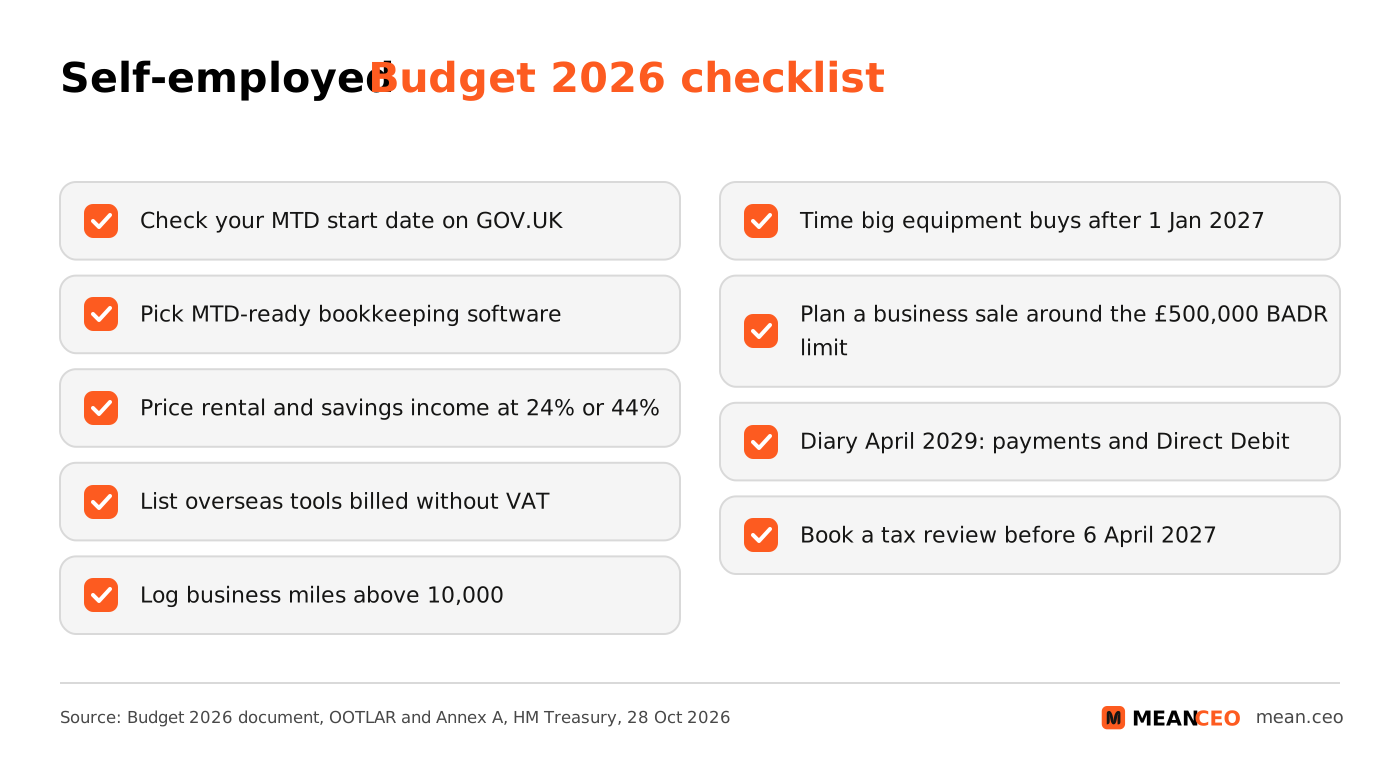
- This week: check your MTD start date on GOV.UK. If your 2025-26 qualifying income was over £30,000, you start on 6 April 2027 and need MTD-compatible software before then.
- Before Christmas: list every overseas subscription and its billing entity. If you're unregistered and the price excludes VAT today, budget 20% more from 1 April 2027.
- Before 5 April 2027: re-forecast rental and savings income at 24% or 44%, and ask your accountant whether any timing choices make sense in 2026-27.
- If you're selling: a disposal made before 6 April 2027 still uses the £1 million BADR limit. Ask your adviser how the special rules treat a contract signed before that date and completed after it.
- Ongoing: keep a monthly tax pot and clean records, using the routine in how startups can build cleaner financial records. It turns the 2029 switch to in-year payments into a non-event.
Are you getting customers from ChatGPT yet?
More and more traffic is coming from Perplexity, ChatGPT, Grok and other AI tools.
👉 Rank on ChatGPT
- Autumn Budget 2026: What It Changes for Small Businesses and First-Time Founders, From the £13.21 Wage to a £3,000 Trading Allowance
- Founders' Relief: A 10% CGT Rate on Up to £10 Million From April 2027, the Proposed Tests Most Startups Won't Pass, and the BADR Cut for Everyone Else
- British Business Bank Gets £5bn in the Autumn Budget 2026: £450m Venture Debt, £1.4bn Equity and £6.5bn of Guaranteed SME Loans
- Trading Allowance Triples to £3,000 From 6 April 2027: What Budget 2026 Means for Your Side Hustle
- UK E-Invoicing From April 2029: What the Budget 2026 Plan Means for SaaS Founders, Plus the Two VAT Changes That Land in 2027
- Online Marketplace VAT From October 2027: What Budget 2026 Means for UK Amazon, eBay and Etsy Sellers
FAQ: self-employed tax changes in Budget 2026
Did Budget 2026 change National Insurance for the self-employed?
No rate changed. Class 4 stays at 6% on profits between £12,570 and £50,270 and 2% above in 2027-28. The Small Profits Threshold rises to £7,355 and voluntary Class 2 to £3.80 a week. The remaining NI limits stay frozen until 2030-31.
Did income tax rates change for sole traders?
Not on trading profit. The main rates stay at 20%, 40% and 45%, with the Personal Allowance at £12,570 and the higher rate from £37,701 of taxable income. Property and savings income moves to 24%, 44% and 49% from 6 April 2027.
When do the self-employed tax changes start?
Most start on 6 April 2027. The reverse charge change for overseas services starts on 1 April 2027, marketplace VAT on 1 October 2027, and automated in-year payments, Direct Debit for VAT and parental pay for self-employed fathers and partners in April 2029.
Is there a Making Tax Digital penalty easement?
Yes. If you join MTD for Income Tax in April 2027, you get no penalty points for late submission of your first four quarterly updates in 2027-28. HMRC's guidance says income over £30,000 in 2025-26 means you start on 6 April 2027.
What happens to payments on account?
From April 2029, people who make payments on account will pay smaller, more regular, automated amounts through the year, and eligible taxpayers can choose to pay through PAYE. The detailed design is still being worked out.
Are these changes law yet?
Not yet. They were announced in the Budget on 28 October 2026, and most need Finance Bill 2026-27. National Insurance thresholds are set separately by statutory instrument.
About the Author
Violetta Bonenkamp, also known as MeanCEO, is an experienced startup founder with an impressive educational background including an MBA and four other higher education degrees. She has over 20 years of work experience across multiple countries, including 5 years as a solopreneur and serial entrepreneur. Throughout her startup experience she has applied for multiple startup grants at the EU level, in the Netherlands and Malta, and her startups received quite a few of those. She’s been living, studying and working in many countries around the globe and her extensive multicultural experience has influenced her immensely.
