TL;DR: What is the Salesforce Braze acquisition?
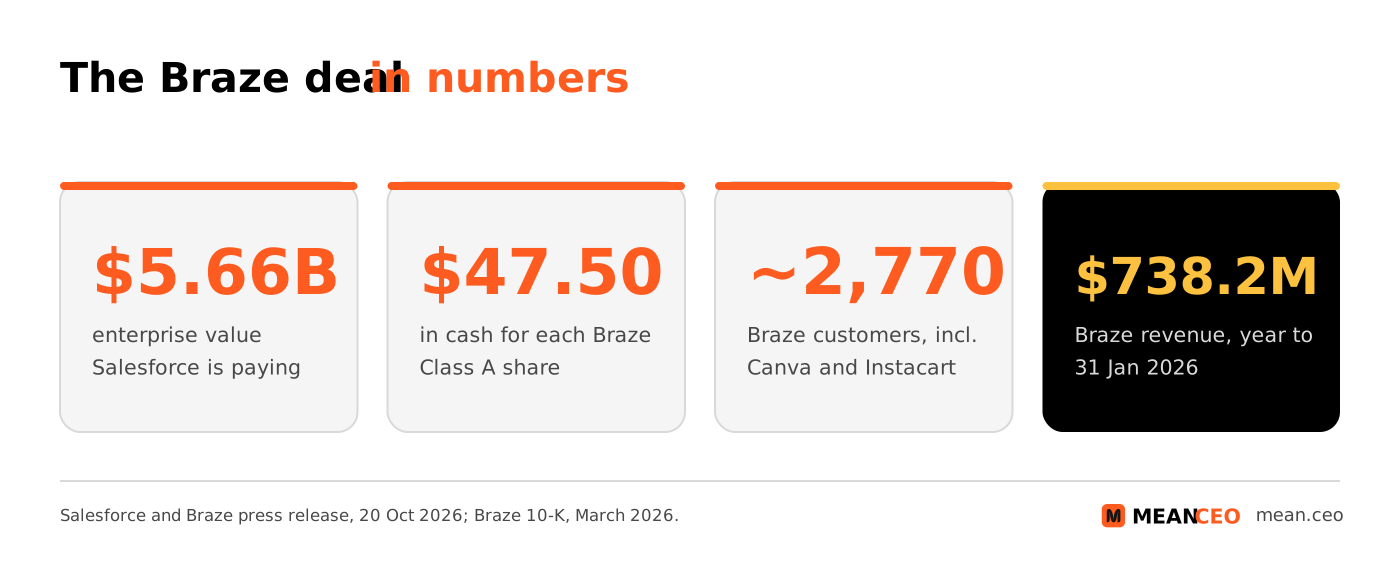
On 20 October 2026, Salesforce agreed to buy Braze, the customer engagement platform behind the push notifications, emails and in-app messages of brands like Canva, Instacart and Venmo. The price is about $5.66 billion in enterprise value, or $47.50 in cash per Braze share. The deal still needs Braze shareholders and regulators, and Salesforce expects it to close in its fiscal year 2028. For founders, it's one more sign that the big CRM platforms are buying the data and AI layer of marketing. If you use Braze, nothing changes today, so use the waiting time to protect your data and your renewal terms.
The Salesforce Braze acquisition is the reason "Braze" shot up Google Trends in the US today, with thousands of people searching for the company, the deal and the share price within hours of the announcement. Salesforce has now agreed to its third multi-billion-dollar software purchase in 17 months, and this one lands right inside the marketing stack that many startups pay for every month.
Here is what was announced, what is still open, and what it means if you run lifecycle marketing for your own product.
What did Salesforce announce on 20 October 2026?
Salesforce and Braze signed a definitive merger agreement on 19 October and announced it the next morning in a joint press release. Here are the confirmed terms:
Salesforce's fiscal year runs from February to January, so fiscal 2028 means somewhere between February 2027 and January 2028. Salesforce hasn't given a more exact date. Braze's own filing with the US Securities and Exchange Commission (SEC) adds the details that matter for timing: the deal needs a majority of Braze's Class A shares, the end of the US antitrust waiting period under the Hart-Scott-Rodino Act, and clearances under other antitrust and foreign investment laws that the filing doesn't name. Braze's board approved it unanimously, co-founders Bill Magnuson and Jon Hyman and Neeraj Agrawal signed agreements to vote their shares for it, and Braze isn't allowed to shop for a better offer.
Salesforce plans to pay in cash from its balance sheet, according to its investor slides. It also warned investors that the deal adds growth but will dilute profitability in the near term.
What does Braze do, and who uses it?
Braze is the software that decides which message a user gets, on which channel, and when. Think of the push notification that reminds you about an abandoned basket, the welcome email on day 3, or the in-app banner that shows up after your fifth order. Braze reacts to what each user does in real time and coordinates those messages across mobile apps, websites, email, SMS, WhatsApp and more.
Those numbers come from the press release, Braze's annual report (10-K) and its September earnings release. Braze is a mid-market and enterprise tool. Its customers include Canva, Dairy Queen, Equinox, Instacart, Urban Outfitters and Venmo, and 361 of them paid $500,000 or more a year as of 31 July 2026. Plenty of funded European apps use it too, which is why this deal matters to our readers too.
Why does Salesforce want Braze?
Salesforce says Braze will plug into all four layers of its platform: Data 360 (its customer data platform), Customer 360 (its CRM and Marketing Cloud apps), Agentforce (its AI agents) and SIForce. Inside Customer 360, Braze is supposed to make Marketing Cloud better at cross-channel personalization.
Patrick Stokes, Salesforce's President of Applications and Marketing, put the pitch like this: "Every interaction is an opportunity to wow your customers." Braze CEO Bill Magnuson said in the same announcement that "we'll continue building as Braze". Neither company has published anything about pricing or contract changes for current Braze customers yet.
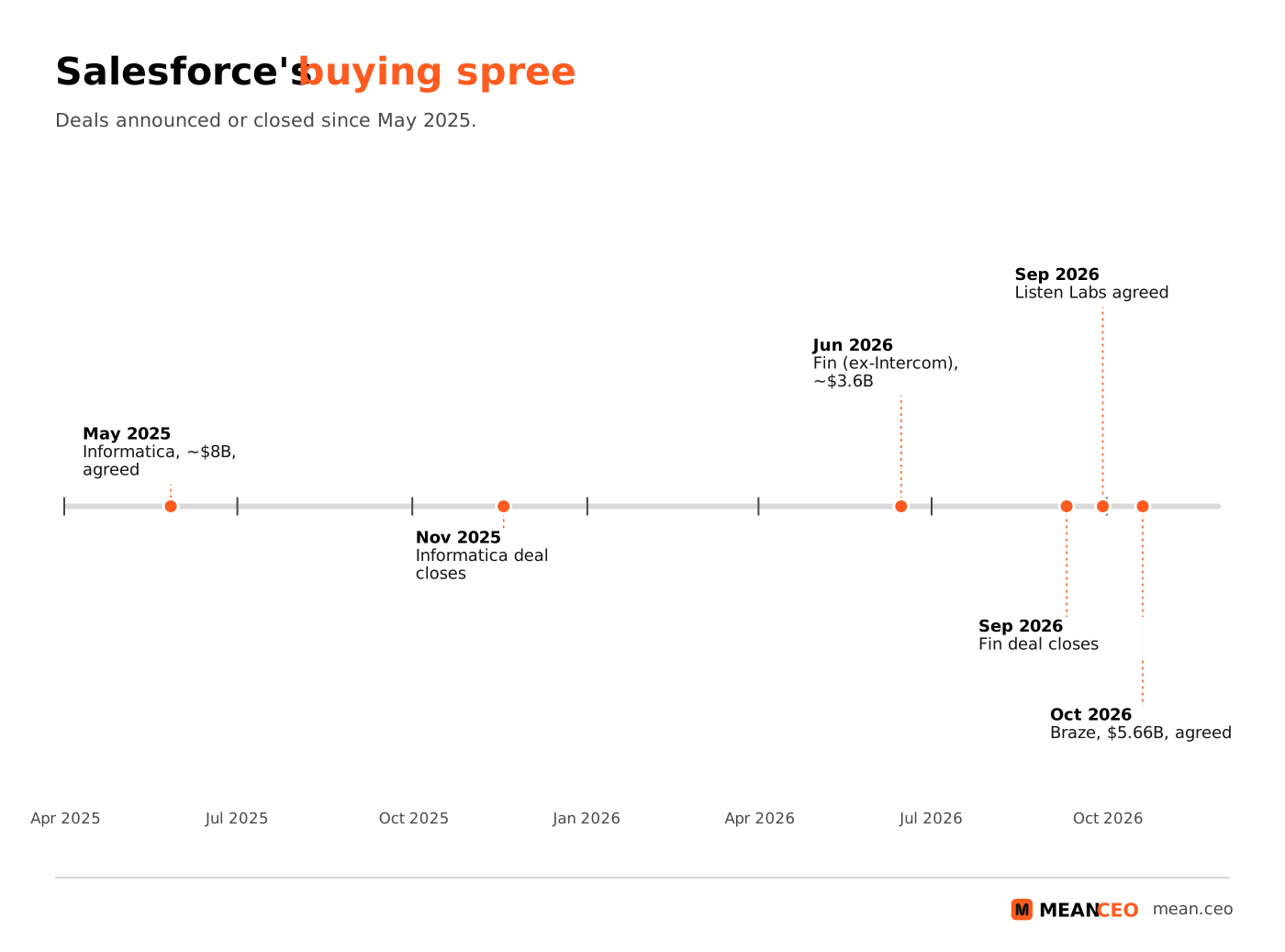
The bigger picture is the buying spree. Salesforce closed its roughly $8 billion Informatica deal in November 2025, then completed the Fin acquisition (formerly Intercom, about $3.6 billion) on 10 September 2026, and agreed to buy the AI research startup Listen Labs on 29 September and the analytics startup Loops on 12 October. Data, customer service, customer research, analytics and now real-time messaging: every piece gives Salesforce's AI agents more customer data to work with and more channels to act on.
If you follow AI agents, this fits a pattern we track in our AI agents news for October 2026: the platforms want agents that don't just write the email but also decide who gets it and when. And it lands in a market where companies already pay for far too many marketing tools, as our martech stack and spend statistics show.
What does the Salesforce Braze deal mean for your startup?
Most bootstrapped founders don't pay for Braze. Plenty of funded app startups do, and almost every founder depends on some marketing platform that a bigger company could buy tomorrow. Here's how I'd read it:
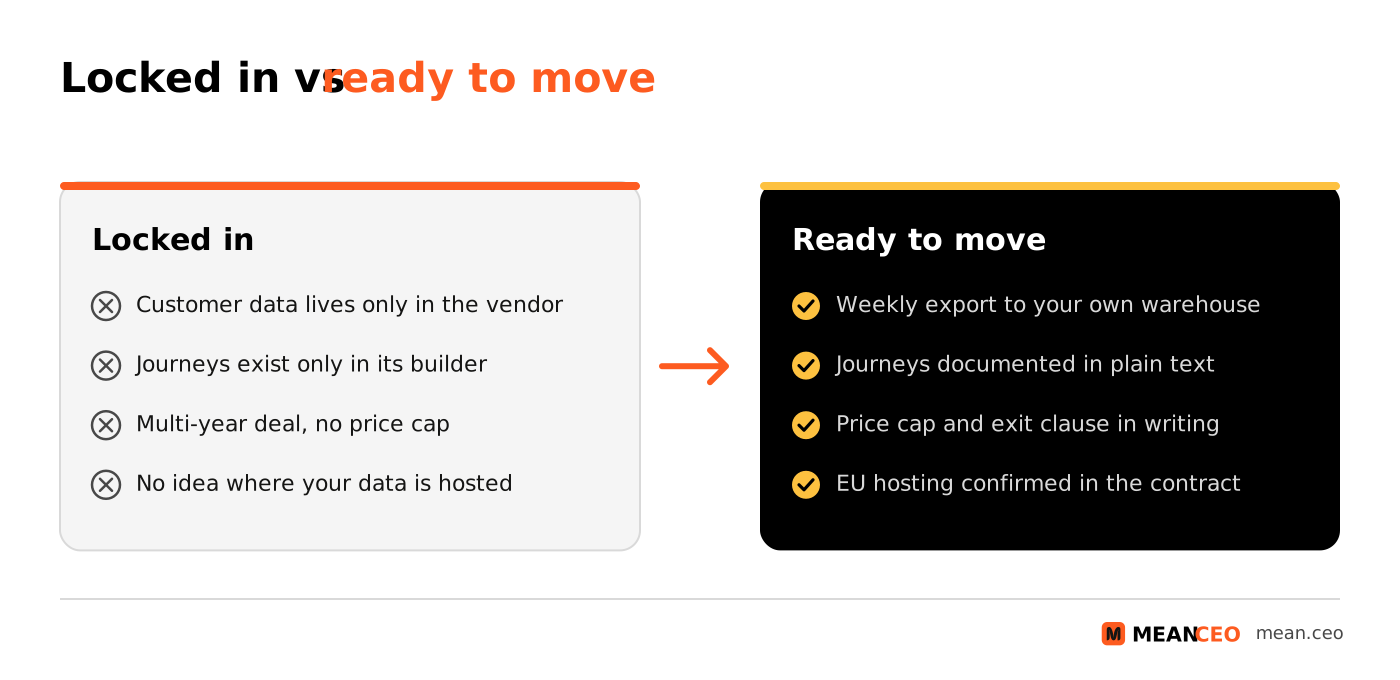
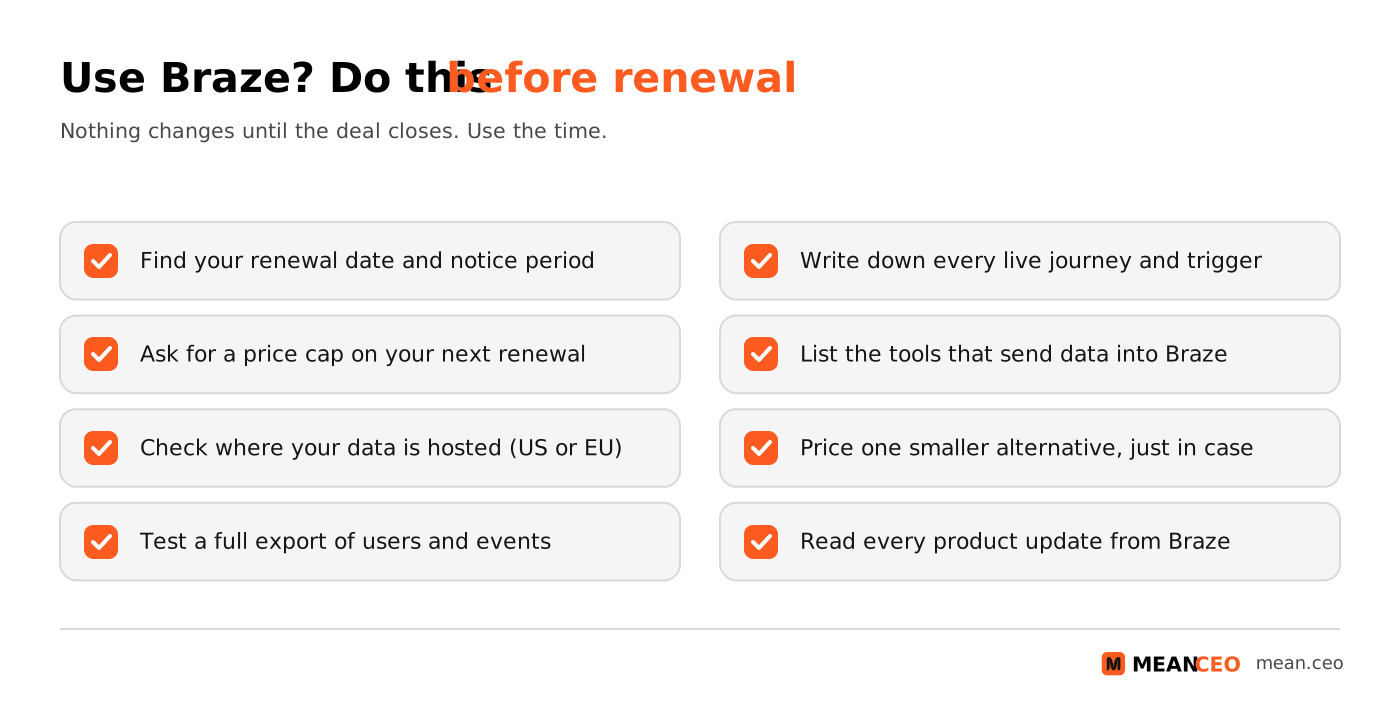
- If you use Braze, nothing changes today. The deal won't close before February 2027 at the earliest, and Braze keeps running as a separate public company until then. Don't panic-migrate. Use the time to check your renewal date, notice period and any price-increase clause, and ask for a price cap before you sign a long renewal. Acquired tools tend to get repackaged into the buyer's bundles, so get your terms in writing now.
- Own your customer data. Your users, events and consent records are worth more than any tool you send them through. Set up a regular export to your own database or warehouse, and test that the export actually works. If you ever need to switch, this is the part that hurts most.
- Check where your data lives. Braze offers EU hosting. If you serve European users, confirm in your contract that your instance sits in the EU, and ask what happens to hosting and data processing terms after the change of ownership. That matters for GDPR (General Data Protection Regulation) and for enterprise customers who ask about it in security reviews.
- Document your journeys outside the tool. Write down every live campaign, its trigger and its goal in a plain document. Your automation workflows should survive a vendor change, and so should your win-back campaigns for churned customers.
- Don't buy enterprise software you don't need. A solo founder with 2,000 users doesn't need a Braze-sized platform. Cheaper email and push tools cover welcome, upsell and win-back flows. Our guide to expansion revenue with upsells and cross-sells shows what to automate first.
- If you build marketing or AI tools, look at who's buying. Salesforce paid for real-time customer data, AI decisions and channels. Listen Labs and Loops show it buys startups too, not only public companies. If your product connects to Salesforce, Agentforce or Marketing Cloud, a good connector is the cheapest way to get noticed by the people who make these deals.
AI is changing who presses send. Salesforce wants its agents to decide when each message goes out. If you want to see how small teams already do this, read our guide to AI for sales and automated lead qualification. And if you're watching how AI is changing hiring at the companies that build these tools, see what Anthropic's own data says about junior tech hires.
Are you getting customers from ChatGPT yet?
More and more traffic is coming from Perplexity, ChatGPT, Grok and other AI tools.
👉 Rank on ChatGPT
What happens next?
Braze shareholders vote first, and regulators review the deal in the US and in other countries the filing doesn't name. In certain cases, such as regulators blocking it, Salesforce owes Braze a $300 million termination fee; if Braze walks away for a better offer or loses the shareholder vote in certain cases, it owes Salesforce $191.39 million. The agreement runs for a year, with up to two 90-day extensions for regulatory approvals.
The market reaction was quick: CNBC reported that Braze shares jumped more than 50% on Tuesday. We don't cover share prices or give investment advice, so for founders the useful dates are the shareholder vote, any EU merger review and the first product announcements about Braze inside Marketing Cloud. We'll cover those on mean.ceo when they happen, and Braze's own announcement is the page to watch for customer updates.
FAQ: Salesforce and Braze
Is Salesforce buying Braze?
Yes. On 20 October 2026, Salesforce announced a definitive agreement to acquire Braze for about $5.66 billion in enterprise value. Braze shareholders get $47.50 in cash per Class A share. The deal still needs shareholder and regulatory approval.
When will the Salesforce Braze acquisition close?
Salesforce expects it to close in its fiscal year 2028, which runs from February 2027 to January 2028. No exact date has been given.
What is Braze used for?
Braze is a customer engagement platform. Companies use it to send personalized messages across mobile apps, websites, email, SMS, WhatsApp and push notifications, based on what each user does in real time.
Will Braze prices or contracts change for customers?
Neither company has announced any changes. Braze CEO Bill Magnuson said the team will "continue building as Braze". Check your renewal date and terms now and ask for a price cap before signing a long renewal.
Does Braze host data in the EU?
Yes. Braze's annual report says it offers hosting in the United States, the European Union, Australia, Japan and Indonesia. Confirm in your contract which region your instance uses.
What other companies has Salesforce bought recently?
Salesforce closed its roughly $8 billion Informatica deal in November 2025 and its roughly $3.6 billion Fin (formerly Intercom) deal in September 2026. It also agreed to buy Listen Labs on 29 September 2026 and Loops on 12 October 2026.
About the Author
Violetta Bonenkamp, also known as MeanCEO, is an experienced startup founder with an impressive educational background including an MBA and four other higher education degrees. She has over 20 years of work experience across multiple countries, including 5 years as a solopreneur and serial entrepreneur. Throughout her startup experience she has applied for multiple startup grants at the EU level, in the Netherlands and Malta, and her startups received quite a few of those. She’s been living, studying and working in many countries around the globe and her extensive multicultural experience has influenced her immensely.
