TL;DR: Can AI chatbots reuse news articles in the EU?
On 3 November 2026, Advocate General Maciej Szpunar told the EU Court of Justice that chatbots which fetch and reuse press articles in real time (RAG, or "grounding") can infringe press publishers' rights in two cases: when the article was accessed unlawfully, for example by getting around a paywall or an anti-scraping block, or when the answer copies the article's wording so closely that the reader no longer needs the original. Training an LLM is, "as a rule", allowed under the text and data mining exception. The opinion is not binding, and a judgment is expected in about six months. One day earlier, The New York Times sued Brave in the US over the same kind of live retrieval.
If you've built a RAG tool, an AI news digest, a research agent or a wrapper around a search API, this week was about you. On both sides of the Atlantic, the legal fight over AI and news moved from "what did you train on?" to "what does your bot fetch and show right now?"
Here's what the EU court's adviser actually said in the Gemini case, what the New York Times claims Brave's search API did, and the simple checks that keep a small AI product on the safe side.
What happened
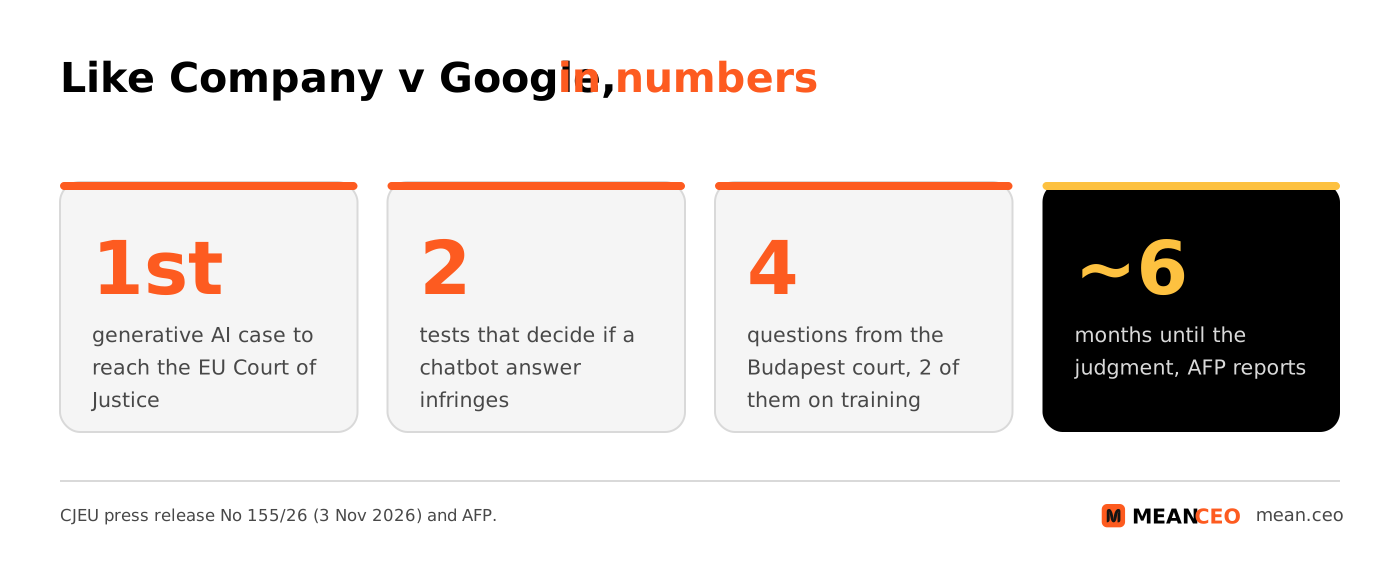
On Tuesday 3 November 2026, Advocate General Maciej Szpunar gave his opinion in Case C-250/25, Like Company v Google Ireland. The Court of Justice's press release calls it "the first generative AI case to reach the Court of Justice".
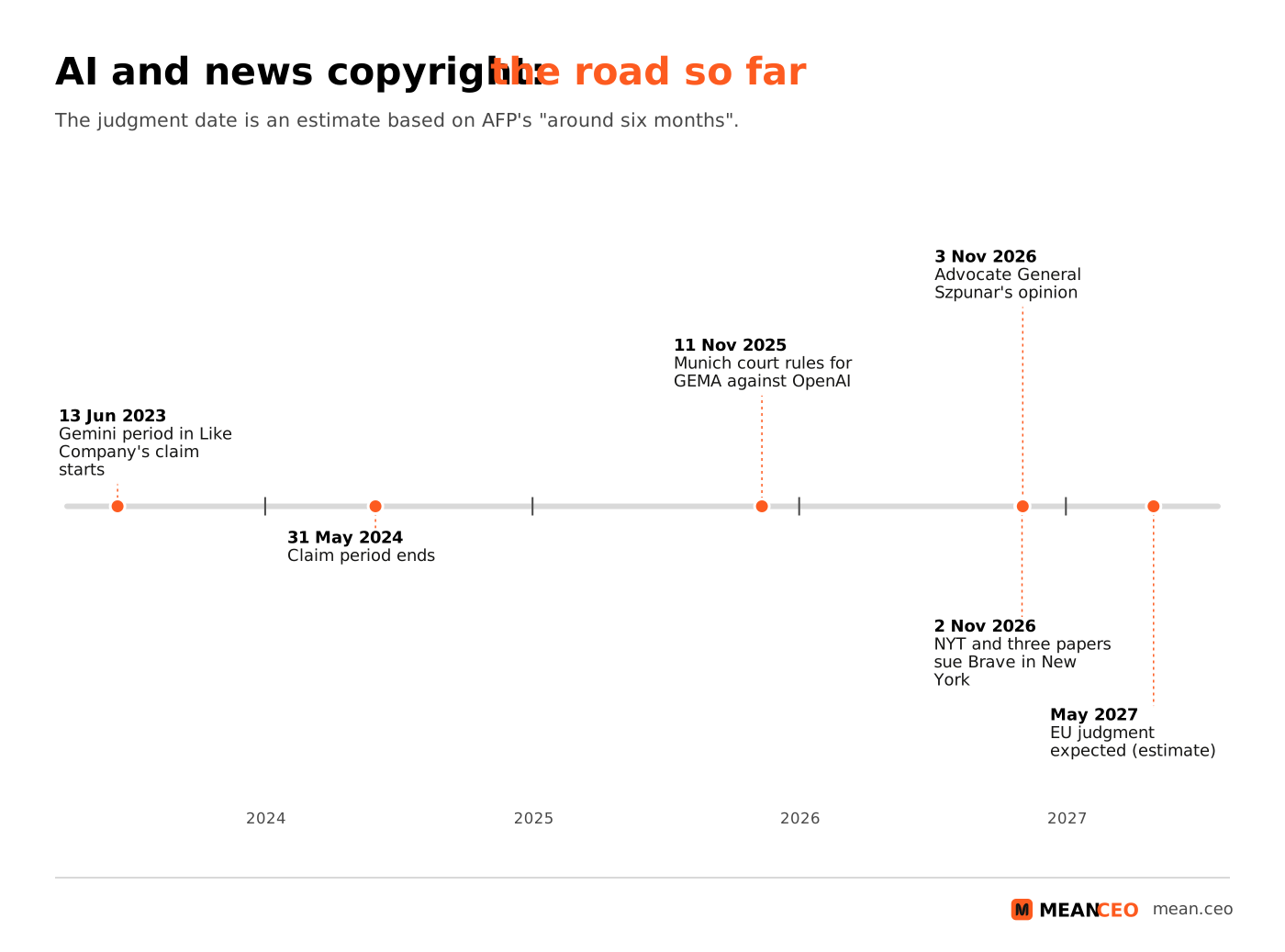
Like Company runs several Hungarian news portals. It sued Google before the Budapest Regional Court, claiming Google used its articles to train the Gemini models and "repeatedly reproduced and made them available to the public through the Gemini chatbot between 13 June 2023 and 31 May 2024". The Hungarian court sent four questions to Luxembourg: two about training, two about the chatbot's answers.
The case turns on the press publishers' right in Article 15(1) of the EU's 2019 copyright directive (the CDSM Directive), and on the text and data mining (TDM) exception in Article 4 of the same directive. You can follow the filings on the Court's case page for C-250/25.
Status: Debated. An Advocate General's opinion is advice, not law. The judges "are now beginning their deliberations", and the judgment will come later. AFP reported that "A judgment is expected in around six months", and Reuters notes that the Court follows most such opinions.
Training: "as a rule" allowed
Szpunar advised the Court to declare the two training questions inadmissible. There's no evidence Like Company's articles were used to train Gemini, and training isn't an "online use" of press publications, so the questions are hypothetical. But "for the sake of completeness", he said training an LLM on protected works "is, as a rule, freely permitted under the text and data mining exception".
Copyright scholar João Pedro Quintais, writing on the Kluwer Copyright Blog, points to the conditions that come with that: the exception applies only with "lawful access and the absence of an applicable reservation of rights", the so-called opt-out. That's why machine-readable opt-outs matter, like the new robots.txt token we covered in our post on the __usage_ai-training signal.
The opinion also sits awkwardly next to a German ruling. In November 2025 the Munich Regional Court sided with the music rights society GEMA against OpenAI, finding, in GEMA's account of the ruling, that "The ChatGPT systems contain copies of the original works". Szpunar calls "memorisation" "incidental to the machine learning process, and not entirely avoidable", and the idea that a model stores copies "far-fetched".
Live answers: the two tests that matter for your product
This is the core of the opinion. When a chatbot retrieves an article from a publisher's site, reuses it to write an answer and shows that answer to the user, the publisher's right "may be infringed in certain circumstances". Quintais reads the opinion as saying RAG involves "technical reproductions which are not covered by the Article 4 TDM exception", because it fetches specific content to improve an answer rather than analysing data for patterns.
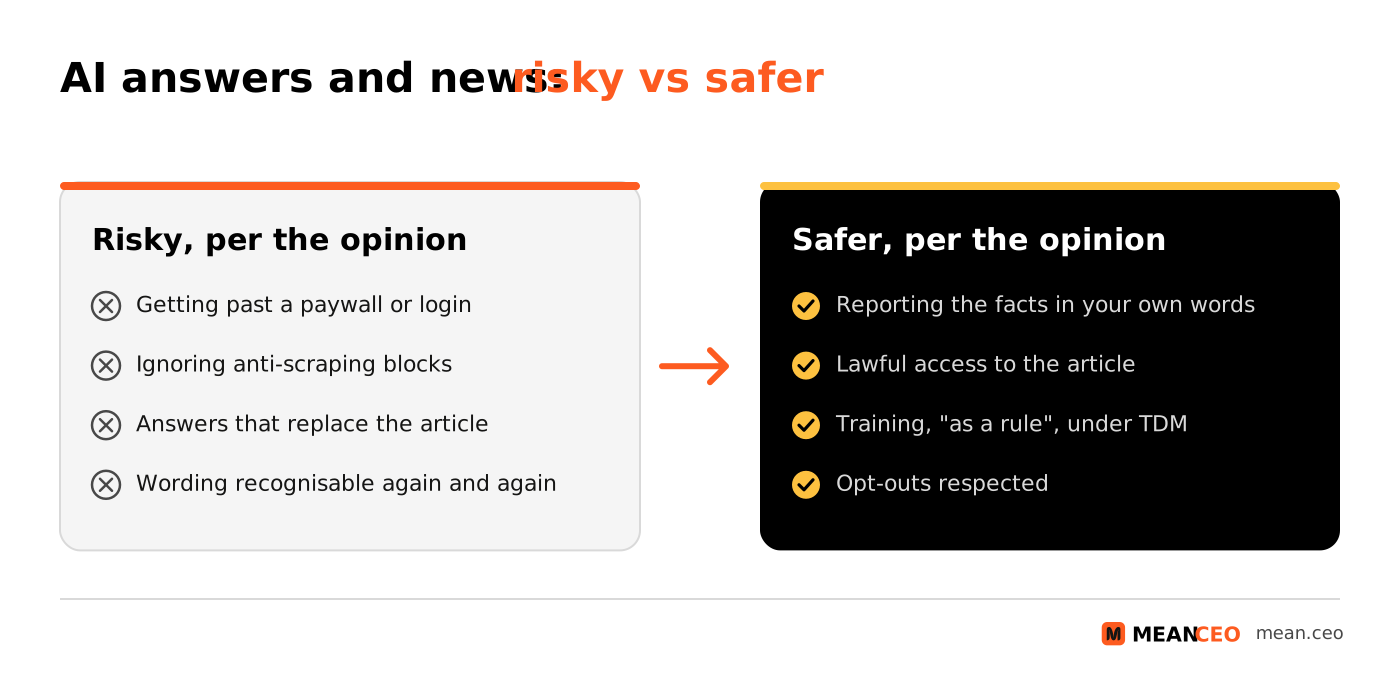
Szpunar starts from a point every founder should remember: the right protects "only the specific form of expression" of an article, "not to give publishers a monopoly over the news itself". Facts are free. Then come the two tests:
Source: CJEU press release No 155/26, 3 November 2026. This is information, not legal advice.
Read the liability line twice. The provider is liable where such use is "inherent to the business model of that provider" or where it "has failed to put in place appropriate measures in order to counter those acts credibly and effectively". In plain words: if your product only works because it reprints articles, you have a problem. If it summarises and links, and you can show the guardrails you built, you're in a much better place.
Google's response
A Google spokesperson told AFP that "Gemini learns linguistic patterns to create original outputs rather than replicating content", "supported by extensive publisher controls that give rightsholders clear choice and the ability to opt out." Google welcomed "the advocate general's opinion recognising that EU law permits AI training on publicly available information".
Publishers read it differently. Angela Mills Wade of the European Publishers Council said publishers "should not have to choose between search visibility and protecting their rights". That tension is real for anyone who blogs: we showed in our roundup of AI search traffic studies how little traffic AI answers send back, and Meta's new crawling terms, covered in our post on Meta's AI crawling terms, show how platforms want more access, not less.
The same week in the US: The New York Times sues Brave
On 2 November, The New York Times filed a 72-page complaint against Brave Software in the Southern District of New York (Case 1:26-cv-09549). The New York Daily News, the Chicago Tribune and the Orlando Sentinel filed a separate suit the same day, CyberInsider reported. These are allegations, not findings:
- A hidden crawler. The Times says Brave built an index of "over 30 billion webpages" (Brave's own figure) but "has never disclosed the name of its 'bot'", so sites can't block it.
- A search API that returns whole articles. Brave's "LLM Context" endpoint is sold for AI agents and RAG pipelines. In one test cited in the complaint, "The Brave API response provided 1,291 out of 1,295 words in the article, verbatim."
- Big AI customers. The complaint calls Brave a supplier to "many of the most prominent GenAI companies, including Anthropic, Perplexity, Mistral, xAI, and Cohere".
- A paywall setting. It says the Brave browser has a "Paywall blocker" setting that Brave describes as letting users "Bypass Paywalls".
- Ignored letters. The Times says it wrote to Brave CEO Brendan Eich on 11 August 2025 and again on 13 April 2026, and Brave ignored both.
The Times brings five counts: direct, contributory and vicarious copyright infringement, a DMCA anti-circumvention claim and unjust enrichment under New York law. The publishers seek damages, profits and a permanent injunction. As of 4 November, Brave had yet to respond publicly.
Sources: CJEU press release No 155/26, the NYT complaint and CyberInsider, read 5 November 2026.
The Europe angle: why this hits small builders, not just Google
Big AI firms have lawyers and licence deals. A two-person startup reselling "AI news briefings" has neither. The two tests don't care how big you are: they look at how your bot gets content and what it shows.
The weak spot for indie builders is the supply chain. Many small AI apps don't scrape anything themselves; they call a search API and pass the text to a model. If a supplier's content was obtained by getting around paywalls or blocks, the US complaint shows publishers will go after the supplier first. How the EU test applies to the customer of such a supplier is an open question the opinion doesn't answer, which is exactly why you should ask your supplier now. Our legal and compliance basics for startups cover the contracts and records that help here.
What this means for you
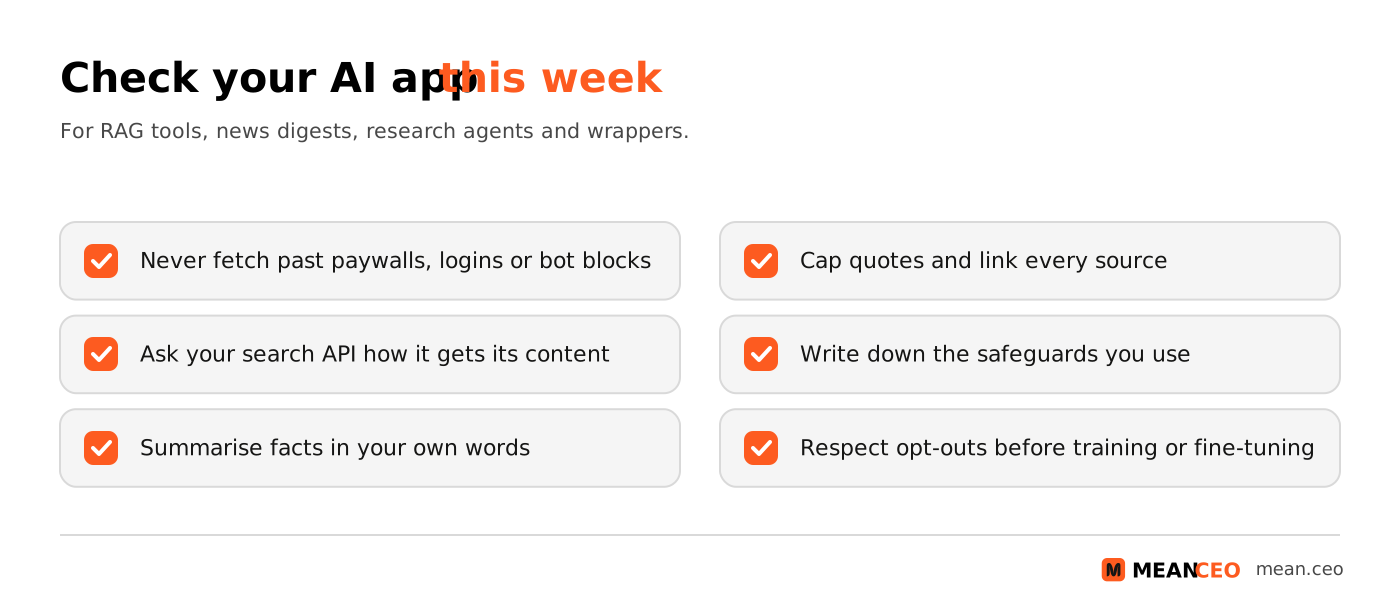
- Never fetch past a wall. No paywall workarounds, no logged-in scraping, no ignoring bot blocks or robots.txt. That's the first test, and it's the easiest one to fail.
- Ask your search or scraping API where its content comes from. Get it in writing: does it identify its crawler, respect robots.txt and avoid paywalled pages? Keep the answer on file.
- Summarise, don't reprint. Write answers that report the facts in your own words. Cap quoted text to a sentence or two and always link the original. That keeps you on the right side of the second test.
- Write down your safeguards. Liability depends on "appropriate measures". A one-page note on your filters, quote limits and blocklists is cheap evidence.
- Respect opt-outs before you train or fine-tune. The TDM exception needs lawful access and no opt-out. Our AI tool stack for solo founders can help you pick providers that document their data sources.
- If you publish, protect your wording. The right protects your expression, not your facts. Platforms are already closing their doors, as our post on Reddit going login-only shows. Follow the case in our AI news for November 2026.
My take: this is good news for builders who play fair. The adviser didn't ban RAG, didn't touch training, and said facts belong to everyone. What he targeted is the lazy business model: bots that sneak past paywalls and hand readers the whole article. If your product summarises, links and respects blocks, keep building. If it only works because it reprints other people's journalism, the next six months are your window to fix it.
Are you getting customers from AI search yet?
More and more traffic is coming from Perplexity, ChatGPT, Grok and other AI tools.
👉 Rank on ChatGPT
FAQ: AI chatbots, RAG and press publishers' rights in the EU
What did the EU Advocate General say about AI chatbots and news?
In Case C-250/25 on 3 November 2026, Advocate General Szpunar said chatbots that retrieve and reuse press articles in real time may infringe press publishers' rights if the article was accessed unlawfully or if the answer reuses its wording so recognisably that the reader no longer needs the original.
Is training AI on news articles legal in the EU?
The Advocate General said training an LLM is, as a rule, allowed under the text and data mining exception, provided access was lawful and the rightsholder hasn't opted out. He advised the Court not to rule on training in this case.
Is the opinion binding?
No. It is advice to the Court of Justice. The judges are now deliberating, and AFP reports a judgment is expected in around six months. The Court follows most such opinions, according to Reuters.
Is RAG legal in the EU?
RAG itself isn't banned. According to the opinion, live retrieval isn't covered by the TDM exception, so it matters how the content was accessed and whether the answer replaces the original article. Summarising facts with a link is the safer pattern.
Why is The New York Times suing Brave?
The Times alleges Brave scraped its articles with an unidentified crawler, helped users bypass paywalls and sold its content to AI companies through the Brave Search API. Brave had not responded publicly as of 4 November 2026.
What should a small AI startup do now?
Don't fetch past paywalls or blocks, ask your search API provider how it sources content, summarise rather than reprint, link sources, and document your safeguards, because liability depends on whether you took appropriate measures.
About the Author
Violetta Bonenkamp, also known as MeanCEO, is an experienced startup founder with an impressive educational background including an MBA and four other higher education degrees. She has over 20 years of work experience across multiple countries, including 5 years as a solopreneur and serial entrepreneur. Throughout her startup experience she has applied for multiple startup grants at the EU level, in the Netherlands and Malta, and her startups received quite a few of those. She’s been living, studying and working in many countries around the globe and her extensive multicultural experience has influenced her immensely.
