TL;DR: Voice Search Optimization for European Startups
In 2024, 16% of people in the EU used a voice assistant, from 41% in Ireland to about 1% in Bulgaria (Eurostat), and in 2026 the assistants themselves changed: Gemini is replacing Google Assistant, Alexa+ reached the UK, Italy, Spain, Germany, Austria and France, and Apple’s new Siri AI isn’t on iPhones in the EU yet. Assistants read their answers from normal search results and business listings, so there’s no special voice markup to buy. Win voice search by completing your free listings (Google Business Profile, Apple Business Connect, Bing Places), answering real customer questions in plain language in every language you sell in, and keeping mobile pages fast.
💡 Looking to drive organic traffic without backlinks? Check out this founder-friendly SEO guide for practical insights.
Voice Search Optimization for European Startups: A Practical Guide for Founders
Voice search optimization for European startups is the process of tailoring your website, content and business listings for questions people ask out loud through Siri, Alexa, Google’s Gemini and the voice mode of Google Search. It isn’t just about technology; it’s about being the one answer an assistant reads out when a customer asks for what you sell.
For startups, optimizing for voice search helps with customer acquisition and local visibility, and most of the work is free. European founders, especially bootstrapping entrepreneurs, should prioritize conversational, local and multilingual SEO, because those are the signals assistants rely on, and they cost time rather than ad money.
In 2024, 16% of people aged 16–74 in the EU used a voice assistant in the previous three months. In Ireland it was 41%, in the Netherlands 29% and in Bulgaria just 1% (Eurostat). Where your customers live changes how much voice matters.
Boost Your SEO by Publishing Your Startup Press Release with us.
We publish content about startups, education, tech, funding, etc., that ranks well in Google, ChatGPT, Perplexity, Grok, and other AI tools.
👉 Publish Press Release
Why Voice Search Optimization Is Crucial for European Startups
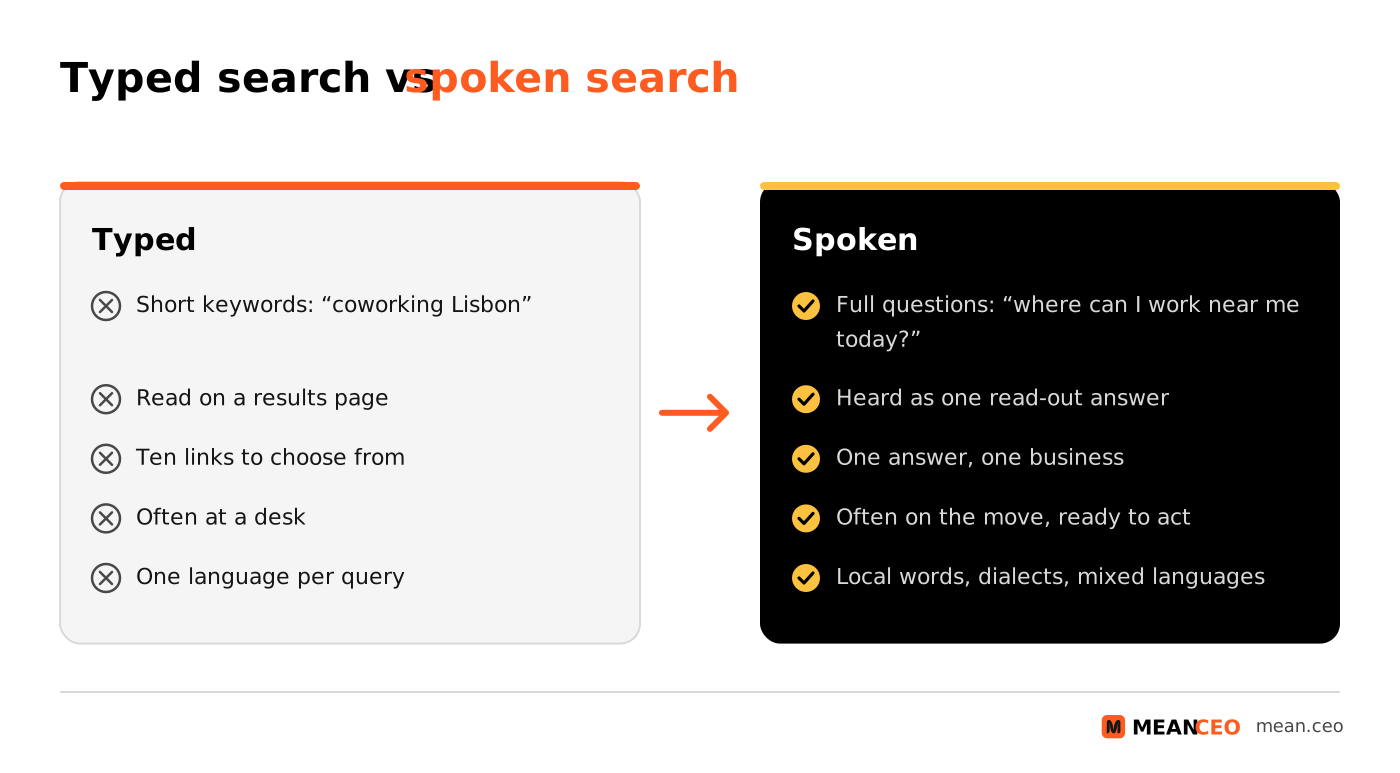
Voice search rewards startups that write the way customers talk and keep their local details accurate. Spoken questions tend to be longer and more specific than typed keywords, and many of them are about something nearby: opening hours, directions, prices, “near me”. That’s the lifeline of small and bootstrapped startups across Europe, and Eurostat’s Internet of Things data show how uneven the market is: voice assistant use ranges from over 40% in Ireland to under 5% in the Baltic states and Bulgaria.
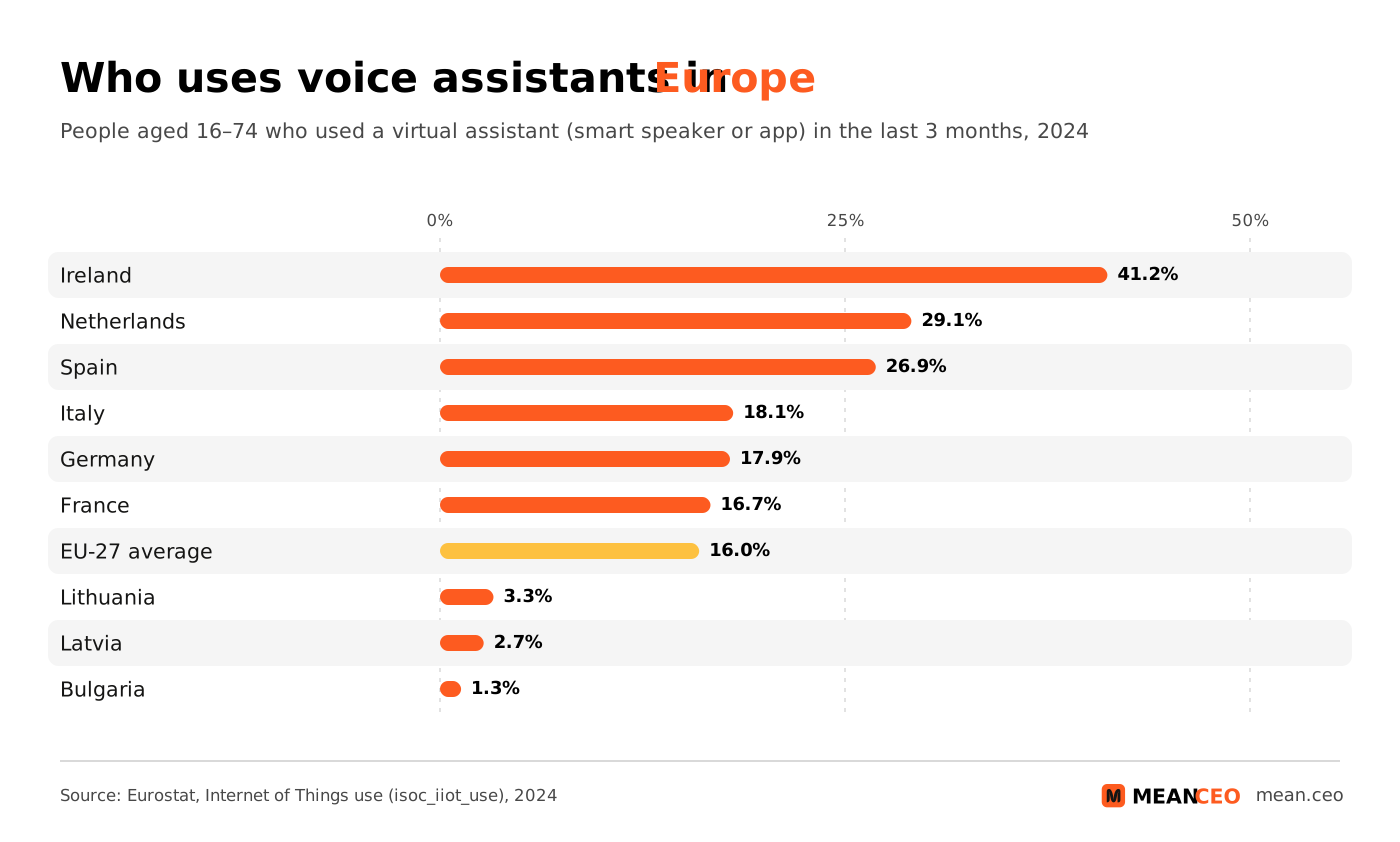
Usage is growing slowly rather than exploding: the EU share was 11.4% in 2020 and 13.4% in 2022 before reaching 16.0% in 2024, though Eurostat changed the question in 2024, so treat the trend as indicative. In the same 2024 survey, 19.3% of people used a smart speaker or connected home audio system.
This growing trend aligns perfectly with the strengths of European entrepreneurs who embrace non-dilutive funding methods, such as EU grants, and creative customer acquisition models that capitalize on local markets.
Consider how local SEO for service-based startups can build this momentum, enabling founders to show up in nearby searches whether people type or speak them.
Which Voice Assistants Europeans Use in 2026
2026 was a big year for assistants, and not every change reached every European country. Here’s where each one stands and where it gets its answers:
Sources: Google, Amazon and Apple announcements, 2025–2026. Alexa+ is free during early access and then €22.99 a month (£19.99 in the UK) for customers without Prime, according to Amazon’s international launch page. Apple says Siri AI is currently unavailable in the EU on iOS, iPadOS and watchOS, so Apple users there still get the classic Siri, which also answers from Apple Maps and the web.
The lesson for founders: don’t optimize for one assistant. Google, Apple and Microsoft each run their own business directory, and all three are free. Get the basics right in all of them and you’re covered whichever assistant your customers use.
Core Steps to Optimize Your Startup for Voice Search
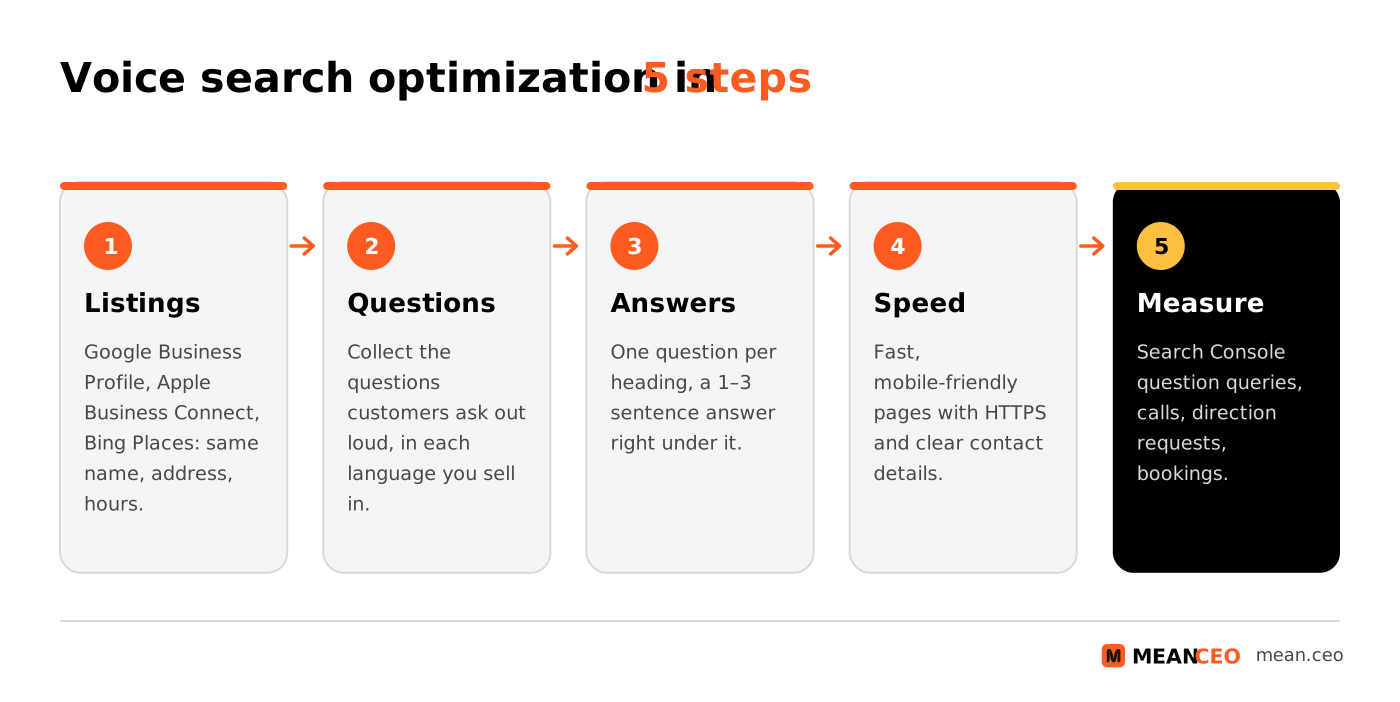
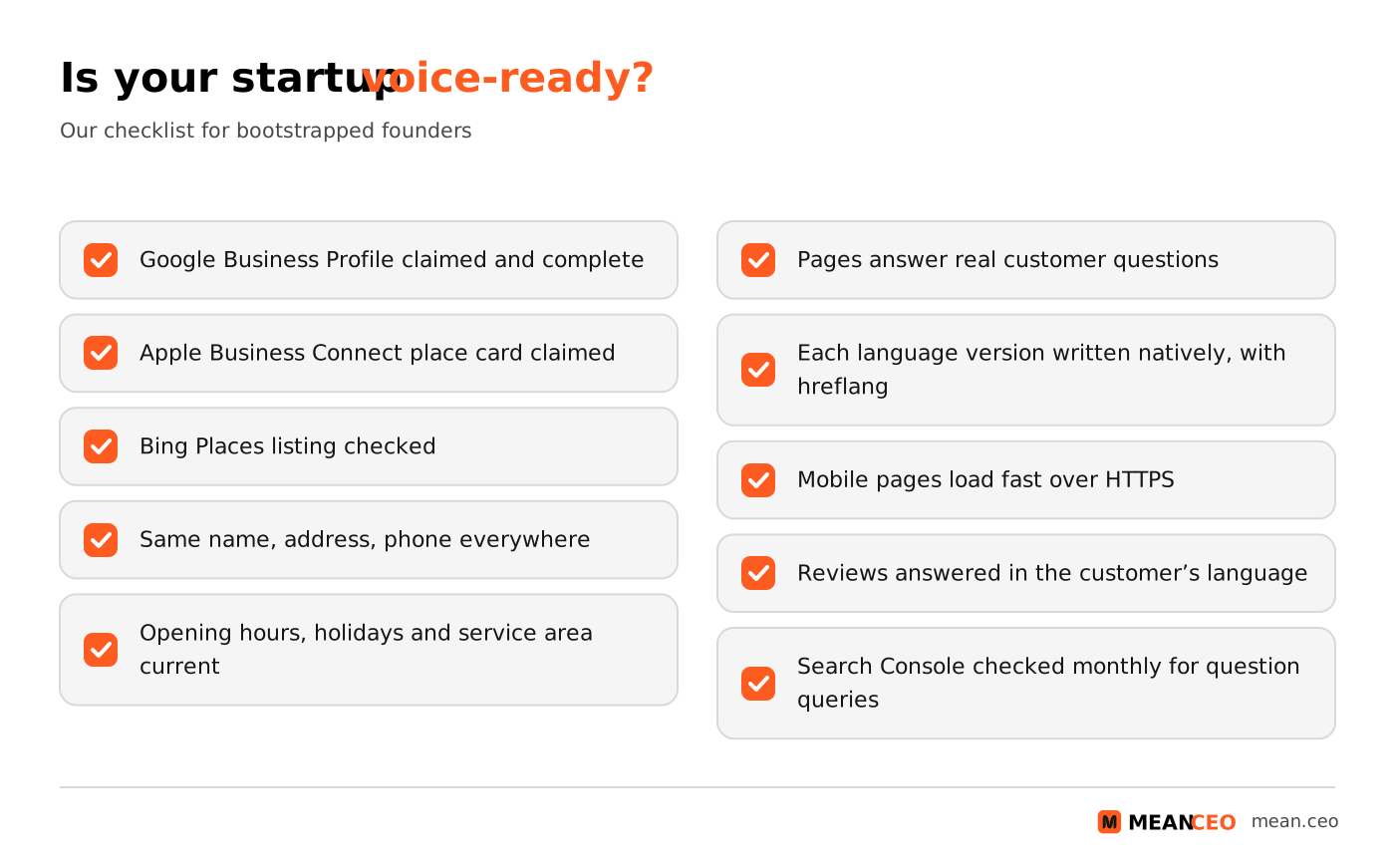
- Claim your listings: complete your free Google Business Profile, Apple Business Connect place card and Bing Places listing, with identical name, address, phone, hours and service area.
- Collect spoken questions: write down what customers ask on the phone, in emails, in reviews and in Search Console queries that start with who, what, where, how or can.
- Answer them in plain language: one question per heading, and a direct answer of one to three sentences right under it, then the detail.
- Cover every language you sell in: write each language version natively rather than machine-translating keywords, and connect the versions with hreflang.
- Speed up mobile pages: fast loading, HTTPS, readable text and a tap-to-call phone number.
- Add basic structured data: Organization or LocalBusiness markup helps search engines understand who you are, but it isn’t a voice switch and there’s no special voice markup a small site needs.
To get your answers into AI-based snippets, read our guide to visibility in Google AI Overviews.
Examples of Voice Search Optimization in Practice
Here’s what this looks like for three typical bootstrapped businesses. These are illustrations of the method, not case studies with measured results.
A coworking space in a mid-sized Portuguese town. People ask their phones “where can I work near me today?” or “coworking com Wi-Fi perto de mim”. The space completes its Google and Apple listings with day-pass prices and opening hours, and adds a page that answers “Can I book a desk for one day?” in Portuguese and English.
A Berlin bike repair startup. Customers ask “Wer repariert E-Bikes in Kreuzberg?” and “How much does a bike service cost?”. The founder writes a short price page with one answer per question in German and English, keeps Saturday hours current in every listing and replies to reviews in the language they were written in. A Dutch B2B SaaS. Voice matters less for software bought at a desk, so the founder only answers the top ten spoken-style questions prospects ask (“Does it work with Exact Online?”) on the help pages and spends the rest of the SEO time elsewhere.
Spoken queries look different in every language. Here are typical typed and spoken versions of the same search:
Source: our examples. Notice how spoken queries add a question word, a place (“near me”) and a time. That’s what your answers need to contain.
Key Features to Implement Now
- Question-and-answer sections: Short, direct answers under question headings are easy for assistants to read out. Write them for people; Google stopped showing FAQ rich results on 7 May 2026, so FAQ markup no longer earns extra space in results.
- Mobile-first design: Spoken searches mostly happen on phones and in cars, so test every key page on a phone.
- Localized content: Use the place names, local words and currency your customers use, and give full business details such as name, address and opening hours.
- Featured snippets: An older Backlinko study of 10,000 Google Home answers (2018) found that 40.7% came from featured snippets and three in four came from pages already in the top 3. Ranking well comes first; voice follows.
For detailed advice on startup visibility strategies, consult this optimization guide.
The Business Listings Voice Assistants Read
When someone asks for a business “near me”, the assistant doesn’t read your homepage first. It reads a listing. These are the ones that matter in Europe:
Sources: Google, Apple and Amazon help pages. Google ranks local results by relevance, distance and prominence, and prominence includes your review count and rating, so answering reviews is part of voice search too. Our guide to local SEO for physical startup locations goes deeper.
Voice Search in Several Languages
Europe is where voice search gets complicated: one market can mean two or three languages, and people mix them. A Brussels customer may ask in French at home and in English at work, and Swiss users can use Google’s AI Mode in German, French and Italian. Google’s AI Mode supports every official EU language, and Search Live works wherever AI Mode does, so a spoken question in Portuguese or Polish gets a spoken answer built from pages in that language.
- Write each language natively. Translate meaning, not keywords: people don’t speak your English keyword list in German.
- Use hreflang to connect language versions, as described in Google’s guide to localized versions, so the right version is used for the right user.
- Keep listing details identical across languages, especially the business name and phone number.
- Start with your main market. One well-answered language beats five thin ones; add the next language when customers ask for it.
For finding the phrases people actually use in a small market, see our guide to keyword research for niche startup markets.
Biggest Voice Search Mistakes Founders Make and How to Fix Them
Founders, particularly in Europe, often miss voice-driven customers by writing only for typed keywords and leaving their listings half-finished. The most common slip is an outdated listing: wrong holiday hours or an old phone number get read out with full confidence, and the customer goes elsewhere.
Other mistakes include buying “voice SEO” add-ons, chasing FAQ or speakable markup (speakable is still a beta feature for English-language news publishers in the US, and FAQ rich results are gone, as Google’s changelog shows), translating keywords word for word and ignoring mobile speed. Google states that there are no special optimizations needed for its AI features, and the same is true for voice: useful, crawlable pages and accurate listings do the work. If you want structured data for other reasons, our schema markup guide for non-technical founders explains the basics.
Actionable Tips for Immediate Improvement
- Filter your Search Console queries for question words (how, what, where, can, is) in each language to find spoken-style searches you already appear for.
- Check “People Also Ask” boxes in each market for the questions people ask around your topic.
- Add a short question-and-answer section to your key service and pricing pages.
- Ask your phone, in each of your languages, the five questions customers ask most, and note who gets read out.
- Update holiday hours in every listing a week before each public holiday in your country.
- Fix slow mobile pages first; our technical SEO checklist for startup websites lists the checks.
How to Measure Voice Search Results
There’s no voice report anywhere. Google has said that spoken searches appear in Search Console like any other query, and that answers an assistant reads out aren’t counted as impressions, so you measure the effects instead:
- Search Console: question-style and long-tail queries, especially on mobile. Our guide to Google Search Console for startups shows where to find them.
- Google Business Profile and Apple Business Connect insights: calls, direction requests and website clicks from your listing.
- Your own data: ask new customers how they found you, and track calls and bookings from mobile.
If those numbers don’t move after three months of clean listings and good answers, your customers probably don’t search by voice much. That’s fine: the same work still helps typed search.
Closing Thoughts and Next Steps
Voice search isn’t a separate channel; it’s ordinary search spoken out loud, and in 2026 more of it runs through AI assistants. European startups have a real opening here: assistants are changing country by country and language by language, and big competitors often handle smaller languages and local listings badly. Get your listings, answers and languages right and you’re ready whichever assistant your customers use.
As you move forward, learn how semantic SEO helps you rank without backlinks, build organic traffic with this founder’s SEO growth guide, or start automating your business workflows using an AI-powered toolkit selected for lean European teams.
Are you getting customers from ChatGPT yet?
More and more traffic is coming from Perplexity, ChatGPT, Grok and other AI tools.
👉 Rank on ChatGPT
People Also Ask:
What is Voice Search Optimization?
Voice search optimization means making your content and business listings easy for voice assistants to find and read out. It focuses on conversational, question-based phrases, short direct answers and accurate local details, for assistants such as Siri, Alexa, Gemini and the voice mode of Google Search.
Is SEO dead or evolving in 2026?
SEO is evolving, not dying. People get answers from AI Overviews, AI Mode, chat assistants and voice as well as from blue links, and those answers are built from web pages and listings. Search intent, helpful content, local relevance and solid technical basics matter as much as ever.
What are the 3 C's of SEO?
There’s no official definition, but one common version is content, context and connections: content that answers what people search for, context that matches their intent and situation (for voice, often location and time), and connections such as links and internal linking. Other versions use content, code and credibility. Treat it as a memory aid, not a Google rule.
Is voice search optimization worth it?
It depends on your customers. For local businesses in countries with high voice assistant use, such as Ireland, the Netherlands or Spain, it’s worth it, especially because most of the work (listings, clear answers, fast pages) is free and helps typed search too. For B2B software bought at a desk, a few well-answered questions are usually enough.
Why is voice search important for small European startups?
Voice answers usually name one business, not ten. A small startup with a complete listing and a clear answer can be that business, even against bigger competitors with ad budgets. That makes voice search a low-cost channel for bootstrapped founders in local services, education, wellness, food and retail.
How can startups implement voice search strategies?
Startups can implement strategies by focusing on long-tail keywords, question-based phrasing, and structured data suitable for voice search requirements. Founders should also ensure that their site loads quickly, improves mobile compatibility, and integrates content aimed at answering specific questions directly relevant to their target audience.
What challenges face European startups targeting voice search?
European startups face language diversity, regional dialects, formal and informal forms of address, and assistants that launch country by country. In multilingual markets, each language needs its own research and its own natively written pages, which takes time. Assistant features also differ between countries; for example, Apple’s Siri AI isn’t on iPhones in the EU yet.
How does voice search change user behavior?
Voice search promotes concise and conversational interaction, shaping user expectations for instant responses. This makes content brevity critical, as well as ensuring relevance through an understanding of queries structured under ‘Who,’ ‘What,’ ‘Where,’ or ‘How.’ In turn, brands must assess how their solutions integrate naturally into user dialogue patterns.
Which industries benefit most from voice search?
Retail, healthcare, local services, hospitality and education benefit most, because their customers often ask questions with a place or time in them. For service providers, accurate listings and opening hours bring calls and visits directly; for education businesses, short answers to common questions help assistants recommend them.
How does voice search help bootstrapped startups compete?
Most voice search work costs time, not money: free listings, clear answers and fast pages. That lets bootstrapped founders compete with better-funded brands for local and question-based searches without paying for ads, and the same work improves typed search and AI answers.
FAQ on Voice Search Optimization for European Startups
How does voice search optimization help startups rank locally?
Voice search optimization captures 'near me' queries, ensuring startups appear in localized results. A well-optimized Google Business Profile and structured data help you rank for mobile and voice-based searches, critical for capturing nearby traffic.
What are the best tools to track voice search success?
No tool shows voice searches separately. Google Search Console logs spoken searches like any other query, so look for question-style queries on mobile; listing insights show calls and direction requests. Semrush and Ahrefs can track featured snippets, which assistants often read out. Learn more about AI tools for SEO in the Semantic Search Mastery Guide.
Can voice optimization improve click-through rates on mobile?
Often, yes, but indirectly. The same work that suits voice, such as clear answers, question headings and fast mobile pages, makes your results more useful on a phone screen. Read-out answers themselves don’t produce clicks, so judge success by calls, visits and bookings as well as CTR.
Why do startups need FAQ schema markup?
They don’t need it for voice. Google stopped showing FAQ rich results on 7 May 2026, and there’s no special markup needed for voice or AI answers. Question-and-answer sections still help readers and assistants, so keep them as normal text; basic Organization or LocalBusiness markup is still useful. For more on structured data, refer to the SEO Starter Guide.
How does conversational content impact voice SEO rankings?
Conversational content caters to natural-language queries, favored by voice assistants like Siri and Alexa. Using long-tail, question-based keywords helps startups rank better, meeting user intent effectively, especially for local searches regarding services or products.
What makes 'near me' queries so essential for European startups?
'Near me' queries focus on local intent, capturing audiences seeking immediate services. Optimizing Google listings with accurate details enhances visibility for these searches, crucial for scaling bootstrap businesses within regional markets.
How do bootstrapped startups benefit from voice optimization?
Bootstrapped founders can answer the specific, conversational questions their customers ask, which big brands often ignore, and build visibility without costly advertising. Free listings and plain-language answers help them rank organically for local and question-based searches.
What are the biggest voice optimization challenges startups face?
Challenges include identifying spoken phrases for long-tail keywords, maintaining rapid page speeds, and perfecting mobile design. Startups must also optimize for snippets favored by voice assistants and align content with natural speech patterns for relevance.
Can startups succeed without optimizing for AI-driven voice queries?
Yes, many can, especially B2B startups whose customers search at a desk. But the basics behind voice search, such as accurate listings, clear answers and fast mobile pages, also help typed search and AI answers, so they’re worth doing anyway.
What immediate steps can founders take to optimize for voice?
Start by adding FAQs, updating Google Business profiles, and speeding up your mobile page load time. Use conversational keywords to structure content naturally, targeting local queries. Publish SEO-friendly guides tailored to voice search audience habits.
About the Author
Violetta Bonenkamp, also known as MeanCEO, is an experienced startup founder with an impressive educational background including an MBA and four other higher education degrees. She has over 20 years of work experience across multiple countries, including 5 years as a solopreneur and serial entrepreneur. Throughout her startup experience she has applied for multiple startup grants at the EU level, in the Netherlands and Malta, and her startups received quite a few of those. She’s been living, studying and working in many countries around the globe and her extensive multicultural experience has influenced her immensely.
