TL;DR: Cross-Border Payments for European Startups
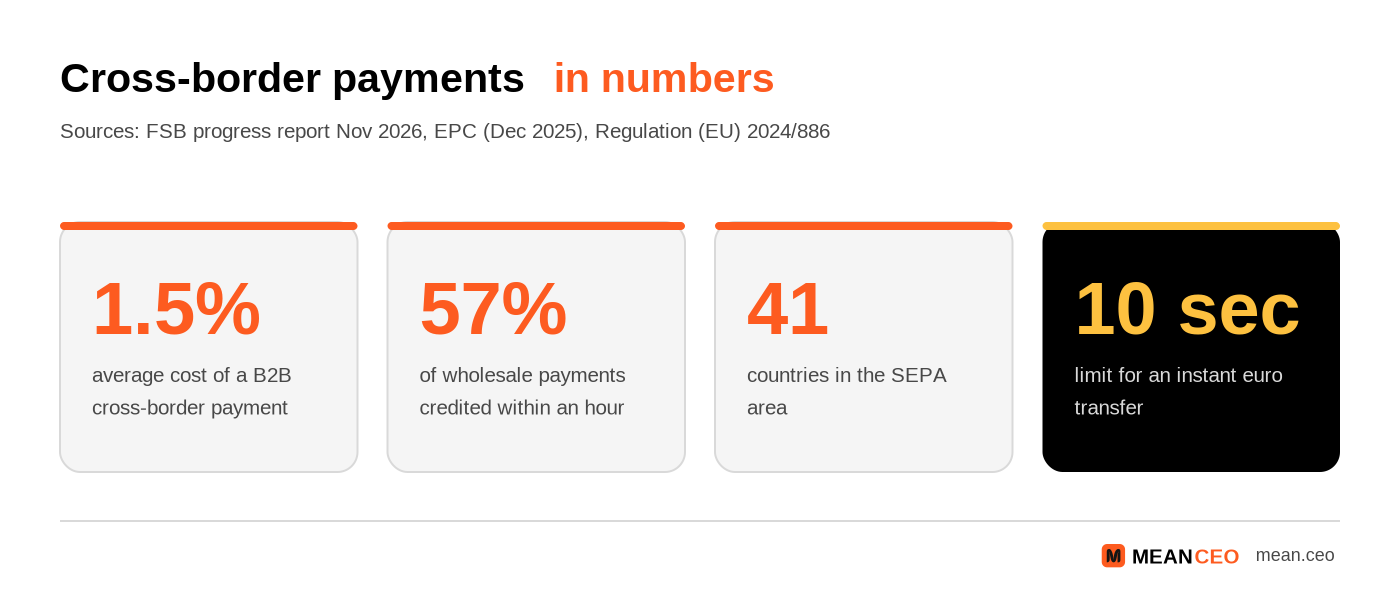
Inside Europe, moving euros is now cheap and fast: SEPA covers 41 countries, a euro transfer to another EU country must cost the same as a domestic one, and euro-area banks must offer instant transfers that arrive within 10 seconds. The real costs hide elsewhere: currency conversion margins, card surcharges and Swift payments outside SEPA, where business payments still cost 1.5% on average worldwide. Map where your money comes from and goes to, pick the cheapest rail for each flow, get local account details for your main currencies, put clear payment terms on every invoice and review fees every quarter.
💡 Planning to sell across Europe? Our European Startup Ecosystem Guide compares the main markets country by country.
Cross-Border Payments for European Startups: A Vital Growth Engine
Cross-border payments for European startups are more than a way to send money abroad: they decide how quickly foreign customers can pay you, how much of each sale you keep, and whether your checkout feels trustworthy. For a bootstrapped startup selling to customers in several countries from the first month, a good setup means lower costs, faster cash and fewer compliance surprises.
The topic matters more now because the rules changed. Since 9 October 2025, every bank in the euro area must be able to send and receive instant euro transfers under the Instant Payments Regulation: the money arrives within 10 seconds, 24 hours a day, on any calendar day, and the fee may not be higher than for a regular transfer. Banks must also check the payee: Verification of Payee tells the payer whether the name matches the IBAN before the money leaves. Banks outside the euro area follow by 9 July 2027, and payment and e-money institutions such as many fintech accounts by 9 April 2027 (non-euro: July 2027).
Business-to-business cross-border payments still cost 1.5% on average worldwide, with no measurable progress since 2023. — Financial Stability Board, G20 progress report, November 2026
Maximize your startup efficiency with optimized cross-border payments.
Ensure your international transactions are cost-efficient and compliant.
👉 Learn about Revolut vs Qonto for cross-border transactions
This guide is about moving and receiving money across borders: the payment rails, the providers, the hidden costs and the rules. If you are still choosing your main business account, see our guide to European startup banking options; for tax, our VAT guide for cross-border EU startups.
Why Cross-Border Payments Are Crucial for Startups
The biggest constraints for European startups dealing with international customers are cost inefficiency and regulatory complexity. Unlike multinationals, startups often lack the in-house resources to manage foreign exchange risks or deal with regional compliance laws. On top of that, the fees charged by traditional banks for cross-border transactions hit smaller businesses disproportionately harder.
The global numbers show why this still matters. The Financial Stability Board, which tracks the G20 targets for cheaper and faster cross-border payments, reported in its November 2026 progress report that progress remains gradual and uneven: business-to-business payments still cost 1.5% on average and business-to-person payments 1.8%, with no measurable improvement since 2023. Only 57% of wholesale cross-border payments are credited within an hour worldwide (69.6% in the euro area), against a G20 target of 75% by the end of 2027. The receiver often pays too: on payments under $500, an average of 1.4%, plus another 0.9% when the money has to be converted.
Here's how cross-border payments solve these issues:
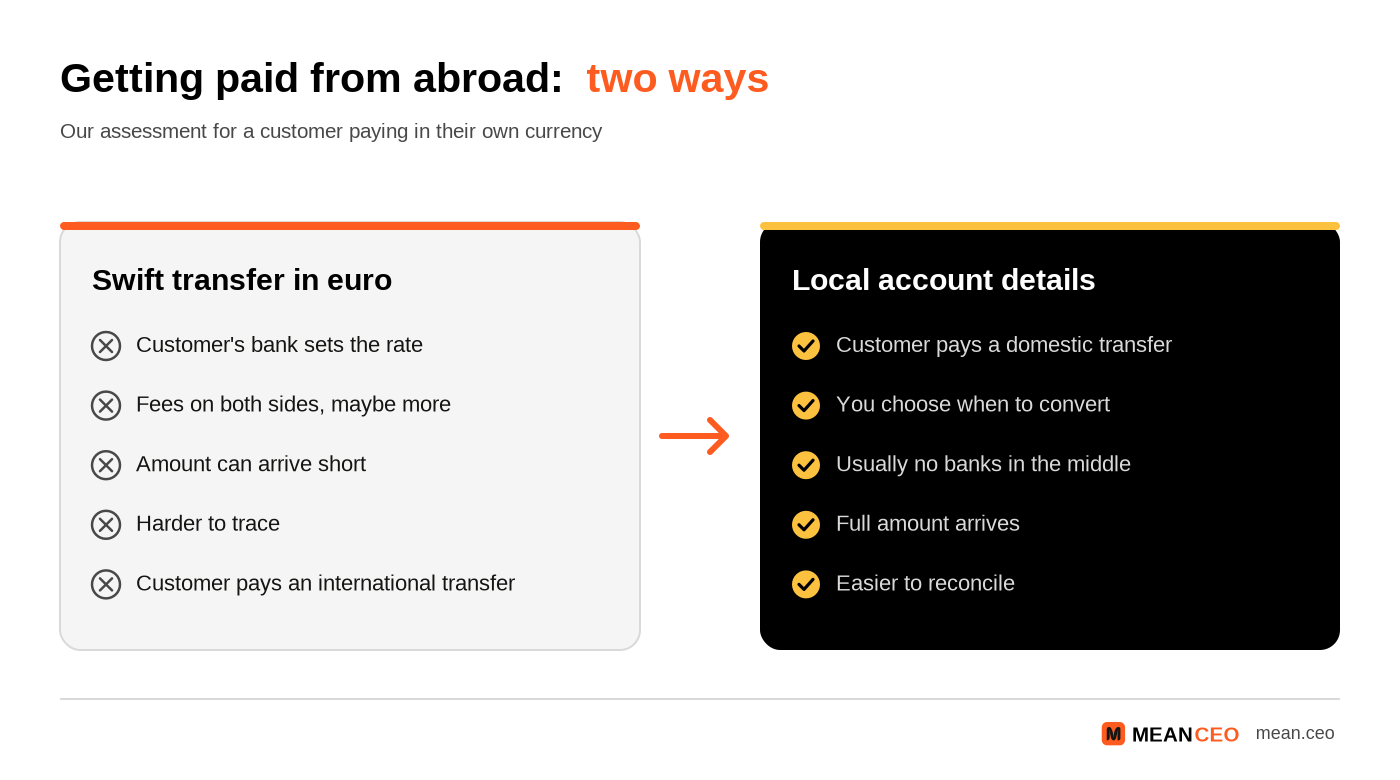
- Fee transparency: specialist providers such as Wise show the fee and the exchange rate before you send, so you can compare the total amount that arrives instead of guessing the bank's margin.
- Rules on your side: EU law caps euro transfer fees at domestic levels and requires instant transfers to cost no more than regular ones, so inside Europe you can get paid fast without paying extra.
- Better cash flow: instant transfers and local account details mean customers pay sooner and you wait less for money stuck between banks. Our guide to cash flow management for first-year founders shows why every day counts.
The Payment Rails: SEPA, SEPA Instant, Swift and Cards
Inside Europe the picture is far better than it was. SEPA, the Single Euro Payments Area, now covers 41 countries: the 27 EU states, Iceland, Liechtenstein and Norway, and 11 others including Switzerland and the UK. Under EU law (Regulation (EU) 2021/1230), a euro transfer to another EU or EEA country must cost the same as a domestic euro transfer of the same value, and Sweden and Romania extended that rule to their own currencies. Before the 2019 reform, the European Commission found that sending €50 from Bulgaria to Finland could cost up to €24.
Outside SEPA, most business payments travel over Swift, the messaging network banks use to send money worldwide. Swift's tracking service (gpi) lets both sides follow a payment end to end. Swift's own data from October 2024 shows that 90% of payments on its network reach the receiving bank within an hour, but only 43% are credited to the final customer within an hour: the last step, at the receiving bank, is often the slow one.
Sources: EPC, Regulation (EU) 2021/1230 and 2024/886, Swift (Oct 2024 data), Stripe Ireland pricing page (checked 19 Nov 2026). Fees change; check your provider's current price list.
The Top Payment Solutions to Consider
Many startups don't know where to start when choosing a payment provider. Here is a breakdown of some leading solutions available in Europe:
- Wise: a multi-currency account regulated in the EEA by the National Bank of Belgium. A business account can hold 40+ currencies and get local account details in 22, so a US customer pays you like a local US payment. Popular with bootstrapped founders for its transparent rates.
- ConnectPay: a Lithuanian e-money institution licensed by the Bank of Lithuania, offering business IBAN accounts, SEPA Instant and Swift payments, FX in 80+ currencies, cards and payment acceptance, with a focus on platforms that embed payments through its API.
- Payoneer: built for getting paid by marketplaces and clients abroad; its European entity is an e-money institution authorised by the Central Bank of Ireland.
- Thunes: a Singapore-based payment infrastructure provider that connects banks, wallets, payment companies and large platforms in 133 countries. Useful to know, but not something a small startup signs up to directly.
Facts from each provider's own pages (checked 19 Nov 2026). Neo-bank accounts such as Revolut Business, Qonto and N26 are compared in a separate guide.
For a detailed comparison of fintech and banking accounts for startups in Europe, see this breakdown of Revolut vs Qonto vs N26, and for the wider market, our look at the European fintech landscape.
How to Implement Cross-Border Payments in Your Startup
Step 1: Audit Your Payment Needs
Evaluate your startup’s business model: Are you shipping physical products or offering services digitally? Are your transactions likely to remain low-volume or do you foresee scaling into high-volume territory?
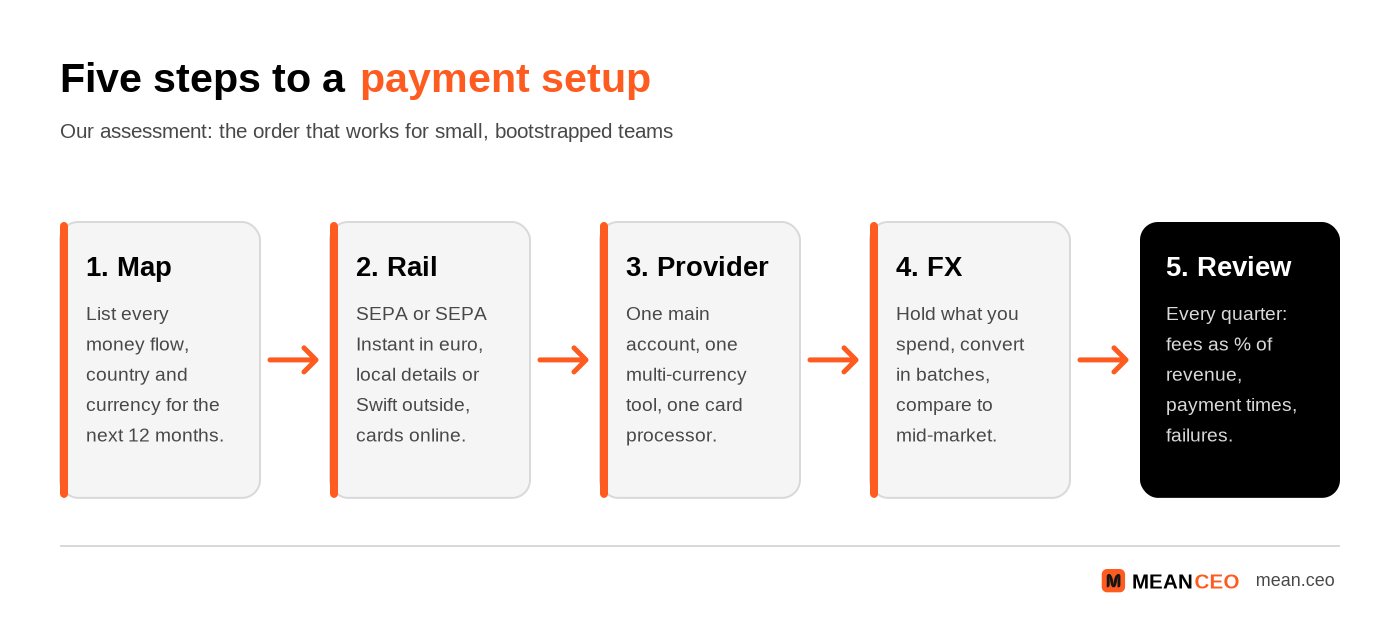
Then write down every money flow for the next 12 months: which countries and currencies customers pay in, which suppliers, freelancers and tools you pay abroad, and roughly how much. That list tells you which rail each flow needs: SEPA or SEPA Instant for euro flows inside Europe, local account details or Swift for customers in the US, UK or Asia, and card or wallet payments for online consumers. If you pay team members abroad, our guide to avoiding payroll errors with international teams covers that flow; Fe/male Switch's checklist to audit your startup's payment infrastructure helps you review the rest.
Step 2: Focus on Regulatory Mastery
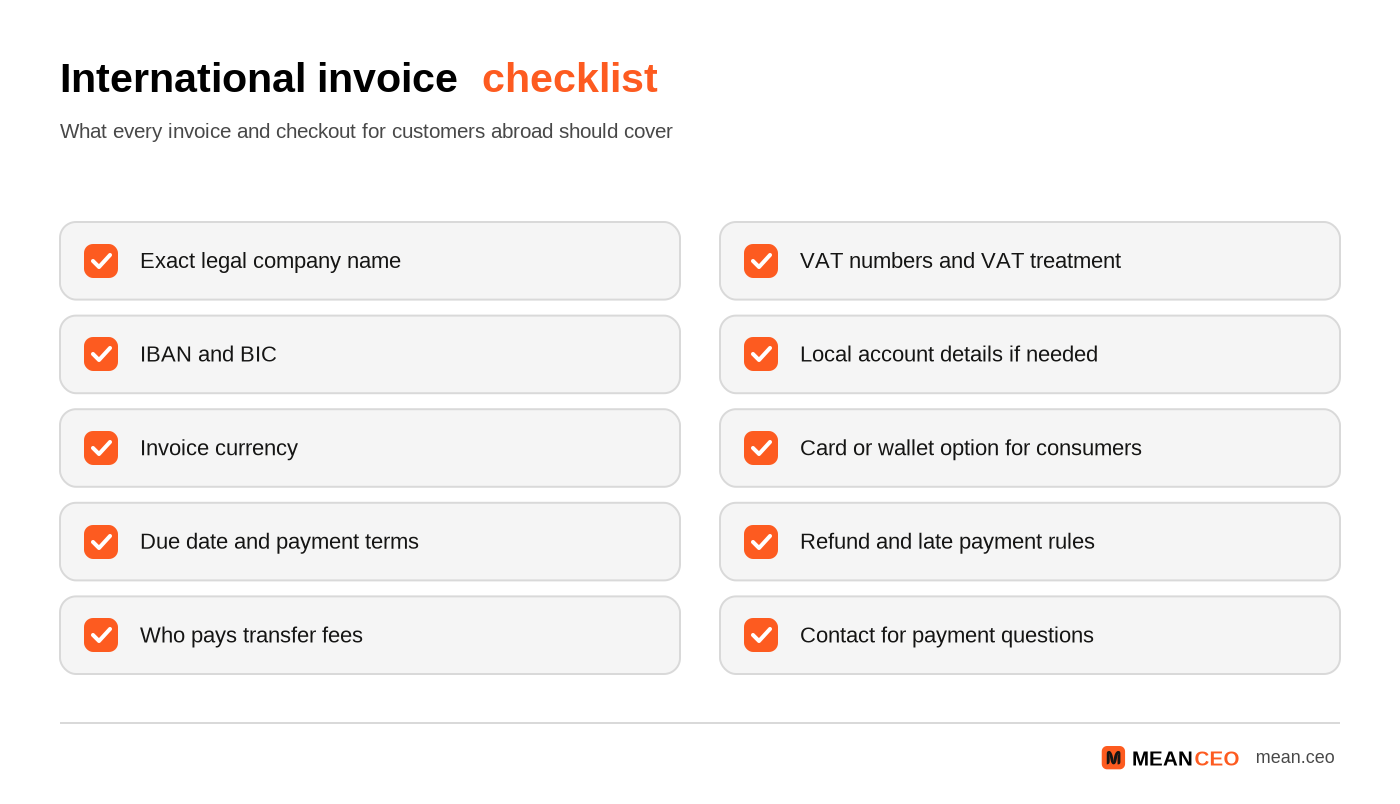
Compliance can make or break international transactions. Expect your provider to verify your company and its owners before you can send or receive money, and keep the documents ready. Put your exact legal company name and IBAN on every invoice: since Verification of Payee, a customer's bank warns them if the name doesn't match, and a warning makes people hesitate to pay. For EU-based startups, VAT is the other critical challenge, and missteps lead to penalties; explore our VAT optimization strategy for cross-border e-commerce. Your terms of service should also state the currency, payment terms and refund rules.
Sources: EUR-Lex (Regulations 2023/1113, 2023/1114, 2024/886, 2024/1624), Swift, European Commission. The new Payment Services Regulation and PSD3 were agreed in November 2025 and adopted by the Council in October 2026; the final steps were still pending on 19 November 2026.
Step 3: Build for Scalability
Choose payment providers that scale easily as your business grows: an API or a direct link to your accounting tool, batch payouts, more currencies, and separate user permissions for your team. ConnectPay, for example, offers API integration for SaaS companies and platforms that need embedded payments. Our startup tool stack guide shows how payments fit with the rest of your tools.
Step 4: Control Currency Costs
Currency conversion is where most of the money disappears. The FSB found that receivers pay an extra 0.9% on average when a small payment has to be converted, and card processors add their own fee: Stripe Ireland charges 2% on top when conversion is required.
Our assessment. The simplest hedge is a natural one: hold the currencies you also spend in (for example, receive dollars and pay your US software bills from them) and convert the rest in planned batches. Pricing in the customer's currency can lift conversion; our guide to pricing strategy for bootstrapped SaaS explains how to set prices per market.
Step 5: Make It Easy to Pay You
Every invoice should show your legal company name, IBAN and BIC, the currency, the due date and who pays the transfer fees. Offer the payment methods your customers already use: SEPA transfers for European B2B clients, local account details for clients in other currencies, and cards or wallets for consumers.
Then review the setup every quarter: total fees as a share of revenue, how long payments take to arrive, and failed or returned payments. A provider that was right for your first 20 customers may not be right for your first 2,000.
Mistakes Founders Often Make (and Solutions)
- Undervaluing cost transparency: comparing the advertised fee instead of the total amount that arrives. Check the rate against the mid-market rate and include receiving fees.
- Neglecting compliance: opening accounts at the last minute. Onboarding checks take time, so open a multi-currency account before the first foreign customer pays.
- Overcomplicating setups: five accounts that nobody reconciles. One main business account plus one tool for foreign currencies and one card processor covers most early startups.
- Pricing only in euro: foreign customers then pay conversion fees on their side and may drop out at checkout. Test local-currency prices in your biggest non-euro markets.
- Unclear payment terms: invoices without currency, due date or fee split lead to short payments and awkward reminders.
"Every euro saved in transaction costs is a euro reinvested into growth. That’s how bootstrapped startups scale." — Violetta Bonenkamp
Boost Your startup margins by optimizing VAT compliance.
Master cross-border invoicing challenges with tailored strategies.
👉 Master VAT Simplifications
Closing Thoughts: Building Towards Sustainable Scalability
Payment solutions might seem like a back-office necessity, but the right setup directly influences your cash flow, customer trust and ability to sell abroad. Inside Europe, the rules now work for you: use SEPA and SEPA Instant, get local account details for your main foreign currencies, and keep an eye on conversion costs. For bootstrapped startups, every small improvement compounds over time.
Selling in several countries also means company, tax and contract rules in each of them; our startup legal checklist by country shows what to check before your first foreign invoice, and the European Startup Ecosystem Guide helps you choose markets.
Stablecoins are regulated in the EU under the Markets in Crypto-Assets Regulation (MiCA): the stablecoin rules applied from 30 June 2024 and the rest from 30 December 2024. Issuers need an EU licence; Circle, for example, issues USDC and EURC through its French e-money institution. Major exchanges removed trading in non-compliant stablecoins such as USDT for EEA users in March 2025.
Boost Your SEO by Sharing Unique Insights.
Optimized founder content can rank on platforms like Google, ChatGPT, and more. More and more traffic is coming from Perplexity, ChatGPT, Grok and other AI tools.
👉 Rank on ChatGPT
People Also Ask:
What is the purpose of cross-border payments?
They move money between countries: paying suppliers, getting paid by foreign customers, paying remote team members and receiving investment. For a startup, they decide how much of each foreign sale actually reaches your account and how quickly.
Is CIPS an alternative to SWIFT?
Partly. CIPS, China's Cross-border Interbank Payment System, launched in October 2015 to clear and settle renminbi payments. As of September 2026 it had 214 direct and 1,651 indirect participants, 271 of them in Europe. It competes with Swift for renminbi payments, but most of the world's cross-border payments still run over Swift messaging. It matters to you only if you trade in renminbi.
What is the 'holy grail' of cross-border payments?
Payments that are instant, cheap, available everywhere and transparent. The G20 turned this into targets for the end of 2027: retail cross-border payments at no more than 1% on average and 75% of payments credited within an hour. The FSB's November 2026 report shows the world is not on track: average business payments still cost 1.5%.
Is XRP necessary for cross-border payments?
No. Ripple's payment network can settle using XRP or its RLUSD stablecoin, but most cross-border business payments run over bank rails, card networks and payment providers, and there is no independent evidence that banks widely use XRP as a bridge currency. The US SEC case against Ripple ended in August 2025.
How do cross-border payments impact European startups led by women?
The same way they affect any small team: fees and slow settlement eat into thin margins. Because women-led startups in Europe receive only a small share of venture capital, many grow on revenue, so keeping more of each international payment matters even more.
What challenges do startups face in cross-border transactions?
Hidden FX margins, fees on both sides of a Swift payment, slow settlement outside SEPA, onboarding checks (KYC) when opening accounts, and VAT and invoicing rules that differ by customer type and country.
Are blockchain-based systems solving cross-border payment issues?
For a few use cases. MiCA-compliant stablecoins can settle in minutes, but you still pay to convert in and out of euro, your customer must be set up for it, and accounting and tax add work. For most European startups, SEPA Instant already solves speed inside Europe.
Why should startups prioritize cost-effective payment methods?
Because fees come straight off your margin. If an international customer pays by card with conversion, Stripe Ireland's list price is 3.15% + €0.25 plus 2%; a SEPA transfer of the same invoice can cost you little or nothing.
Which industries benefit most from cross-border payment solutions?
E-commerce, SaaS, marketplaces, agencies and remote services: anyone who sells to customers or pays suppliers and freelancers in other countries from the first month.
How does regulation influence cross-border payments for SMEs?
Heavily, and mostly in your favour: EU rules cap euro transfer fees at domestic levels, make instant transfers cheap and checked, and protect you with Verification of Payee. In return, providers must check who you are (KYC and AML), so keep your company documents ready.
What can female entrepreneurs do to expand cross-border capabilities?
Open a multi-currency or local-details account before the first foreign customer, put clear payment terms on every invoice, price in the customer's currency where it helps conversion, and review fees every quarter. Founder communities and accelerators are a good place to compare providers with peers.
FAQ on Cross-Border Payments for European Startups
What are cross-border payments, and why are they important for startups?
Payments between countries, often in different currencies. For a startup they decide how fast you get paid by foreign customers, how much you lose to fees and FX margins, and whether customers trust your checkout.
How does fee transparency benefit growing startups?
You can price correctly. Compare the total amount that arrives against the mid-market rate, not the advertised fee. In the EU, euro transfers must cost the same as domestic ones, so most surprises come from conversions, card surcharges and Swift payments outside SEPA.
Are stablecoins a viable solution for international payments?
Sometimes, if both sides are set up for it. Under MiCA, only licensed issuers' stablecoins (for example USDC and EURC) can be offered to EU users. Add the cost of converting in and out of euro and the accounting work before you decide. For an example of the product pitch, see this piece on Due's stablecoin API.
What role does compliance play in cross-border payments?
Providers must verify your company and its owners (KYC) and monitor payments for money laundering. Have your registration documents, ownership details and a short description of your money flows ready, and expect stricter checks when the EU Anti-Money Laundering Regulation applies from 10 July 2027.
Which fintech options are best for startups with limited resources?
Usually a multi-currency account with local account details (such as Wise Business) plus your normal business account, and a card processor if you sell online. Thunes and similar infrastructure providers serve banks and large platforms, not small startups.
How can startups reduce the risks of currency fluctuations?
Hold balances in the currencies you also spend in, invoice in euro where customers accept it, keep payment terms short, and convert large sums in planned batches. Some providers can fix a rate for a period; ask yours what it offers and at what cost. Our assessment: for most early startups, natural hedging is enough.
Is VAT compliance a major obstacle in cross-border payments?
It is separate from the payment itself but just as important. Since 1 July 2021, the VAT One Stop Shop lets you report EU consumer sales above the €10,000 EU-wide threshold in one return. Our VAT guide for cross-border EU startups explains the rules.
What does scalability mean for cross-border payment solutions?
That the setup still works at ten times the volume: an API or integration with your accounting tool, batch payouts, more currencies and users with their own permissions, without changing providers in the middle of growth.
How is trust built with international customers during transactions?
Show prices in their currency, offer the payment methods they know, put your legal company name and IBAN clearly on the invoice so Verification of Payee shows a match, and use a regulated provider. Our guide to designing for trust in fintech covers the product side.
Are there EU-specific supports for startups adopting cross-border payments?
There is no EU grant for payment tools; the support comes through regulation: domestic-level euro transfer fees, instant transfers at no extra cost and payee checks. Some countries make it easier to run an EU company online, such as Estonia's e-Residency programme.
How do female entrepreneurs approach cross-border payment challenges?
Like any founder with a tight budget: they keep the setup simple, compare total costs and lean on peers for provider tips. Fe/male Switch collects useful tools in its resources for female entrepreneurs.
About the Author
Violetta Bonenkamp, also known as MeanCEO, is an experienced startup founder with an impressive educational background including an MBA and four other higher education degrees. She has over 20 years of work experience across multiple countries, including 5 years as a solopreneur and serial entrepreneur. Throughout her startup experience she has applied for multiple startup grants at the EU level, in the Netherlands and Malta, and her startups received quite a few of those. She’s been living, studying and working in many countries around the globe and her extensive multicultural experience has influenced her immensely.
