
Revenue diversification for startups: when to add a second stream
Revenue diversification means earning from more than one product, customer group, channel or market, so that losing one of them doesn't sink the business. For a startup it is a timing question more than a strategy question. Add a stream too early and you split a small team's attention; add it too late and one lost client or one algorithm change can wipe out half your income.
Quick answer: diversify when your core offer already sells and one customer, channel or product brings in an uncomfortable share of revenue (a common warning line is about a quarter). Start with the streams closest to what you already sell, such as upsells, add-ons and services for existing customers, and test each one for 30 days before you commit people or money to it.
Write FREE SEO-optimized Blog Articles! Our Article Writer ensures your blog is loved by both Google and your readers, turning those clicks into customers.
👉 Write your article here
When diversifying revenue helps, and when it hurts
Diversification protects you against concentration: too much revenue from one place. That risk is serious enough that US accounting rules make public companies disclose any single customer that brings in 10% or more of revenue (ASC 280-10-50-42, explained in Deloitte's segment reporting roadmap). Investors and acquirers read the same signal in a startup: if one client pays half your bills, they price in the day that client leaves.
But for an early startup, a second stream is often a distraction dressed up as safety. If your main product isn't growing yet, a new stream won't fix that. It halves the time you spend finding out why. Run these four checks first:
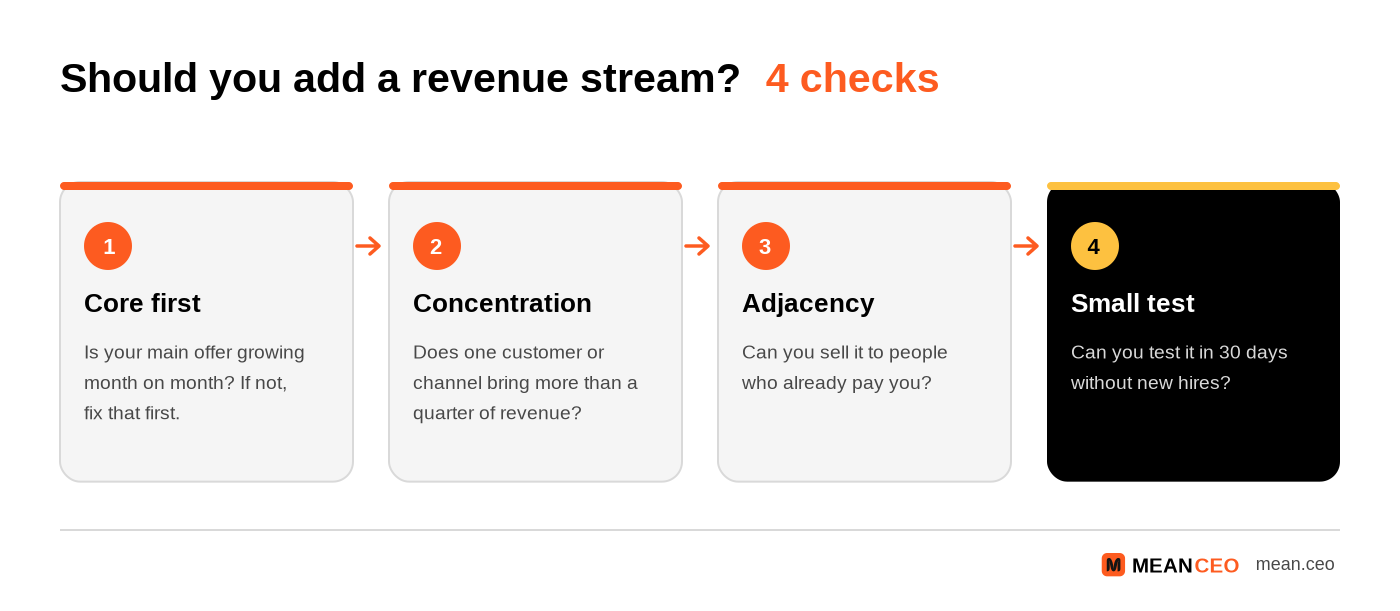
- Is the core growing? If your main offer isn't growing month on month, work on that first: pricing, positioning or the channel.
- How concentrated are you? Work out the share of revenue from your largest customer, your largest channel and your largest product. A share above about a quarter is a good reason to act.
- Is it adjacent? The best second stream is something people who already pay you would also buy.
- Can you test it small? If it needs a new hire, a new entity or months of building before the first sale, it isn't a test.
7 ways to diversify revenue streams, ranked by risk
In 1957, H. Igor Ansoff set out four growth paths in his Harvard Business Review article "Strategies for Diversification": sell more of what you have to the same market, take it to new markets, develop new products, or diversify into new products for new markets. The further you move from what you already sell and who you already sell to, the higher the risk. The options below follow that order, from the safest to the riskiest.
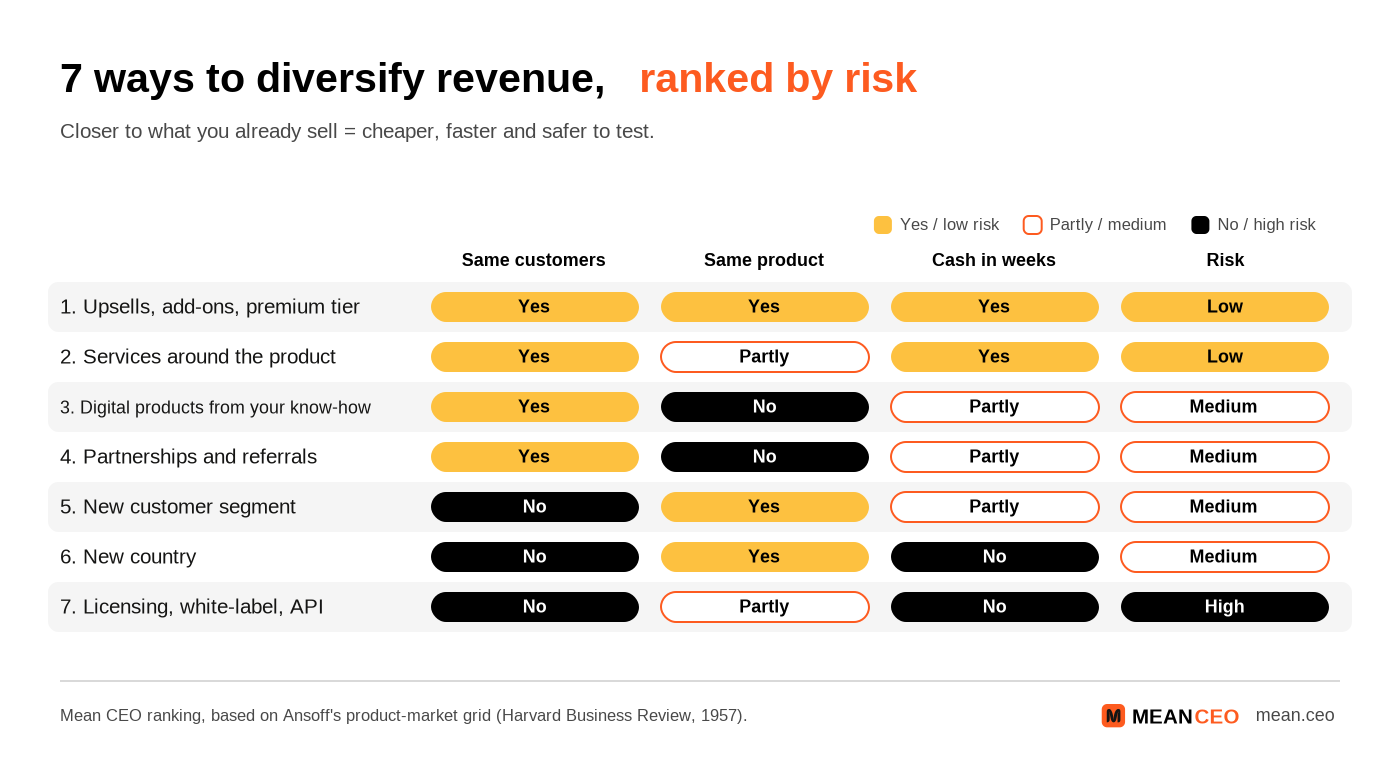
1. Upsells, add-ons and a premium tier
Sell more to customers who already trust you: a higher plan, extra seats, an add-on feature or priority support. It's the cheapest stream to test because there's no new audience to find. Our guide to expansion revenue with upsells and cross-sells covers how to price and time the offer.
2. Services around the product
Setup, onboarding, training, audits or done-for-you work. Services bring cash in weeks and teach you what customers struggle with. The risk is that they eat the time you need for the product, so price them to be worth it and cap the hours. See building revenue before the product for the service-to-product path.
3. Digital products from your know-how
Templates, a paid guide, a course or a paid community built on what you've learned serving your customers. Low marginal cost, but they only sell if you already have an audience that trusts you.
4. Partnerships and referrals
Referral fees or revenue share from tools your customers already need. Only recommend products you'd use yourself, and tell readers when you earn a fee. It's rarely big money for a young startup, but it costs little to set up.
5. A new customer segment
The same product for a different buyer: freelancers instead of agencies, or schools instead of companies. You'll need new messaging and often a different pricing model, so test the segment with a landing page and a few sales calls before changing the product.
6. A new country
For European startups, a second country is a natural step, but it means language, local payment methods, VAT and sometimes local support. Test it with one channel and one language before translating the whole product.
7. Licensing, white-label or API access
Letting other companies resell or build on your product can bring large contracts, but sales cycles are long, contracts are complex, and one big licensee can create the very concentration you were trying to avoid.
Worked example: checking your revenue concentration
Here is how to run the concentration check on your own numbers. The figures below are an illustration, not a real company: a small B2B software startup with €12,000 in monthly revenue.
Example figures for illustration only. The 10% single-customer threshold comes from ASC 280-10-50-42; the quarter-of-revenue warning line is a common rule of thumb, not a standard.
In this example, the right move isn't a new product. It's to win more mid-sized clients so the largest one drops below about a quarter, and to package the setup services into a fixed-price offer for every new client. Track it monthly in your cash flow plan, next to your retention metrics.
Mistakes founders make when they diversify
- Diversifying instead of fixing the core. A second stream won't rescue a first one that nobody wants.
- Confusing personal investments with company revenue. Rental income or a stock portfolio may diversify your income, but it does nothing for the startup's dependence on one client or channel.
- Launching three streams at once. Add one, measure it for a full quarter, then decide on the next.
- Ignoring margins. Services can grow revenue while shrinking profit if they're priced like a favour.
- Forgetting channel concentration. Ten products that all sell through one marketplace or one search engine are still one stream of risk.
- Not paying yourself. Founders often add side income because the startup can't pay them. Plan a pre-revenue founder salary instead of hiding the problem.
If a new stream works better than the core, that's a signal too. Some founders end up pivoting from services to product, or the other way round.
Validate your business idea in the Fe/male Switch Sandbox! Test, experiment, and pivot your way to success, all in a risk-free environment with an AI Co-Founder.
FAQ on revenue diversification
What is revenue diversification?
Revenue diversification means earning from several products, customer groups, channels or markets instead of depending on one. The aim is that losing any single source doesn't threaten the business.
When should a startup diversify its revenue streams?
When the core offer already sells and grows, and one customer, channel or product brings in a large share of revenue. Before that point, most startups are better off focusing on the main offer.
What is the safest way to diversify revenue?
Sell more to the customers you already have: upsells, add-ons, a premium tier or services around the product. They need no new audience and can be tested in weeks.
How many revenue streams should a startup have?
There's no right number. Most early startups do well with one core stream and one adjacent stream. What matters more is that no single customer or channel dominates.
What is revenue concentration?
It's the share of your revenue that comes from your largest customer, channel or product. US public companies must disclose any customer that brings in 10% or more of revenue, which shows how seriously investors take it.
Is diversifying income the same as diversifying revenue?
No. Diversifying income usually means a person's own earnings, such as a side business or investments. Revenue diversification is about the company's sources of sales. A founder can need both, but they solve different problems.
Can diversification hurt a startup?
Yes. Each new stream takes time, money and attention. Adding streams too early, or too far from what you already sell, often slows growth of the core product.
How do I test a new revenue stream?
Offer it to existing customers first, with a price, for about 30 days, and decide in advance how many sales count as a pass. Only build or hire for it once it passes.
About the Author
Violetta Bonenkamp, also known as MeanCEO, is an experienced startup founder with an impressive educational background including an MBA and four other higher education degrees. She has over 20 years of work experience across multiple countries, including 5 years as a solopreneur and serial entrepreneur.
