B2B2C for consumer brands: how to sell through shops, employers and partners without losing your margin
B2B2C (business-to-business-to-consumer) means you sell to a business, and that business gets your product to the consumer: a shop stocks it, an employer offers it as a benefit, a company buys it as a gift, or a partner sells it under its own name. For a consumer brand it's the usual way to add business revenue without abandoning your customers. Big-company definitions are easy to find; what small brands need is the channel choice, the price math and the contract terms.
Quick answer: pick one B2B2C channel that matches your product (wholesale to shops for physical products, employer or insurer benefits for health and wellbeing, corporate gifting for giftable goods, licensing for a strong design or method). Set your wholesale price at about half your retail price and make sure that still leaves you a healthy margin over your unit cost. Agree minimum orders and payment terms in writing, and test one channel before you open the next.
Write FREE SEO-optimized Blog Articles! Our Article Writer ensures your blog is loved by both Google and your readers, turning those clicks into customers.
👉 Write your article here
What B2B2C looks like for a women-focused brand
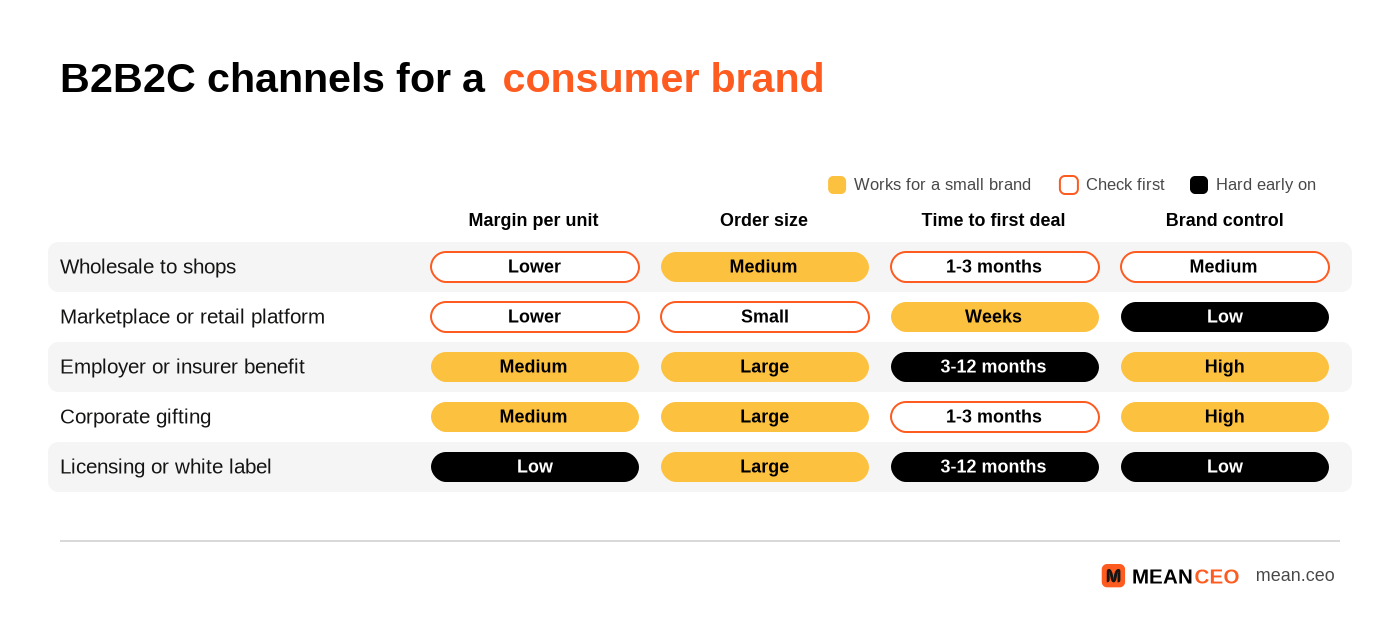
The business in the middle changes who you sell to, how long the sale takes and how much you keep. Five common channels:
Source: Mean CEO comparison; examples are illustrations, not real companies. If you're still deciding whether a second revenue stream makes sense at all, start with our guide to revenue diversification for startups. Selling software or services to businesses rather than a consumer product? Our guide to design partners shows how to validate a B2B idea with three to five early customers before you build.
Wholesale vs retail pricing: the math that decides if B2B2C works
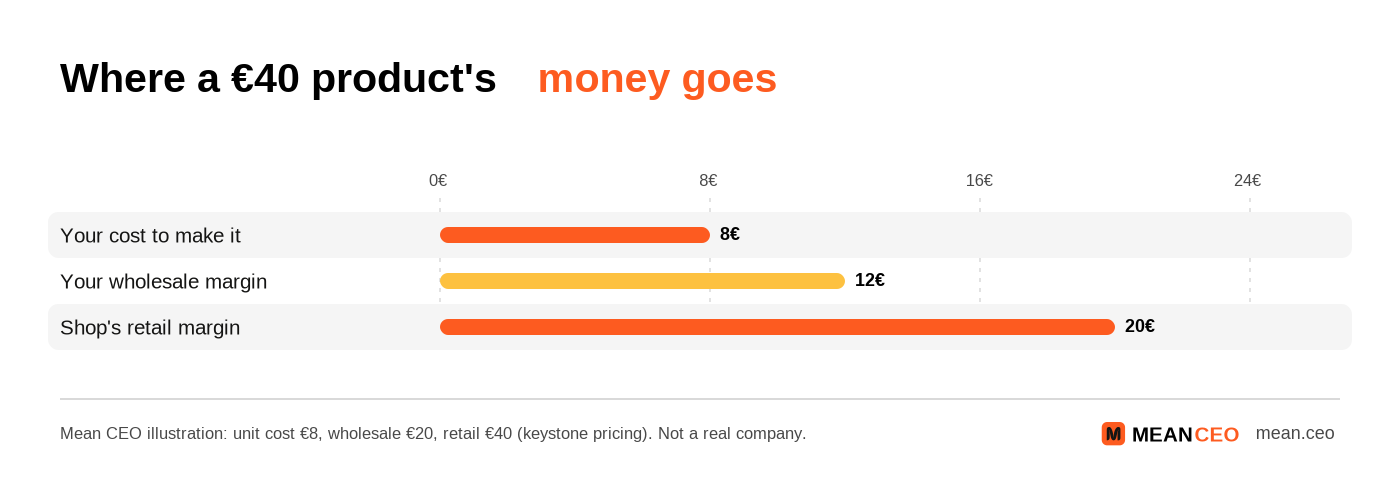
Wholesale price is what the shop pays you. Retail price is what the consumer pays the shop. A common rule of thumb in retail, called keystone pricing, is that shops sell at about twice the wholesale price. Work backwards from the retail price you want, not forwards from your cost.
Source: Mean CEO illustration with round numbers, not a real company. The wholesale pricing formula behind it: wholesale price = retail price ÷ 2, then check (wholesale price − unit cost) ÷ wholesale price. If that margin is thin, raise the retail price, cut the unit cost or don't wholesale yet. Keep your own online price at the same retail level, or shops won't stock you.
For pricing your direct offer first, see how to optimise pricing strategies; for upsells to existing customers, our guide to expansion revenue.
How to get your product into stores and other B2B2C channels in 6 steps
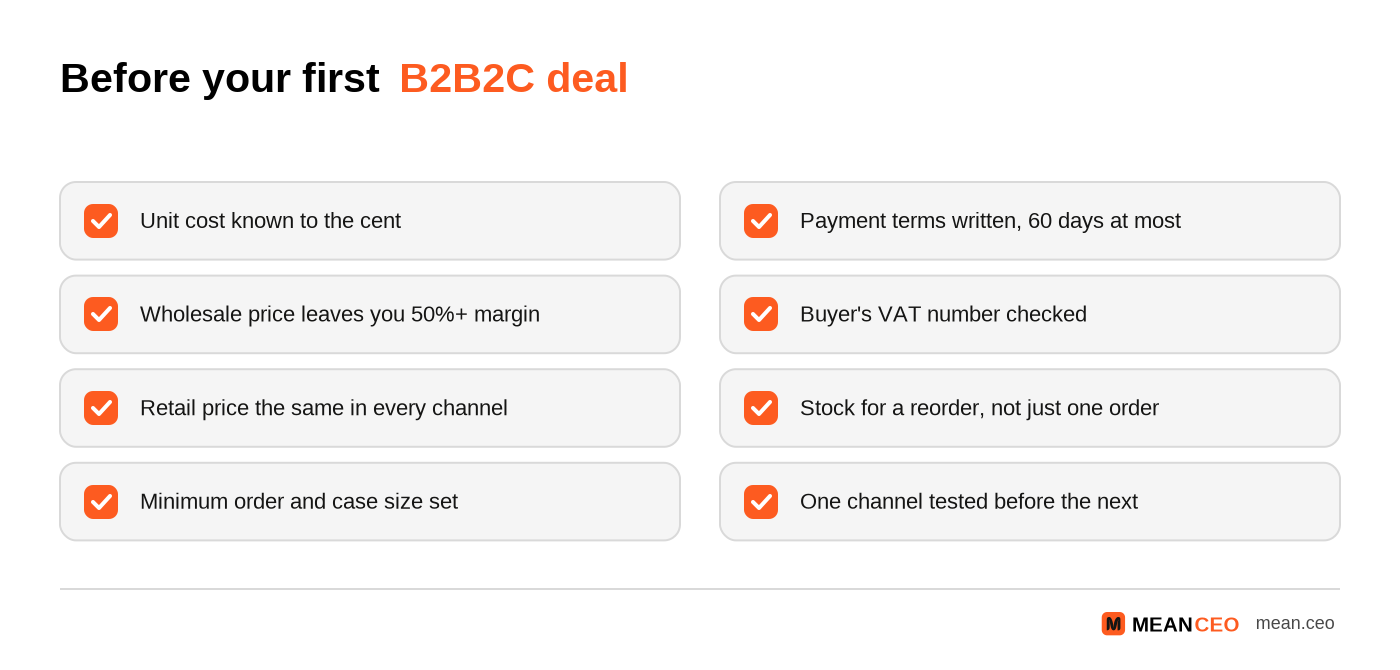
- Pick one channel. Match it to the product: repeat-purchase goods to shops, services that improve health or retention to employers, giftable goods to companies. One channel done well beats five half-started.
- Fix the numbers. Unit cost, retail price, wholesale price, minimum order, case size and delivery cost per order. If the margin doesn't work at 24 units, it won't work at 2,400.
- Make a sales kit. A one-page line sheet (products, photos, wholesale and retail prices, minimum order, lead time), proof that consumers buy it (sales, reviews, repeat rate) and a short reason why it sells in their shop or helps their staff.
- Start with ten targets you can visit or call. Independent shops near you, two or three HR managers in your network, local companies that send gifts. Sell in person before you pay a trade show or a distributor.
- Write the terms down. Price, payment terms, delivery, returns, exclusivity and how long the deal runs. Employers and insurers will also ask about data protection and contracts; prepare for a longer sales process with our objection handling framework for B2B sales.
- Measure the reorder. A first wholesale order proves a buyer believed you; a reorder proves consumers bought it from the shelf. Decide whether to expand the channel only after the second order.
For fulfilment as orders grow, see our list of 3PL providers for ecommerce brands, and to test a physical product with consumers before pitching shops, see product testing platforms for CPG brands.
B2B terms that matter in the EU
- Payment terms. Under the EU Late Payment Directive, payment periods between businesses are, as a general rule, limited to 60 calendar days; longer periods must be expressly agreed and must not be grossly unfair to the supplier. Small brands should still ask for 30 days or payment on the first order up front.
- VAT on cross-border sales. When you sell goods to a VAT-registered business in another EU country, check the buyer's VAT number in the European Commission's VIES VAT number validation service and keep the result with the invoice; the VAT treatment differs from a sale to a consumer.
- Exclusivity. A shop or partner may ask to be the only stockist in an area. Limit it by area and time, and tie it to minimum orders.
- Returns and unsold stock. Agree in writing whether unsold stock can be returned. Sale-or-return deals look easy but leave you carrying the risk.
B2B2C mistakes to avoid
- Pricing wholesale from your cost. Cost plus a markup often gives a wholesale price that makes the shelf price too high or your margin too thin. Start from the retail price.
- Undercutting your stockists online. If your own shop is cheaper than theirs, they stop reordering.
- Saying yes to long payment terms. A large order paid in 90 days can empty a small brand's bank account. Price the wait in, or say no.
- Treating a corporate buyer like a consumer. HR and procurement buy on budget, risk and evidence, not on brand love. Bring numbers and references.
- Running too many channels at once. Every channel needs its own sales kit, terms and follow-up. Win one, then add the next.
- Forgetting the consumer. B2B2C still depends on the end customer choosing your product. Keep talking to them, and keep selling direct if you can.
Dreaming of startup success but too scared to get started?
Join the Fe/male Switch women-first startup game and turn that dream into your reality. With tailored guidance, support networks, and a plethora of resources, we'll nurture your ascent to the startup stratosphere! And we have AI co-founders, PlayPals!
Join F/MS now.
FAQ on B2B2C
What is B2B2C?
Business-to-business-to-consumer: you sell to a business, and that business delivers your product to the consumer, for example a shop stocking your product, an employer offering your service as a benefit or a partner selling it under its own name.
What is the difference between B2B2C and B2C?
In B2C you sell directly to the consumer and keep the full price. In B2B2C a business sits in the middle: you get reach, bigger orders or a trusted channel, and you give up part of the price and some control over how the product is presented.
What is the difference between wholesale and retail pricing?
Wholesale price is what a shop pays you; retail price is what the consumer pays the shop. A common rule of thumb is that retail is about twice wholesale, so the shop keeps about half.
How do I calculate my wholesale price?
Divide your target retail price by two, then check your margin: (wholesale price minus unit cost) divided by wholesale price. If it's too low for your business, raise the retail price, lower your cost or wait before wholesaling.
How do I get my product into stores?
Start with independent shops that already sell to your customers. Bring a one-page line sheet with wholesale and retail prices, minimum order and lead time, plus proof that consumers buy the product. Ask for a small opening order and follow up for the reorder.
Can a service business use B2B2C?
Yes. Coaching, health, learning and care services are often sold to employers, insurers or schools, who offer them to their staff, members or students. Expect a longer sales process and questions about data protection and results.
What payment terms should I offer business buyers?
Ask for payment up front on the first order and 30 days after that. In the EU, payment periods between businesses are generally limited to 60 days unless expressly agreed otherwise, and longer terms must not be grossly unfair to you.
Is B2B2C a good idea for an early-stage startup?
Only once you know consumers buy the product and your margin can survive giving half the price to a partner. Before that, sell direct and learn; then test one B2B2C channel with a small number of buyers.
About the Author
Violetta Bonenkamp, also known as MeanCEO, is an experienced startup founder with an impressive educational background including an MBA and four other higher education degrees. She has over 20 years of work experience across multiple countries, including 5 years as a solopreneur and serial entrepreneur.
