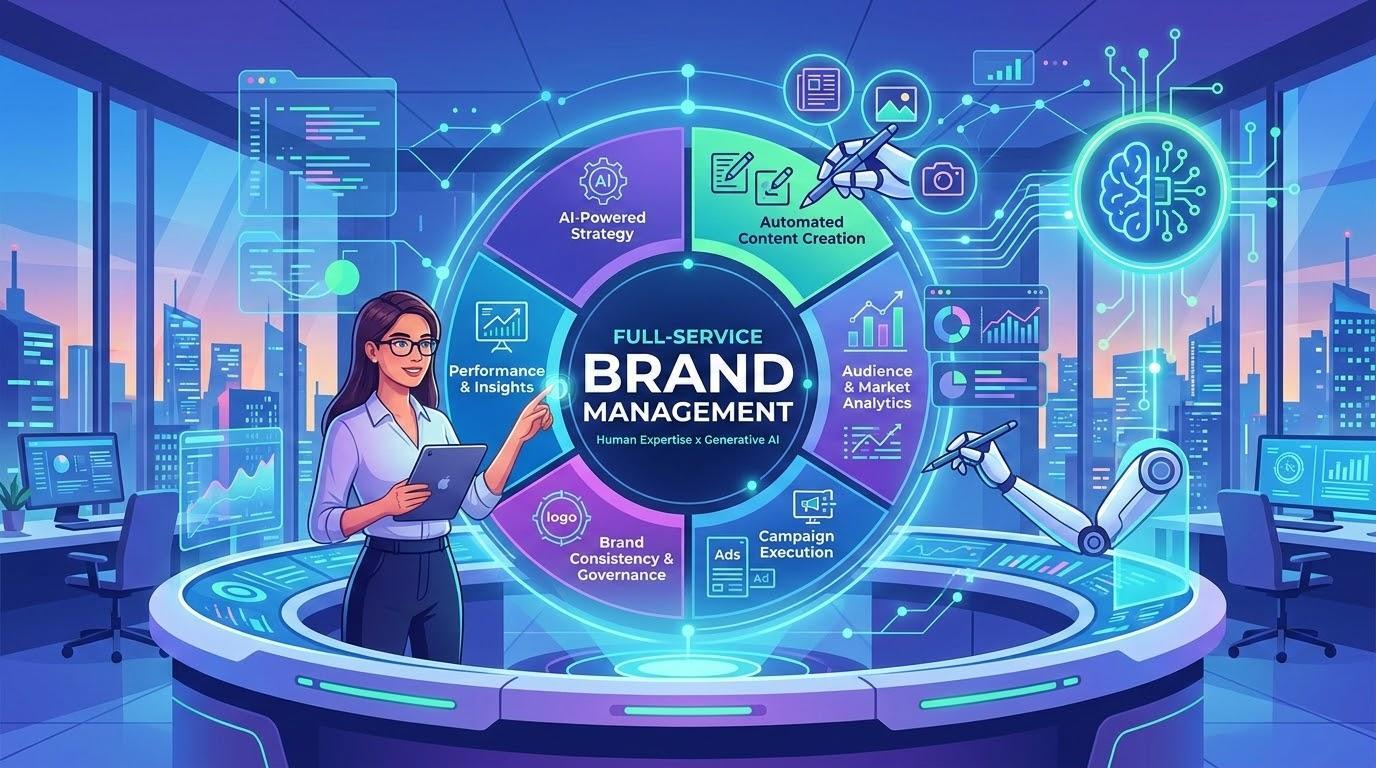
Generative AI is redefining how brands are built, protected, and scaled. From real-time market intelligence and dynamic positioning models to automated visual systems and ethical governance frameworks, organizations must adapt their brand management services or risk falling behind. This shift raises critical questions about consistency, creativity, and control.
AI-Driven Brand Strategy
AI-driven brand strategy uses tools such as Brandwatch and Sprinklr, alongside custom LLMs, to process 50,000-plus social mentions daily and generate positioning recommendations within 15 minutes. This replaces rigid annual planning cycles with systems that adapt to market signals as they emerge. Full-service brand management teams can now maintain alignment between brand identity and audience expectations at every touchpoint.
Brand strategy operates as a living framework that incorporates real-time data feeds from multiple channels. Predictive models surface opportunities and risks before they become obvious to competitors. Teams can test messaging variations and push changes across platforms within hours rather than weeks.
The shift toward AI-powered branding means organizations can maintain consistent brand guidelines while responding to cultural moments and competitive moves. Large language models analyze patterns across conversations, reviews, and search behavior to inform strategic decisions. This continuous feedback loop strengthens brand positioning and keeps visual identity systems relevant to current market conditions.
Agile branding practices emerge when teams combine generative design tools with performance analytics. Stakeholders receive updated recommendations based on actual engagement data rather than assumptions. The result is a messaging framework that evolves without losing core brand voice or visual consistency.
Real-Time Market Intelligence
Real-time market intelligence is the practice of continuously aggregating competitor data, audience sentiment, and search behavior to inform brand decisions as conditions change, rather than on a quarterly or annual basis.
Crayon aggregates 200-plus data sources, including G2 Crowd reviews, App Store ratings, and SEC filings, to deliver daily competitive briefings with 94 percent accuracy on pricing changes. It forms one part of a broader intelligence system that informs competitive analysis across the brand management workflow.
Teams rely on several specialized platforms to maintain current market understanding:
- Crayon for competitor tracking at $1,200 monthly
- Brandwatch Consumer Research for sentiment volume tracking, processing 1.2 million posts daily
- AlphaSense for earnings call analysis
- Google Trends API for search volume shifts
- SimilarWeb for traffic source monitoring
Unilever identified a 34 percent drop in sentiment within six hours of a product recall using Brandwatch alerts. That rapid detection allowed the company to activate crisis communication protocols and adjust messaging before broader reputation damage occurred. Real-time market intelligence supports proactive reputation management rather than reactive responses.
Dynamic Positioning Models
Dynamic positioning deploys Klue's battlecard system, which auto-updates value propositions when competitors change their messaging, reducing repositioning cycles from six months to three weeks. This acceleration comes from automation that removes manual research bottlenecks from the brand strategy process.
Positioning adjustments now respond to specific triggers detected through integrated data systems:
- Competitor feature launches tracked via Klue
- Search query shifts from Semrush data showing 15 percent or greater volume changes
- Review sentiment drops exceeding 20 points on Trustpilot
- New market entrants identified by CB Insights
A typical three-week sprint begins with data aggregation across all monitoring tools during week one. Week two focuses on positioning testing through A/B headlines across digital channels. Week three moves into implementation across website content and sales materials, with updated brand guidelines distributed to all teams.
Iterative design sprints, supported by generative AI, enable brands to maintain consistency while adapting to market conditions. Continuous optimization becomes standard practice. Teams use performance analytics to validate positioning changes and refine approaches based on measurable outcomes.
Generative Content Systems
Generative content systems combine Jasper and Copy.ai to produce 40-plus brand-compliant assets weekly while enforcing tone consistency through custom brand voice training on 50,000 words of approved content. These platforms help full-service brand management teams maintain output at scale.
Teams integrate these tools into existing workflows through API connections that pull approved assets from digital asset libraries. The system automatically applies brand guidelines before any output reaches the review stages.
Quality gates check for compliance with messaging frameworks and visual identity systems. When content falls outside acceptable parameters, the system flags items for human review rather than publishing directly.
This approach allows brand strategy teams to focus on creative direction while automation handles repetitive production tasks. The result supports consistent brand positioning across multiple channels without expanding headcount.
Multi-Channel Content Creation
Descript and Runway ML enable simultaneous creation of eight formats from a single script: a 1,200-word blog post, a LinkedIn carousel with six slides, an eight-tweet Twitter thread, a 60-second YouTube Short, an email newsletter, and Instagram Reels with auto-generated captions. This workflow supports omnichannel branding efforts across platforms.
Zapier automation connects Figma designs to scheduling in Hootsuite with three approval checkpoints built into each workflow. This ensures every piece passes through the necessary review stages before publication.
Brand Voice Consistency
Writer.com's style guide feature enforces 12 brand voice parameters across 3,000 monthly pieces, reducing tone deviations from 23 percent to 4 percent within 60 days of implementation at Intercom. AI-powered branding tools maintain the integrity of the messaging framework at scale by learning from approved content and applying those patterns to new outputs.
Custom LLM fine-tuning on 75 approved brand examples using Writer creates the foundation for voice consistency. Real-time tone scoring provides a 1-10 scale alert when content falls below 7.5. Glossary enforcement through Acrolinx monitors 150 approved terms to prevent unauthorized language variations from appearing in final materials.
Monthly voice audits compare 50 random outputs against brand guidelines scorecards. Anthropic's Claude implementation adds ethical tone boundaries that prevent problematic messaging from reaching audiences while supporting brand compliance across all generated content.
Visual Identity Automation
Looka and Brandmark generate 500-plus logo variations from brand brief inputs, with 98 percent Pantone color-matching accuracy for print production and SVG export for digital deployment. These platforms form part of a broader shift toward full-service brand management powered by generative AI. Teams can scale visual identity system creation without sacrificing consistency across markets.
Modern workflows replace manual asset production with automated systems that maintain brand guidelines at every stage. Teams input core attributes once, then rely on generative design tools to produce variations that meet technical and aesthetic requirements. This method supports omnichannel branding efforts in which the same visual language must appear consistently across packaging, websites, and advertising.
Implementation follows a clear sequence:
- Enter brand attributes into the AI tool
- Generate multiple variations for review
- Score each option against established design principles
- Export approved assets to Brandfolder for organized storage and version control
- Apply dynamic templates across marketing channels
Personalized Customer Experiences
Generative AI transforms how brands connect with audiences by creating individualized touchpoints across every digital property. Full-service brand management now relies on these systems to deliver relevant messaging that adapts as customer behavior changes.
Dynamic Yield and Optimizely deliver 1:1 messaging variations to 2.3 million monthly visitors, achieving 31 percent higher conversion rates than generic campaigns. These platforms integrate with existing marketing automation to maintain a consistent brand identity while tailoring content to each user segment.
AI-powered branding tools analyze real-time signals to determine which visual assets, messages, and offers resonate with specific individuals. This approach supports omnichannel branding strategies that feel cohesive across websites, mobile apps, and social platforms.
AI-Powered Segmentation
Modern audience segmentation relies on multiple data dimensions that are continuously updated. Full-service brand management platforms process behavioral information to identify micro-segments that traditional demographic approaches miss.
Segment ($139/mo) processes behavioral data from 180,000 users to create 47 micro-segments updated hourly, with lookalike expansion reaching new audiences at 3.2x ROAS for fashion retailer Everlane. Five key segmentation dimensions drive these capabilities:
- RFM scoring updated daily via Segment CDP to track customer value
- Content affinity clusters emerging from 12 engagement metrics that reveal topic preferences
- Purchase stage identification using 8 funnel signals to determine readiness levels
- Device and channel preferences tracked via Mixpanel to inform delivery optimization
- Sentiment-based grouping from Zendesk interactions highlighting emotional responses to brand messaging
Nike creates 12 dynamic homepage variants based on real-time weather and user location data. This shows how generative AI enables hyper-personalization at scale while maintaining brand consistency across all touchpoints.
Reputation and Sentiment Monitoring
Meltwater and Brand24 monitor 85,000 brand mentions daily across 27 languages, with crisis detection algorithms triggering Slack alerts within 4 minutes of negative sentiment spikes exceeding 300%. Full-service brand management teams now rely on these platforms to maintain visibility across channels. Speed of detection directly shapes how quickly responses can be crafted and deployed.
Reputation management becomes more precise when monitoring spans multiple data points simultaneously. Teams track not only volume but also how conversations spread through different audience segments. This informs faster decisions about when to engage and when to let discussions develop naturally. Companies like NetReputation have written extensively about how these detection windows matter most in the first hour of a reputational event.
During the KFC UK horse-meat scandal, Meltwater detected the first negative mentions and sent an alert. The brand team reviewed the incoming data and issued a public statement 47 minutes after the initial notification. That timeline shows how sentiment analysis tools and predefined protocols can compress response windows from hours to minutes.
Teams that maintain these monitoring specifications can distinguish routine fluctuations from genuine threats. Regular review of thresholds and protocols keeps the system aligned with current platform behaviors and audience expectations.
Campaign Optimization
Campaign optimization in full-service brand management uses generative AI to continuously test and refine messaging across channels. Systems automatically shift budget allocations based on real-time performance signals.
Mutiny and Evolv run 150 concurrent A/B tests monthly, with winning variants automatically promoted to 100 percent of traffic within 72 hours of statistical significance. This rapid cycle keeps brand campaigns aligned with audience preferences without requiring manual intervention on every test.
AI-powered branding tools analyze engagement patterns at scale and surface creative combinations that drive higher conversion rates. Teams review automated recommendations rather than adjusting each element manually. Continuous optimization becomes necessary when audiences expect personalized marketing that adapts within days.
Performance Analytics
Performance analytics frameworks combine attribution, brand lift, predictive modeling, and budget tracking into one integrated view. Full-service brand management teams rely on these systems to measure impact across every touchpoint.
Tableau and Domo connect with 15 marketing platforms to produce attribution models showing 47 percent of conversions involve four or more brand touchpoints, with predictive LTV calculations accurate to within 12 percent of actual 12-month values. Four core analytics frameworks support decision-making:
- Multi-touch attribution via Google Analytics 4 plus Adobe Analytics, using a 30-day lookback window
- Brand lift measurement applying Nielsen Brand Effect surveys with 2,000 respondents per campaign
- Predictive ROI modeling through Salesforce Einstein, delivering forecasts on quarterly revenue
- Real-time budget pacing through Adverity, triggering alerts when spend deviates more than 15 percent from daily targets
The weekly optimization cadence follows a set rhythm. Monday covers data review across all channels. Tuesday involves creative adjustments based on test results. Wednesday shifts budgets toward winning segments. Thursday expands audience segments that show strong response patterns.
Ethical AI Governance in Brand Management Services
Ethical AI governance forms the foundation of full-service brand management when teams deploy generative AI across creative workflows. The three main components are bias detection, data sourcing protocols, and accountability audits.
Organizations integrate Hugging Face bias detection models and Credo AI governance platforms to audit 100 percent of generative outputs for demographic bias, with a 94 percent detection rate across eight protected characteristics. This systematic oversight protects brand identity while supporting rapid content creation at scale.
Training data is sourced exclusively from licensed datasets via Scale AI, ensuring every model respects copyright and avoids unauthorized material. This protocol prevents legal exposure and maintains brand compliance across all generated assets. Teams establish clear documentation trails that track the origins of data throughout the production process.
Six governance protocols work together to support safe AI-powered branding:
- Quarterly bias audits by third-party firm Parity AI with public transparency reports
- Content watermarking via C2PA standards for all AI-generated assets
- Human review gates for synthetic spokespeople require two-person legal approval
- IP screening via Clarifai for trademark conflicts before asset deployment
- Red team testing by an internal ethics board reviewing 200 random outputs monthly
- Documentation trails tracking data origins throughout the production process
These protocols create accountability that stakeholders expect without slowing campaign velocity.
FAQ on full-service brand management in a generative AI world
What do full-service brand management services include in a generative AI world?
Full-service brand management in a generative AI world combines strategy, content production, market intelligence, visual identity, personalization, reputation monitoring, and governance into one connected system. Instead of treating branding as a yearly exercise, businesses can continuously refine their positioning based on real-time signals from customers, competitors, and search behavior. This gives founders and growth-minded teams a more agile way to build a brand that stays consistent while moving at market speed. For entrepreneurial companies, that means less guesswork and faster brand decisions that support scale.
How is generative AI changing brand strategy?
Generative AI turns brand strategy into a living framework rather than a static document stored in a folder. It helps teams analyze large volumes of audience conversations, reviews, and market trends quickly, then translate those insights into updated messaging and positioning recommendations. This makes it easier for businesses to spot opportunities early and adjust before competitors do. For startups and ambitious brands, that speed can become a real strategic advantage.
Why is real-time market intelligence important for brand management?
Real-time market intelligence helps brands understand what is happening now instead of reacting weeks or months later. By tracking competitor moves, customer sentiment, search shifts, and review trends, teams can detect risks and opportunities before they become obvious across the market. This supports smarter campaign timing, stronger messaging, and quicker reputation protection. In practical terms, it helps entrepreneurs make sharper brand decisions with less delay and less wasted spend.
How do dynamic positioning models improve branding results?
Dynamic positioning models allow brands to update their value proposition when meaningful market changes occur, such as competitor launches or sudden sentiment shifts. Rather than waiting for a full rebrand cycle, teams can test new headlines, offers, and messages in short sprints and roll out winners quickly. This creates a more resilient brand that evolves with demand while preserving core identity. For businesses trying to grow efficiently, it means positioning becomes an active growth lever instead of a slow internal process.
Can AI-generated content stay on-brand across multiple channels?
Yes, AI-generated content can stay on-brand when it is trained on approved messaging, controlled by style rules, and reviewed through clear quality gates. Modern systems can generate blogs, social posts, emails, videos, and visuals at scale while still applying brand voice and visual standards. Human oversight remains essential, especially for nuance, compliance, and strategic judgment. The best-performing teams use AI to increase output, not to replace brand stewardship.
What tools help maintain brand voice consistency with AI?
Tools like Writer, Acrolinx, Jasper, and custom large language models can help enforce tone, terminology, and style guidelines across thousands of content assets. These systems compare new outputs against defined brand parameters and can flag weak or off-brand language before publication. That creates a more repeatable editorial process, which is especially helpful when multiple contributors or agencies are involved. If your team is exploring broader messaging systems, this guide to brand and content strategy for startups is a natural next read.
How does visual identity automation support modern brand management?
Visual identity automation helps teams generate, test, organize, and deploy branded assets faster without sacrificing consistency. AI design tools can create logo variations, templates, and visual components that match approved brand attributes, then export them into organized asset libraries for reuse. This is especially valuable when brands need to produce high volumes of content across websites, ads, packaging, and social media. For entrepreneurial teams with limited time, it can dramatically reduce design bottlenecks.
How does generative AI enable personalized customer experiences?
Generative AI allows brands to tailor messages, offers, and creative assets to different audiences in real time. Instead of showing everyone the same content, businesses can personalize experiences based on behavior, location, purchase stage, device, or engagement signals while still preserving a unified brand feel. This improves conversion rates because messaging becomes more relevant without becoming fragmented. For growth-focused brands, personalization is no longer just a marketing tactic but a scalable revenue engine.
Why is reputation and sentiment monitoring essential for AI-powered brands?
As brands publish faster and across more channels, reputational risks can spread more quickly too. Reputation and sentiment monitoring tools help teams detect spikes in negative mentions, identify patterns across languages and platforms, and trigger response workflows within minutes. That speed is critical when a brand needs to clarify, apologize, or correct a public narrative before trust erodes. In a generative AI environment, strong monitoring is not optional; it is part of responsible brand operations.
What role does ethical AI governance play in brand management services?
Ethical AI governance ensures that speed and scale do not come at the cost of trust, fairness, or legal safety. It includes bias detection, licensed data sourcing, human approval layers, transparency standards, and documentation that tracks how AI-generated assets were created. These controls protect both brand reputation and long-term business value, especially for companies building in public or scaling rapidly. Smart founders understand that sustainable branding is not just about output volume, but about disciplined systems that keep growth credible.
About the Author
Violetta Bonenkamp, also known as MeanCEO, is an experienced startup founder with an impressive educational background including an MBA and four other higher education degrees. She has over 20 years of work experience across multiple countries, including 5 years as a solopreneur and serial entrepreneur. Throughout her startup experience she has applied for multiple startup grants at the EU level, in the Netherlands and Malta, and her startups received quite a few of those. She’s been living, studying and working in many countries around the globe and her extensive multicultural experience has influenced her immensely.
