TL;DR: Building Strategic Partnerships in the European Startup Ecosystem
For a bootstrapped founder in Europe, a good partner is often worth more than a small funding round: you trade what you have (a product, a niche audience, speed) for what you lack (customers, technology, credibility, access to EU programmes). Start by writing down what you need and what you offer, find partners through EU networks such as the Enterprise Europe Network, accelerators and events, and test every partnership with one small pilot before you sign anything big. Then put scope, IP, personal data, money and exit in a short written agreement, and review shared KPIs every quarter. Most partnerships fail on vague goals and silence, not on contracts.
🌍 Want a deeper dive into Europe's startup hubs? Check out the European Startup Ecosystem Guide for actionable insights by country.
Building Strategic Partnerships in the European Startup Ecosystem
Building strategic partnerships in the European startup ecosystem has become one of the most effective ways for founders to overcome resource limitations, accelerate innovation, and gain cross-border traction. For women entrepreneurs specifically, partnerships often provide essential leverage in environments where traditional funding or networks may fall short.
In Europe, the interconnected nature of the startup ecosystem allows founders to collaborate across geographies, tap into shared resources, and benefit from unified policy frameworks. Whether it’s accessing talent through visa programs or co-developing products with accelerators, partnerships act as the backbone for sustainable growth.
“Strategic partnerships aren’t a luxury in Europe, they're a necessity. When you’re bootstrapping, you trade resources for relationships, and that’s a game-changer.” — Violetta Bonenkamp, serial entrepreneur and founder of Fe/male Switch.
This guide shows how to find, test and formalise partnerships in Europe: the main partnership types, the EU programmes that are built around collaboration, what to put in writing, and the mistakes that end most partnerships early. It is about partnerships with companies, research groups and public programmes. For partnerships built mainly to add revenue lines, see 15 steps to building partnerships that enhance your revenue model; for joint campaigns with other brands, our guide to co-marketing partnerships.
Discover Europe’s Best Startup Communities
Learn how to connect through events that build meaningful partnerships.
👉 See our guide to startup conferences and events in Europe
Why Strategic Partnerships Are Essential for Startups in Europe
The European startup ecosystem, comprised of highly diverse regional hubs like Berlin, Amsterdam, and Lisbon, provides startups with opportunities to enhance their resources through collaboration. However, cross-border fragmentation, cultural differences, and structural barriers can isolate founders, especially those bootstrapping.
That fragmentation is well documented. Beyond Fragmentation, a 2024 report from the EU-funded StepUp Startups project published on the Commission’s digital strategy site, maps how weakly Europe’s startup hubs are connected to each other. For a founder, the practical answer is partnerships: a partner in another country gives you customers, rules and contacts you would otherwise need years to build.
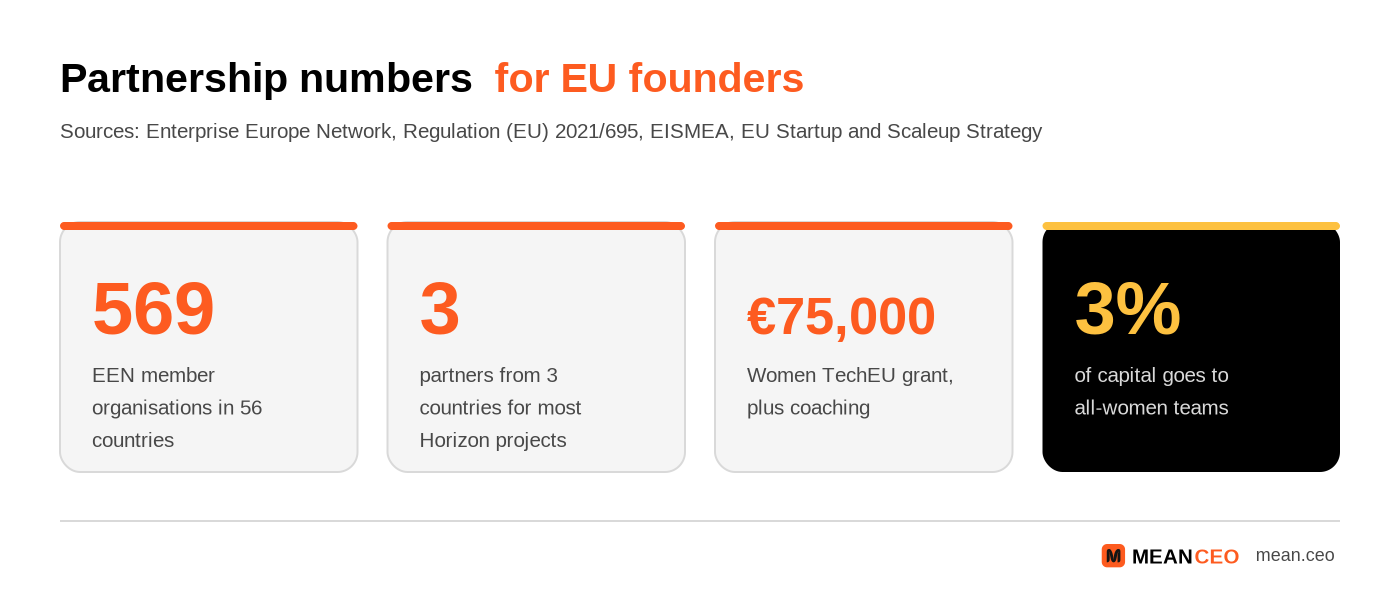
Policy is moving in the same direction. The EU Startup and Scaleup Strategy, adopted on 28 May 2025 under the name “Choose Europe to start and scale”, lists 26 actions, including a “28th regime” for companies that operate across borders, a European Corporate Network to connect startups with large companies, a Lab to Unicorn initiative for research spin-offs and the Scaleup Europe Fund. The strategy also notes that all-women founding teams receive about 3% of capital, compared with 15% for mixed-gender teams, and calls for female-led investor networks.
Women founders particularly benefit from such frameworks, which help them navigate persistent barriers like limited funding access and smaller professional networks. A strategic partner can, for example, unlock regional expertise or shared marketing infrastructure to scale efficiently.
Funding without Venture Capital
Explore alternative funding pathways to keep your business independent.
👉 Learn about non-VC funding
Types of Strategic Partnerships for European Startups
“Partnership” covers very different deals. Name the type before your first meeting, because each one trades different things and needs different paperwork.
Our assessment, based on how these deals usually work for small teams. Distribution and integration partnerships tend to pay back fastest for bootstrapped startups; research consortia take longer but can bring grant money.
How to Build Strategic Partnerships: A Step-by-Step Guide
Successful partnerships require clarity, mutual benefit, and long-term thinking. Here’s how to implement a step-by-step approach to build a foundation for reliable relationships:
Step 1: Research and Align Goals
- Identify potential collaborators aligned with your mission (e.g., shared focus on sustainability or sector-specific innovation).
- Clarify your needs, whether it’s technology integration, market access, or talent sourcing, and assess how your startup adds value to potential partners.
- Look beyond industry silos. Cross-industry collaborations (e.g., deep tech startups partnering with legal tech firms) often yield unique opportunities.
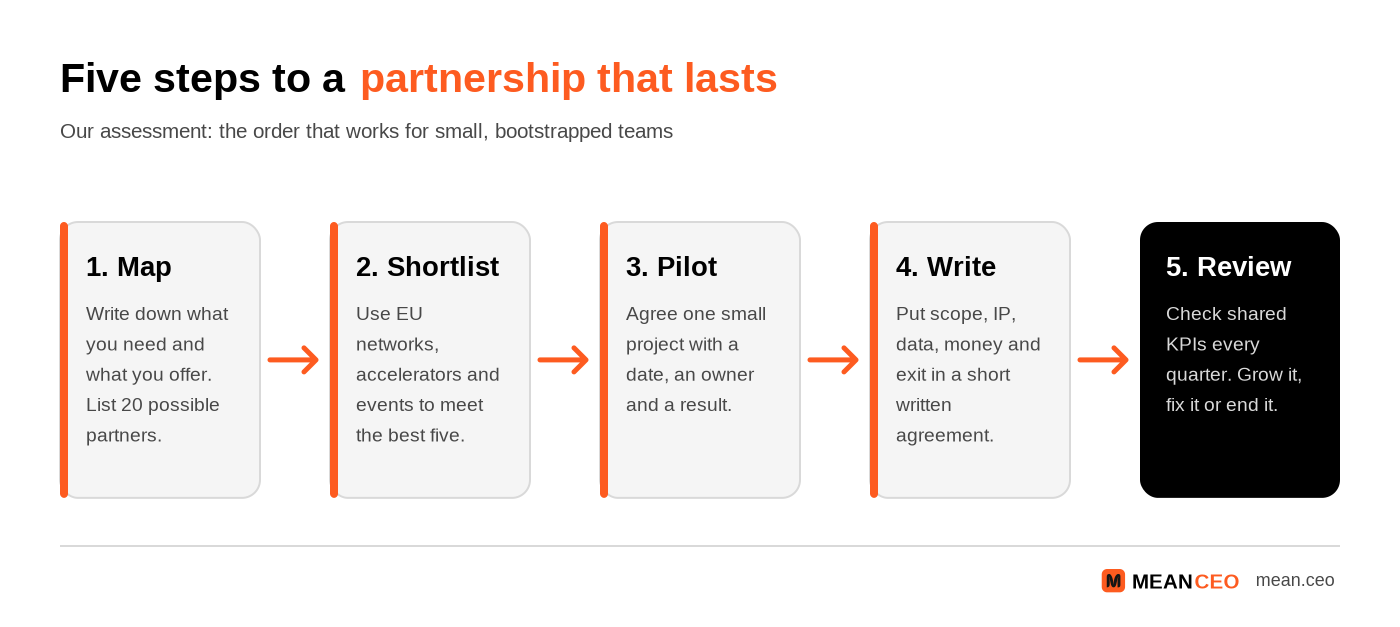
Write it down as two short lists: what you need (customers in a new country, a technology, a lab, a reference client, a grant consortium) and what you can offer (a product that fills a gap in their offer, access to a niche audience, speed, data, a research question). If you can’t fill in the second list, you are asking for a favour, not proposing a partnership. Then list 20 organisations that could plausibly want what you offer, and rank them by how easy they are to reach.
If you are still choosing where to base the company, regional benefits matter too: our guide to relocating your startup within Europe compares the options.
Step 2: Leverage European Startup Programs
- Join accelerators that open doors to corporates and investors; our guide to European accelerators worth applying to compares 12 programmes on their real terms.
- Use the Enterprise Europe Network’s partnering opportunities, which the Commission describes as Europe’s largest online database of business opportunities. The network has 569 member organisations in 56 countries, and its advisers organise matchmaking events where you can book short meetings with potential partners.
- Join a research consortium. Most Horizon Europe collaborative projects need at least three independent partners from three different countries (one in an EU Member State), so universities and larger companies often look for startups to complete their consortium.
- Look at Eurostars if you want to lead. It funds R&D projects led by an innovative SME with at least one partner from another Eurostars country; SMEs must carry at least half of the project cost, and the money comes from national funding agencies.
Sources: Enterprise Europe Network, Regulation (EU) 2021/695 Article 22, Eurostars-3 call rules via national funders (checked 17 Nov 2026). Rules can change per call, so check each call text.
Grants with a consortium have long timelines, so start the partner search months before the deadline. Our guide to how European bootstrapped startups use grants for growth covers the money side, and our step-by-step grant application guide the writing.
Step 3: Prioritize Early Trust-Building
Building partnership trust doesn’t happen overnight. Contracts won’t anchor the relationship, mutual respect and quick wins will. Achieve early milestones and continuously provide value to your collaborators to maintain momentum.
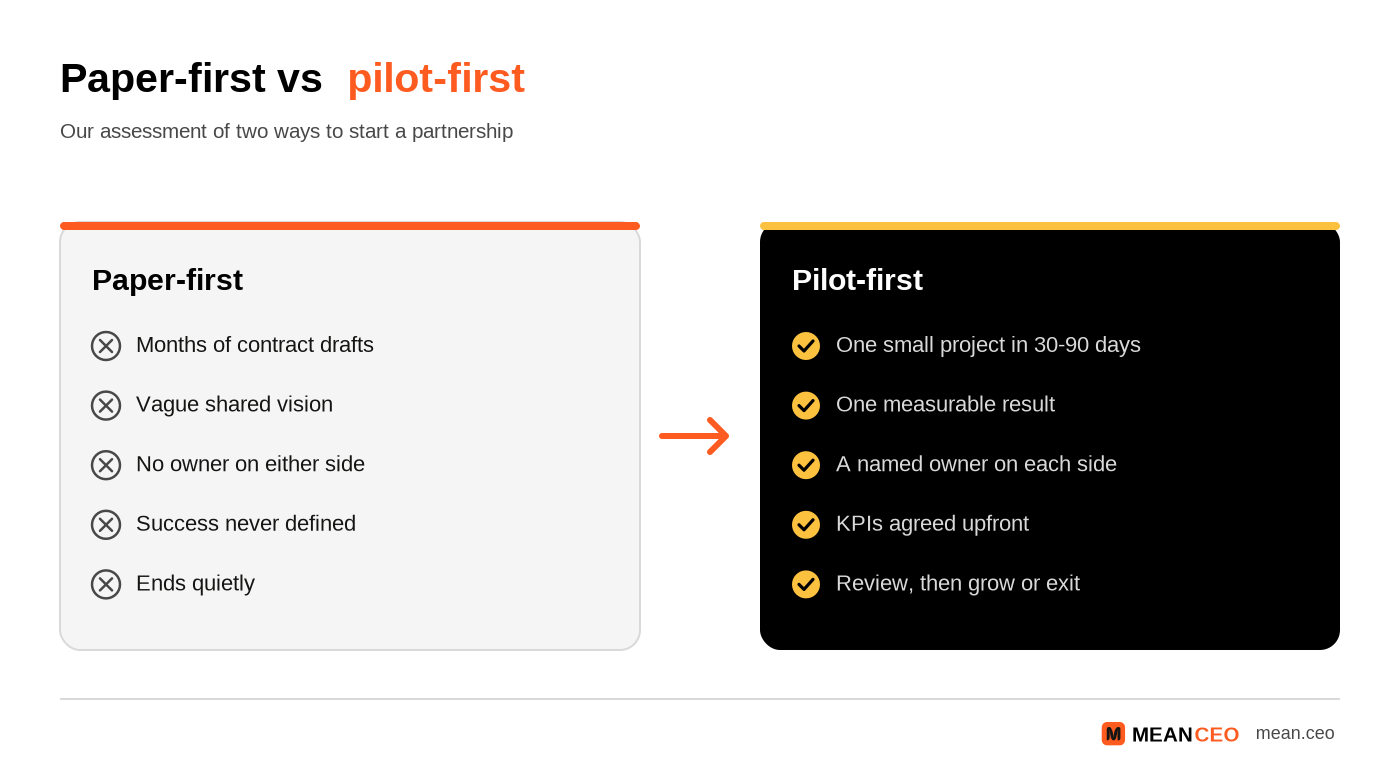
The safest way to build trust is a small pilot: one project with a date, an owner on each side and a result you can measure, finished in 30 to 90 days. Many large companies run “venture client” programmes for exactly this: instead of investing in a startup, they buy its product for a pilot. The BMW Startup Garage calls itself the BMW Group’s venture client unit: BMW departments buy and pilot startups’ products, and startups that succeed can become suppliers. A paid pilot is worth more than a free one, because a budget means someone inside the partner company is accountable for the result.
“The fastest trust builder is action. Deliver something small but valuable quickly, and you'll stay on your partner's radar.” — Violetta Bonenkamp
Step 4: Put It in Writing, Short and Clear
Once the pilot works, write down what you agreed. Small partnerships don’t need a 40-page contract, but they do need answers to a few questions, and the time to ask them is before money, data or code moves between you.
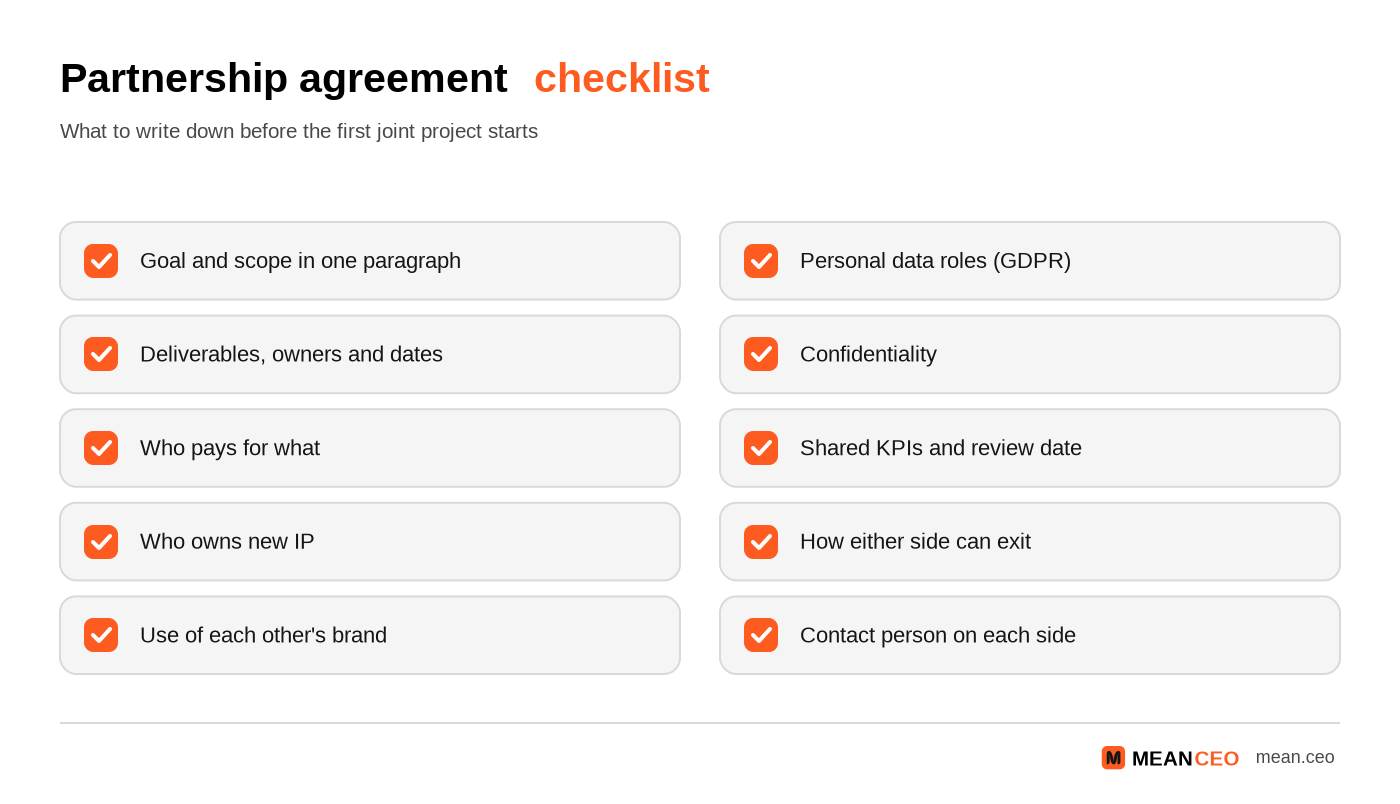
Personal data needs its own paperwork. If one partner processes personal data on the other’s behalf, GDPR Article 28 requires a processing contract; if you decide together why and how data is used, for example in a joint campaign, Article 26 makes you joint controllers who must set out your responsibilities in an arrangement between you.
Partnering with a competitor is allowed, but competition law applies. For joint research and development, the EU’s R&D Block Exemption Regulation (Regulation (EU) 2023/1066, applying until 30 June 2035) gives a safe harbour when competing partners’ combined market share is no more than 25%. Never agree with a competitor on prices or on splitting customers or markets; if the deal is more than a joint project, ask a lawyer.
If the partnership creates new technology or content, decide who owns it before you build it; our IP strategy guide explains patents, trademarks and copyright, and our guide to data processing agreements covers the data side. For partners in other countries, check the startup legal checklist by country.
Step 5: Measure and Review Every Quarter
Agree two or three shared KPIs at the start and look at them together every quarter. Then decide: grow it, fix it or end it politely. A partnership nobody reviews slowly turns into a logo on a slide.
Our assessment. Count results, not meetings: introductions made, pilots signed, revenue or leads from the partner, and the time your team spends on it.
Mistakes That Undermine Strong Partnerships
Many startups derail their partnerships by making preventable mistakes. Avoid these traps:
Failing to Define Clear Deliverables
Open-ended partnerships often result in frustration. Set concrete deliverables from the start. For example, agree on co-branded content or a shared webinar within the first quarter.
Ignoring Cultural Differences
Europe’s multicultural diversity is an asset, but it comes with nuances: how direct feedback is, how fast decisions are made, how much a first meeting is about the relationship rather than the deal. Ask your partner how decisions are made on their side, and who signs. Our guide to cultural considerations for European audiences shows how much these differences matter even in a small product.
Relying Too Heavily on Paper Agreements
Contracts are no substitute for aligned goals and consistent communication. Regular check-ins, shared KPIs, and joint participation in planning deliver stronger results than document-heavy dealings.
Giving Away Your IP Without Noticing
Joint development is where small startups lose the most. If a partner’s engineers help build a feature, or you share your data for a pilot, agree in writing who owns the result and what each side may do with it afterwards. Without that, a larger partner can walk away with the know-how and you have little to stand on.
Partnering With Everyone at Once
Ten loose partnerships give you ten logos and no results. A team of one to ten people can usually run two or three active partnerships well. Say no to the rest for now; how to say no as a CEO without burning bridges shows how.
Conclusion: A Smarter Path to Growth in 2026
Strategic partnerships give startups in Europe an advantage that doesn’t cost equity: customers, technology, credibility and access to programmes you could not reach alone, without burning precious cash reserves. Start small, pick partners for what they need from you, test everything with a pilot, and write down the few things that matter. For female founders, who still receive only a small share of European venture capital, a strong partner network can open doors that funding alone doesn’t.
As a next step, explore the opportunities available for structuring your startup through the lens of European legal entities. You'll find practical insights in the Company Formation Guide by Country, helping you evaluate options like BV or SAS structures tailored to European markets.
Partnerships start with people. Our guides to female founder networking: quality over quantity and CEO networking strategies that don’t feel salesy show how to meet the right ones, and our list of European female founder communities shows where to find them.
Boost Your SEO by Sharing Unique Insights.
Optimized founder content can rank on platforms like Google, ChatGPT, and more. More and more traffic is coming from Perplexity, ChatGPT, Grok and other AI tools.
👉 Rank on ChatGPT
People Also Ask:
What is the EU startup strategy?
The EU Startup and Scaleup Strategy, “Choose Europe to start and scale”, was adopted by the European Commission on 28 May 2025. It sets out 26 actions in five areas, such as a “28th regime” so companies can operate across the EU under one set of rules (proposed as “EU Inc.” in March 2026), the Scaleup Europe Fund, a Lab to Unicorn initiative and a European Innovation Act. It names the funding gap for women: all-women teams get about 3% of capital.
What are strategic partnerships?
Strategic partnerships are long-term collaborations in which two or more organisations combine resources or expertise for a shared goal, such as entering a new market, building a product together or winning a grant. For startups, typical examples are distribution deals, technology integrations, corporate pilots and research consortia.
Which country is number 1 in startups in 2026?
In StartupBlink’s Global Startup Ecosystem Index 2026, the United States ranks first. In Europe, the United Kingdom leads (2nd worldwide), Sweden is the top EU country (6th) and Germany is 7th. Rankings differ by method, so compare cities and sectors that fit your business, not only the overall list.
What are the types of partnerships in Horizon Europe?
Horizon Europe has three types of European Partnerships: co-programmed (the Commission and private or public partners agree a joint programme), co-funded (national funders run a joint programme with EU co-funding) and institutionalised (long-term bodies such as Joint Undertakings and the EIT’s Knowledge and Innovation Communities). Startups usually take part through the calls these partnerships publish.
How do strategic partnerships help startups succeed?
They give a small company what it can’t afford alone: customers through a partner’s channel, technology through an integration, credibility through a well-known reference, and access to EU funding through a consortium. The best ones also cut costs, because each side does what it is already good at.
What barriers do female founders face in Europe?
The biggest is funding: the EU Startup and Scaleup Strategy notes that all-women teams receive about 3% of capital and mixed-gender teams about 15%. Smaller professional networks and bias in investor and corporate meetings make it harder to get introductions, which is why partnerships and peer networks matter so much.
What support exists for female entrepreneurs in Europe?
At EU level, Women TechEU gives women-led deep-tech startups a €75,000 grant plus a six-month coaching and mentoring programme, and the EIC Women Leadership Programme offers training and mentoring. The EIB Gender Finance Lab works with banks to improve lending to women-led businesses. Our list of European grants for female-founded startups covers national programmes too.
Which sectors should European women founders consider?
Choose a sector you know well. EU funding currently puts most money into deep tech, AI, clean tech and health, and Women TechEU targets deep tech specifically, so founders in those fields find more grants and research partners. Education, services and B2B software suit bootstrapping because they can earn revenue early.
Can startups scale without venture capital in Europe?
Yes, many do, by growing from revenue and using non-dilutive money: grants, Eurostars or Horizon Europe projects, and paid pilots with large companies. Partnerships help because they bring customers and resources without giving away shares. Our guide to the European startup funding landscape lists the alternatives to VC.
How do public-private partnerships benefit entrepreneurs?
They connect startups with public money, research infrastructure and large companies at the same time. Horizon Europe partnerships, regional innovation agencies and Enterprise Europe Network events are typical entry points, and public buyers are being pushed to buy more innovative products, which opens doors for startups that solve public problems.
FAQ: Building Strategic Partnerships in the European Startup Ecosystem
How do I identify the best partners for my startup?
Start from what you need and what you can offer, then look for organisations whose customers or goals overlap with yours. Search the Enterprise Europe Network partnering database, ask your accelerator and customers for introductions, and use Crunchbase or LinkedIn to research companies. If you already have partners, account-mapping tools such as Crossbeam (free plan for up to three users) show which customers you share. More ideas: top 10 tools and strategies to build partnerships.
Can early-stage startups benefit from cross-border collaborations?
Yes. A partner in another country gives you local customers, language and rules you would otherwise have to learn yourself. EU programmes are built for it: Horizon Europe projects usually need partners from three countries and Eurostars from two, so cross-border partners can also unlock funding.
What role does AI technology play in facilitating partnerships?
AI tools help with the groundwork: researching potential partners, summarising call texts and partner websites, drafting outreach and meeting notes. They don’t replace the trust-building part. Check what you share: don’t paste a partner’s confidential documents or personal data into an AI tool without their agreement.
What are common challenges in European startup partnerships?
Different cultures and decision speeds, different legal and tax rules, unclear ownership of results, and a partner who loses interest. Most of them are solved by a short written agreement, one owner on each side and a quarterly review of shared KPIs.
How can accelerators enhance my partnership strategy?
Good accelerators introduce startups to corporates, investors and other founders, and some run pilots with corporate partners. Don’t confuse them with funds: the Scaleup Europe Fund, for example, is an equity fund managed by EQT that invests in deep-tech scaleups, not an accelerator. Compare programmes in our guide to European accelerators worth applying to.
What sectors are best suited for partnerships in Europe?
Sectors with long development cycles or heavy regulation, such as deep tech, health, energy and mobility, depend most on partners, because few startups can build, test and certify alone. B2B software benefits from integration and reseller partnerships.
Which countries offer the strongest ecosystem for partnerships?
The UK, Sweden, Germany, Switzerland and the Netherlands rank highest in Europe in StartupBlink’s 2026 index, but the best country is the one where your customers and partners are. Smaller ecosystems can be easier to enter: Malta, for example, is English-speaking and has its own startup support; see our guide to EU startups in Malta.
How can women entrepreneurs leverage partnerships effectively?
Combine peer networks with programme partners: women-founder communities for introductions and advice, Women TechEU or national programmes for funding and coaching, and corporate pilots for revenue. Joining communities like Fe/male Switch helps you meet other founders to partner with. See our European female founder networks directory.
What are quick-win strategies for startup partnerships?
Co-hosted webinars or events, a joint guide, listing each other’s product in a marketplace or integration page, and referral deals on a few named accounts. Agree one number for each, such as leads or sign-ups, so you know if it worked.
Are there tools to measure partnership success?
A shared spreadsheet or your CRM is enough at first: track leads, deals and revenue by partner. Account-mapping tools such as Crossbeam show overlapping customers and pipeline between partners. Whatever you use, review the numbers with your partner every quarter.
About the Author
Violetta Bonenkamp, also known as MeanCEO, is an experienced startup founder with an impressive educational background including an MBA and four other higher education degrees. She has over 20 years of work experience across multiple countries, including 5 years as a solopreneur and serial entrepreneur. Throughout her startup experience she has applied for multiple startup grants at the EU level, in the Netherlands and Malta, and her startups received quite a few of those. She’s been living, studying and working in many countries around the globe and her extensive multicultural experience has influenced her immensely.
