Freemium pricing: how to turn free users into paying customers
Freemium pricing means giving away a useful, permanent free plan and charging for more capacity, more features or team use. It works when the free plan shows your product's value quickly and has a clear limit that serious users reach. For a self-serve product, converting 3% to 5% of free users to paid is good and 6% to 8% is great, according to a survey of more than 1,000 products. If you already have free users and are about to start charging them, read our guide to grandfathered pricing first.
Quick answer: put your core value in the free plan and the business value (more volume, more people, more history, admin and reporting) in the paid plan. Set one limit that active users hit, show an upgrade offer at that moment, and track conversion by sign-up month. If fewer than about 3% of free users upgrade after a few months, test a free trial or a reverse trial instead of adding more free features.
Chat with your AI friend PlayPal, and experience a whole new level of companionship! Discover fun conversations, advice, and endless support—all at your fingertips! Chat with PlayPal NOW!
What is freemium pricing, with examples
Freemium combines "free" and "premium": the free plan never expires, and you earn money from the small share of users who need more. The best free plans are generous enough to become a habit and limited in a way that grows with the user's success, so the people who upgrade are the ones getting the most value.
Source: each company's own pricing or plan page, checked 21 November 2026: Slack free plan, Dropbox Basic and Calendly pricing. Plans change often, so check before you copy a limit.
Notice the pattern: each limit is a value metric (history, storage, event types, seats) that rises as the customer uses the product more. None of them hides the core feature behind the paywall.
Freemium conversion rate: what is good?
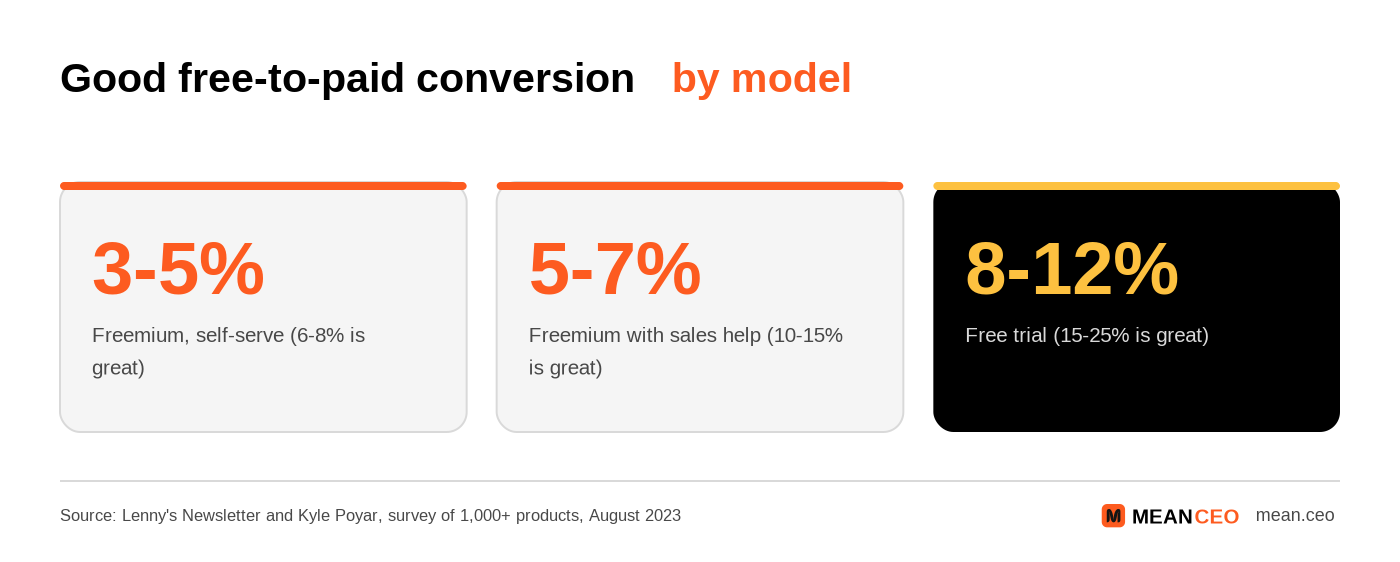
The most cited recent benchmarks come from a 2023 survey of more than 1,000 products run by Kyle Poyar (then at OpenView) with Pendo and Lenny Rachitsky. For self-serve freemium products, 3% to 5% free-to-paid conversion is good and 6% to 8% is great. Freemium products where a salesperson helps close deals reach 5% to 7% (good) and 10% to 15% (great). Free trials convert better, at 8% to 12% (good) and 15% to 25% (great), but fewer people sign up for them: sign-up rates were about 5% for trials against 9% for freemium (Lenny's Newsletter, August 2023).
Do the maths before you choose. With 1,000 free sign-ups a month and 4% conversion, you get 40 paying customers; at €15 a month that's €600 of new monthly revenue, while you also pay to host and support 960 free users. This is our own worked example, not a benchmark. If your price is low and each free user costs you real money (AI credits, storage, support), freemium can lose money for a long time.
Freemium vs free trial vs reverse trial
Freemium is not the only way to let people try before they pay. A free trial gives full access for a limited time, often 7, 14 or 30 days. A reverse trial starts every new user on the premium plan for a limited time and then moves them to the free plan instead of locking them out, so they keep using the product and know exactly what they lost.
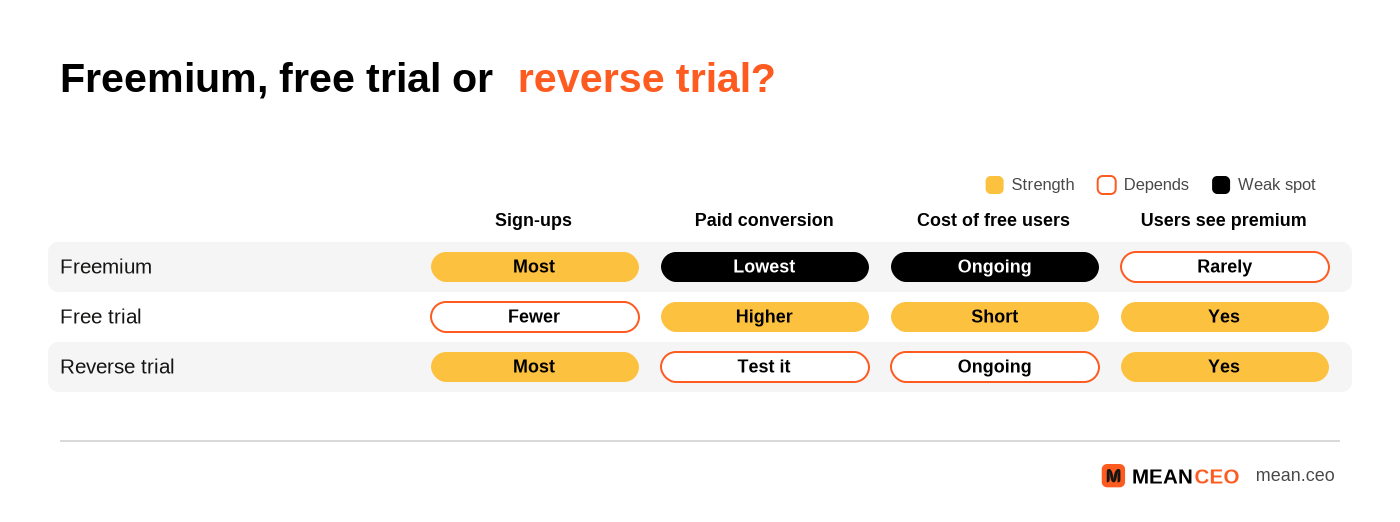
Source: Mean CEO comparison. For the numbers behind both models, see our sister blog's freemium vs free trial statistics.
How to set up freemium pricing in 6 steps
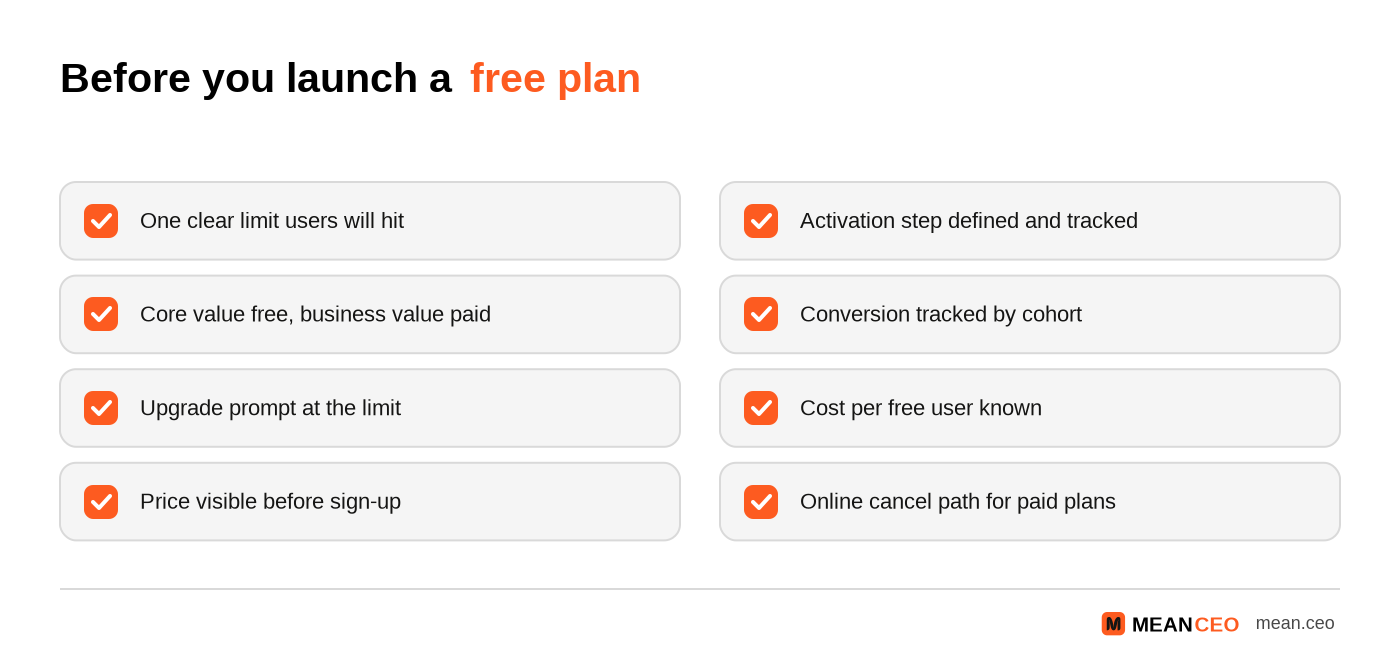
- Pick one value metric. Choose the unit that grows with your customer's success: projects, contacts, storage, seats, history or exports. One clear limit beats ten small ones.
- Give away the core, charge for the business. Free users should reach the moment the product works for them (the "aha" moment). Charge for volume, collaboration, admin, integrations and reports, which matter once the product is part of someone's work.
- Design the upgrade moments. Show the offer when a user hits the limit or tries a paid feature, explain what they get, and make the price visible. A prompt at the right moment converts better than a monthly email.
- Fix onboarding before pricing. Most free users never upgrade because they never get value, not because the price is wrong. Define one activation step and walk new users to it; our guide to building an onboarding process that scales shows how.
- Let users try premium for a while. Offer a short trial of a paid feature when someone shows intent, or test a reverse trial for new sign-ups. Run it as an experiment with a control group, as in our guide to A/B testing for startups.
- Measure by cohort and segment. Track the share of each sign-up month that becomes paying after 30, 60 and 90 days, split by acquisition channel and customer type. Watch retention metrics next to conversion, because a high conversion rate with high churn is still a leaky bucket.
Segment by need, not by gender
The earlier version of this article was about converting "female freemium users". The useful lesson is narrower: don't design pricing for a demographic, design it for a job. A solo founder, a freelancer and a five-person team may all be women and still need completely different limits and prices. Interview your most active free users, ask what they would lose if the product disappeared, and build the paid plan around that answer. If your product is built for women founders or a female-majority market, check your price page and upgrade prompts with real users from that group rather than relying on assumptions about how they buy.
For bootstrapped founders, the same logic decides whether freemium makes sense at all. Our guides to pricing for a bootstrapped SaaS in a competitive market and how to bootstrap a SaaS startup cover when to start with paid plans only.
European rules that affect free plans and trials
A free plan itself raises few legal questions, but the paid plan behind it does when you sell to consumers in the EU:
- 14-day right of withdrawal. Consumers who buy a service online can usually cancel within 14 days without a reason. For digital content they lose that right only after they expressly agree that delivery starts straight away (Your Europe).
- Germany's cancellation button. Subscriptions that consumers can sign up for on a website must also be cancellable there, through a button labelled "Verträge hier kündigen" or equally clear wording (section 312k of the German Civil Code).
- The Digital Fairness Act proposal. On 11 November 2026 the European Commission proposed new rules that target unwanted conversion of free trials into paid subscriptions, automatic renewals and hard-to-cancel contracts (European Commission). It is a proposal, not law yet. Our breakdown of the Digital Fairness Act for SaaS and subscriptions explains what would change for trials and renewals.
Show prices with VAT on consumer price pages, and make the free-to-paid switch an explicit choice, not a surprise charge. It keeps you on the right side of today's rules and the proposed ones.
Freemium mistakes to avoid
- A free plan that does everything. If nobody ever hits a limit, nobody has a reason to pay. Review which limit active users reach and when.
- Limits nobody understands. "5 projects" works; a page of small restrictions confuses people and slows sign-ups.
- Ignoring the cost of free users. Hosting, AI usage and support for thousands of free accounts add up. Know your cost per free user before you scale acquisition.
- Judging by the blended rate. One average hides the truth. Conversion often differs hugely between channels, countries and customer types.
- Copying a big company's free plan. Slack and Dropbox grew through sharing and teams. If your product has no built-in spread, a trial or paid-only plan may suit you better.
- Forgetting expansion. The first upgrade is only the start. Plan the next step up with expansion revenue through upsells and cross-sells.
FAQ on freemium pricing
What is freemium pricing?
A pricing model with a permanent free plan and paid plans for users who need more capacity, more features or team use. The free plan never expires, unlike a free trial.
What is a good freemium conversion rate?
For self-serve freemium products, 3% to 5% of free users converting to paid is good and 6% to 8% is great, according to a 2023 survey of more than 1,000 products. With a sales team helping, 5% to 7% is good and 10% to 15% is great.
Is freemium or a free trial better?
Free trials convert a higher share of sign-ups (8% to 12% is good), but freemium attracts more sign-ups. Freemium suits products that spread through use and cost little per free user; a trial suits products whose value shows within days.
What is a reverse trial?
New users get the premium plan for a limited time, then move to the free plan instead of losing access. They keep using the product and have already seen what the paid features do.
What should be free in a freemium plan?
Enough to reach the product's core value and build a habit. Charge for what matters once the product is part of someone's work: more volume, collaboration, history, integrations, admin and reports.
How do you convert free users to paid?
Help them reach the activation moment fast, set one clear limit active users reach, show an upgrade offer when they hit it, let them try premium features briefly, and track conversion by cohort to see what works.
Are freemium apps legal in the EU?
Yes. The rules apply to the paid part: clear prices, the 14-day withdrawal right for consumers, and easy online cancellation. Germany already requires a cancellation button, and the proposed Digital Fairness Act would require express agreement before a free trial becomes paid.
When should a startup avoid freemium?
When each free user is expensive to serve, when the product has no natural way to spread, or when the market is small and every user could become a paying customer. Then a free trial, a demo or a paid plan with a money-back guarantee is usually better.
Validate your business idea in the Fe/male Switch Sandbox! Test, experiment, and pivot your way to success, all in a risk-free environment with an AI Co-Founder.
About the Author
Violetta Bonenkamp, also known as MeanCEO, is an experienced startup founder with an impressive educational background including an MBA and four other higher education degrees. She has over 20 years of work experience across multiple countries, including 5 years as a solopreneur and serial entrepreneur.
